精读笔记
Problem Setting
这篇论文解决的不是“如何更好重建 fMRI”本身,而是如何用 reconstruction transfer 去刻画认知任务之间的多源依赖关系。以前的 reconstruction-based cognitive taskonomy 把任务关系写成 s→t 的 directed edge,这对于检验单个 source 是否支持 target 足够,但对认知任务这种多成分组合对象明显不够。真正的矛盾是:task state 的认知/神经成分是 compositional 的,而 prior taskonomy 的表示是 pairwise 的;监督预算又是全局约束,不能靠局部最强 source 排名直接决定。困难点在于 source set 的价值不是单个 source transferability 的简单排序问题,而是 coverage、互补性、自覆盖和预算约束共同作用的组合优化问题。
Motivation
已有路线的缺口在于只测量局部一对一 transfer,却试图解释一个多任务系统。对于 fMRI cognitive tasks,一个 target 可能同时需要视觉类别表征、注意/工作记忆、决策、运动准备等不同成分;单个 source encoder 很难代表这种组合结构。作者真正抓住的点是:如果任务关系来自共享 cognitive components,那么 taskonomy 至少应该允许 many-to-one relation,而不是只给 pairwise affinity matrix。进一步,有限监督预算下的“重要任务”也不应等同于平均最强 source,因为直接监督一个任务同时意味着覆盖自身并使其成为其他 transfer assignment 的可用 source。
Core Idea
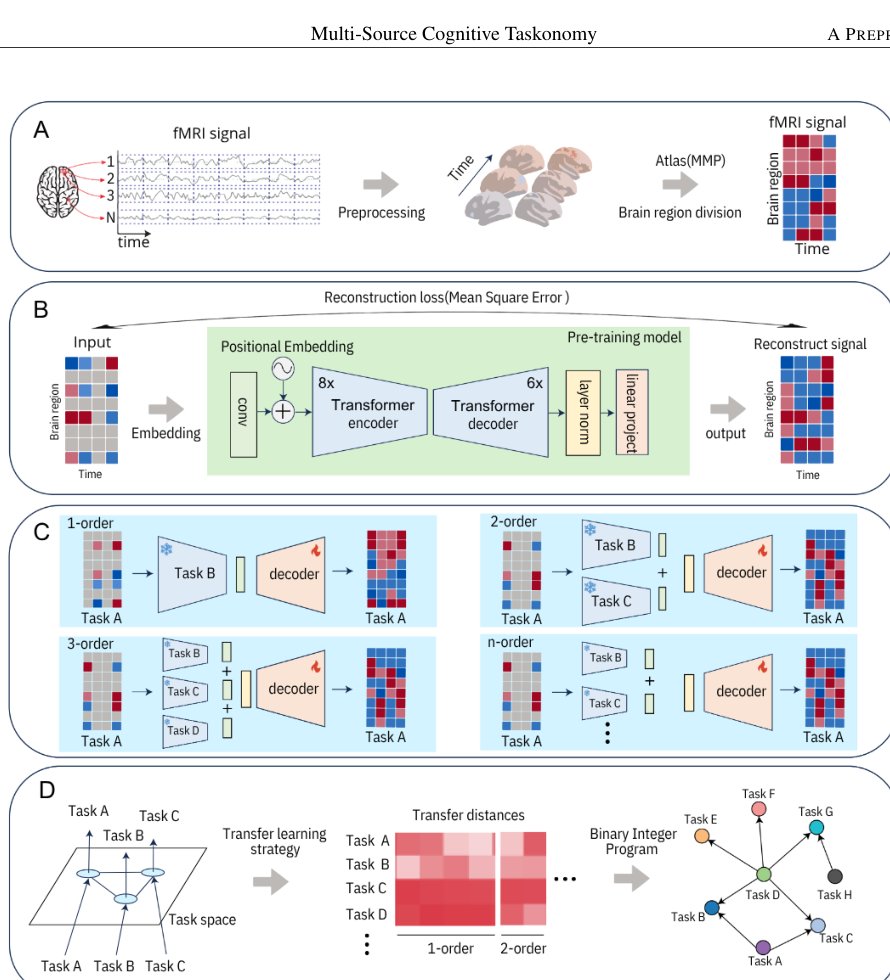
核心思想是把认知任务关系从 pairwise directed graph 改成 source-set-to-target 的 directed hypergraph。每个 task-specific gold encoder 被当作一个已学习的认知状态 representation module;transfer 时冻结若干 source encoders,用少量 target data 学一个 target-side fusion/reconstruction head。这样测到的不是 representation similarity,而是这些 source representations 在低数据 target reconstruction 下的可复用性。
本质区别在于它重新定义了 task relation 的基本单位:prior 问“哪个单一 source 对 target 好”,本文问“哪些已监督 source 的组合可以覆盖 target,并且在预算内覆盖整个任务系统”。这引入的 inductive bias 是 cognitive component reuse:不同 task encoder 可能编码不同可复用成分,组合后的 coverage 才是实际 transfer utility。这个方向比单源 matrix 更 scalable 的地方不在于穷举组合本身,而在于它自然对应 hyperedge selection / budgeted coverage,可以从局部 transfer measurement 过渡到系统级 task allocation。
Method
方法上保留的关键机制只有三层。第一,masked fMRI reconstruction 提供统一目标:所有 task state 都用同一 reconstruction loss 比较,避免把 task-specific decoding label 差异混入 transfer relation;它解决的是跨任务可比性问题。第二,single-source 与 multi-source transfer 都冻结 source encoder,只训练 target-side decoder/fusion module;它把问题限制在“source representation 是否可复用”,而不是让 full fine-tuning 抹掉 source 差异。第三,BIP 把每个 transfer assignment 看成 hyperedge,用预算约束选择直接监督任务;它解决的是从局部 transfer cost 到全局 supervision policy 的转换。
multi-source 的拼接和投影不是深层理论创新,更像一个最直接的 representation fusion probe。它的作用是给多个 frozen encoders 一个共同 target adaptation channel,但同时也引入了 capacity confound:source 数量越多,输入表示和 fusion 容量都可能变化,因此不能把 cardinality effect 直接解释为认知互补性。top-5 candidate screening 是工程上控制组合爆炸的必要折中,但也把 search space 预先偏向 pairwise 强源。
Key Insight / Why It Works
这篇最有价值的 insight 是区分了三种不同的“任务重要性”:pairwise outgoing transfer strength、source-set utility、budgeted allocation priority。很多 taskonomy 工作会把这三者混在一起,但本文显示它们可以明显分离:motor task 内部 transfer 很强,却未必是全局 coverage 的好节点;working-memory states 不一定是最强单源,却在 BIP 中反复被选中。
方法之所以可能成立,主要不是因为模型结构更强,而是因为 masked reconstruction 给了一个低标签、统一、方向性的 operational test。冻结 source encoder 后,target reconstruction loss 成为一种 probe:它测的是 source representation 中有多少可被 target-side 少量数据调动的结构。multi-source transfer 进一步把 representation reuse 从单 memory slot 扩展到多个 memory slots,因此更接近 cognitive component reuse,而不是单一相似性。
但必须直接说,文中没有充分证明 multi-source 的好处来自真正的 higher-order cognitive interaction。增益来源不清,可能包括更多 encoder 带来的 representation coverage、拼接后的容量增加、top-5 screening 带来的强先验、以及 HCP task stimuli/范式之间的 overlap。所谓 source-set composition dependence 目前只能说明“组合不同结果不同”,不能说明存在严格 synergy。BIP 部分的核心贡献是 formulation 与观察到的 allocation pattern,而不是证明这些 selected tasks 在真实下游建模中最优。
Relation To Prior Work
最接近的是 Zamir et al. 的 Taskonomy 和作者此前 Qu et al. 的 reconstruction-based fMRI cognitive taskonomy。本文基本是把 vision Taskonomy 中的 source-set transfer 与 budgeted task selection 思路移植到 fMRI cognitive task states,并接在已有 masked reconstruction framework 上。因此看似新的部分,有相当一部分是已有 taskonomy 逻辑在神经影像任务空间中的重组。
实质新增的信息在于:它把 fMRI taskonomy 从单源 directed transfer 扩展到 many-to-one transfer,并用 BIP 明确区分 local transferability 与 global supervision priority。相对 cognitive ontology / representation geometry 工作,它的差异是 transfer-operational 而非 semantic/similarity-based;相对 fMRI foundation model 工作,它不是追求 universal representation,而是用 task-specific self-supervised models 作为 controlled probes 来测任务关系。它属于 transfer-based task relation analysis,而不是新的 foundation model 或新的 neural architecture paper。
Dataset / Evaluation
评估覆盖 23 个 HCP task states,范式包括 working memory、motor、emotion、gambling、language、social cognition、relational processing。这个覆盖对 HCP 内部 taskonomy 足够有信息量,但仍是单数据集、单任务设计、单 parcellation 下的系统分析,不是跨数据集泛化验证。由于 HCP 的 task states 共享采集流程、被试池、预处理、时间窗口和实验设计,transfer structure 可能部分反映 dataset/task-design regularities,而不一定是稳定的 cognitive ontology。
实验确实支持“pairwise matrix 不足以直接替代 measured source-set transfer”和“BIP priority 不等于 average outgoing affinity”这两个内部 claim。但它没有真正验证 budgeted allocation 的 deployment claim:没有用 BIP 选出的 tasks 重新训练一个实际 downstream system,也没有与 random、greedy、same-paradigm、best-single-source ranking、pooled multitask pretraining 等策略做外部比较。因此 evidence 更像分析性 evidence,而不是 policy effectiveness evidence。
Limitation
最大限制是归因不干净。multi-source transfer 的效果同时受 source composition、source 数量、fusion capacity、candidate screening 和 target decoder adaptation 影响;文中未充分说明如何排除 capacity 与 search bias。若要声称 higher-order task relation,需要 matched-capacity additive baseline、random seed uncertainty、alternative candidate pools、以及对 weak-individually-strong-jointly source sets 的检验。
第二,BIP allocation frequency 不是 intrinsic task importance。它依赖 cost normalization、budget set、candidate pools、category size、自覆盖约束和 HCP task taxonomy。working-memory 被频繁选择可以解释为 frontoparietal/visual/category-selective integration,也可能只是 HCP working-memory 条件数量多、stimulus category 覆盖广、与其他 tasks 有更多低成本边。第三,reconstruction MSE 只测信号重构,不保证得到对 cognition、behavior 或 downstream decoding 最有用的 representation。第四,没有跨数据集、跨 parcellation、跨 split/family-structure 控制与 seed variance;泛化是否真实存在仍未解决。
Takeaway
- 最值得记住的不是 motor cluster 或 working-memory 排名本身,而是 taskonomy 的层级化:pairwise transfer、source-set transfer、budgeted allocation 是三个不同对象,不能互相替代。
- 这个思想可以迁移到任何多任务 representation reuse 场景:先测 directional low-data transfer,再测组合 source utility,最后用显式优化把局部 cost 转成全局 supervision policy。
- 未来真正值得做的是把 source-set utility 从工程拼接推进到可归因的 compositional analysis:capacity-matched synergy test、uncertainty-aware hyperedge estimation、跨数据集验证、以及真实 downstream allocation gains。
- 另一个方向是摆脱 top-k pairwise screening,寻找弱单源但互补性强的 source set;这才更可能发现 pairwise taskonomy 看不到的结构。
一句话总结
这篇论文是把 reconstruction-based fMRI taskonomy 从单源 directed graph 推进到 source-set hypergraph 与 budgeted coverage analysis 的方法扩展,真正贡献在于重新区分局部 transfer、组合复用和全局监督优先级,而不是提出新的 fMRI 表征模型。