精读笔记
Problem Setting
这篇论文不是在做一般的 skin color reconstruction,而是在补 production skin rendering 里长期存在的一个断点:RGB albedo texture 已经有了,但 spectral subsurface transport 参数仍靠 artist 设。实际问题是把一个 3D RGB 观测映射到 per-wavelength α、σt、g、scattering radius / mixture weights,使其能直接进入 random-walk SSS。
困难点在于 skin 的颜色和 translucency 共享同一组生物物理原因,但旧 pipeline 把它们拆开:albedo inversion 只保证颜色,scattering distance 和 anisotropy 是外部自由度。这样在一般材质上方便,在 skin 上反而违背了 chromophore-constrained appearance manifold。关键矛盾是:RGB 信息严重欠定,但 skin 的物理先验又足够强,可能把高维 transport 限制在可学习的低维流形上。
Motivation
已有路线缺的不是一个更好的 RGB-to-albedo inversion,而是一个把颜色、谱域吸收、空间扩散半径、相函数联系起来的约束系统。Chiang / Wrenninge 这类方法可以让 reflectance 对上,但无法自动决定“这个肤色应该有多透、在哪些 wavelength 更透、anisotropy 应该如何变”。
作者的核心观察是:melanin、blood、epidermis thickness 等因素同时决定 spectral reflectance 和 diffusion profile。也就是说,RGB albedo 虽然信息少,但它不是任意 RGB;它落在 skin biophysical manifold 上。论文的方向因此不是从 RGB 自由生成 SSS,而是先构造这个 manifold,再学习从 RGB 到 manifold-conditioned transport 的投影。
Core Idea
论文真正改变的是 skin SSS 的等效建模方式:不再把 multilayer skin 压成一个 homogeneous medium,也不直接在 renderer 里追踪真实多层组织,而是用 K 个 homogeneous media 的 weighted mixture 表示 aggregated transport。每条 random walk 开始时采样一个 medium,然后按该 medium 传播。这个形式保留 production random-walk 的兼容性,同时用多个 transport scale 去拟合 multilayer profile 的 shape。
第二个关键思想是信息流重组:RGB 不直接预测高维 SSS 参数,而是经过 biophysical latent 和 spectral reflectance context,再预测 per-wavelength mixture parameters。这里的 inductive bias 很强:spectral reflectance 是连接 chromophore composition 与 transport 的中间表征,它把 ill-posed RGB inversion 约束到皮肤物理可行区域。相比 prior,本质区别不是“用了神经网络”,而是把 artist-controlled degrees of freedom 重新绑定回 skin color manifold。
Method
方法上最关键的是三层机制,而不是具体 MLP 结构。
第一,使用两层 biophysical skin model 生成监督:输入是五个生物物理参数,输出包括 spectral reflectance 和 radial diffusion profile。这一步解决真实 paired data 难采的问题,但也把最终能力绑定到 simulator fidelity。
第二,把每个 wavelength 的 MC profile 拟合成 K-media mixture。单 medium 的问题是 shape 与 amplitude 纠缠,无法同时拟合 reflectance 和扩散尾部;mixture 允许不同 component 承担不同 transport scale,相当于用可 path-trace 的形式近似 sum-of-lobes diffusion。
第三,用 scale-independent homogeneous LUT 代替优化中的反复 MC。LUT 利用 homogeneous medium 的 profile scale invariance,把 α、g 决定 shape、σt 决定 radial scale 这件事工程化为可微查询。这是使大规模 per-tone / per-wavelength fitting 可行的核心加速。
第四,训练 chained decoder 蒸馏 fitted parameters。spectral reflectance conditioning、reflectance loss、spectral smoothness 共同压制参数空间中的多解和 wavelength-level 抖动。这里 smoothness 和 shared network weights 很可能是 decoder 能优于 independent joint optimization 的主要原因,而不是网络表达力本身。
Key Insight / Why It Works
最核心的有效性来源是 representation alignment:目标 renderer 需要 homogeneous random-walk 参数,而真实 skin 是 multilayer transport;mixture-of-media 在两者之间提供了一个足够 expressive、又能直接执行的中间表示。它不像真实生物层那样精确,但它对 production rendering 的目标量——radial scattering profile 和 reflectance——是对齐的。
第二个有效性来源是强先验而非纯学习。RGB 到 spectral SSS 本来严重欠定,论文能做是因为它假设输入来自正常 skin tone manifold,并用 simulator 大规模覆盖这个 manifold。换句话说,这更像 constrained inversion / manifold projection,不是从 RGB 中“发现”了全部 spectral transport 信息。核心能力可能主要来自 data coverage 和 biophysical prior。
K=2 到 K=3 的结果说明值得警惕:主要性能跃迁来自 single medium 到 mixture medium,而不是三分量本身。K=3 的物理解释有价值,尤其低 α component 对 epidermal short-wavelength absorption 的解释,但数值增益有限,可能更多是 structural regularization / interpretability,而不是必要表达力。
神经 decoder 超过 per-tone joint optimization 的现象也不应过度解读。更合理的解释是 shared weights、spectral smoothness、reflectance loss 改善了 noisy / degenerate fitting landscape,相当于跨样本正则化;不是 NN 找到了比物理优化更真实的解。增益来源部分不清,可能主要来自 regularization 和 evaluation pipeline 与训练目标更一致。
Relation To Prior Work
它最接近三条谱系:production albedo inversion、biophysical skin inversion、sum-of-lobes / diffusion-profile skin rendering。和 Chiang / Wrenninge 的本质差异是:prior 只从 albedo 得到 single-scattering albedo,scattering distance 和 anisotropy 仍是外部 knob;本文试图一次性预测 renderer 所需的全套 spectral optical parameters。
和 d’Eon / Jimenez / Christensen 一类 profile mixture 的关系更微妙:mixture-of-lobes 的思想并不新,新的是把 lobe 写成可 random-walk 的 homogeneous medium,并把它作为 spectral inversion 的目标表示。这是实质工程-表示创新,价值在于兼容现代 path tracer,而不是提出新的 light transport theory。
和 Aliaga 2023 hyperspectral skin inversion 相比,本文把 biophysical inversion 从“恢复 spectral reflectance / skin parameters”推进到“恢复可渲染的 spatial transport parameters”。真正新增的信息是 radial diffusion profile supervision;没有这个,RGB-to-spectrum 仍只能解决颜色,不能解决 translucency。
Dataset / Evaluation
数据覆盖上,训练集是 25k skin tones、376 wavelengths 的 simulator-generated profiles,范围覆盖从 UV 到 NIR。这个覆盖对论文 claim 很关键,因为方法的泛化基本依赖在 biophysical parameter space 中采样得足够密。它不是多场景、多材质泛化,而是 skin manifold 内插泛化。
评估最强的是 synthetic physical closure:用同一 biophysical MC / LUT / random-walk renderer 比较 fitted 或 predicted parameters 的 reflectance 和 profile。它能验证该表示在作者定义的物理世界里可行,也能证明 single medium 不够。
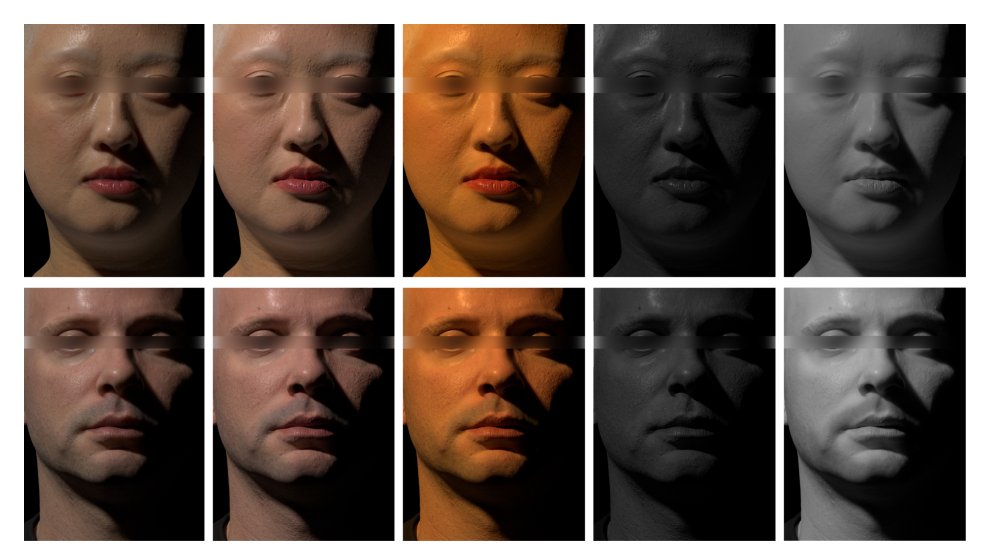
但它没有充分验证真实世界 physical accuracy。真实 face albedo render 是 qualitative,且没有 measured in-vivo diffusion profile 或 integrating-sphere profile 对照。benchmark 支持“从 RGB skin albedo 在 simulator manifold 内预测 plausible spectral SSS”,但还不足以支持“对真实皮肤物理正确”。此外,evaluation 与训练数据同源,存在 simulator bias 被闭环掩盖的问题。
Limitation
最大前提是 simulator 就是真实世界的足够好代理。如果两层模型、chromophore ranges、固定 basal concentrations、smooth boundary 假设偏离真实皮肤,网络会稳定地产生错误但看似物理一致的参数。
第二个前提是 RGB albedo 足以定位 skin manifold。metamerism 没有被真正解决,只是被 skin prior 压低了自由度。在跨相机、跨照明、不同 albedo extraction pipeline 下,这个假设可能很脆弱。
第三,mixture-of-media 是 effective representation,不是 anatomical decomposition。K=3 component 的物理解读有启发,但不能保证对应真实 epidermis / dermis transport。尤其低-order scattering、grazing incidence、rough boundary、micro-wrinkles 都被 normal-incidence radial profile 吸收掉了。
第四,scalability 的上限来自 LUT 和数据生成。若要加入角度、roughness、finite thickness、region-specific lips / ears / scars,维度会迅速膨胀;当前框架可能需要重新生成大规模 MC 数据,而不是简单扩展网络。
第五,K=3 的增益来源不清。文中显示 K=2 已经解决主要误差,K=3 更像为了结构解释和稳定训练服务。若部署只看可见光 skin rendering,三分量是否值得复杂度,文中没有完全说服。
Takeaway
- 最值得记住的不是 RGB 能神奇恢复 spectral SSS,而是:当目标材质落在强物理先验流形上时,可以把 artist knobs 重新绑定到 observable appearance 上,用 simulator manifold 做 constrained inversion。
- mixture-of-media 是一个很有迁移价值的表示:它把复杂分层介质压缩成 renderer-native 的 mixture,而不是压成不可执行的 latent 或纯 profile texture。
- 类似思路可用于 wax、marble、plant tissue、food 等 multilayer translucent materials。
- 未来真正值得做的是把 synthetic closure 推向 measured closure:用真实 diffusion profile、multi-view / multi-spectral capture、不同入射角验证这个 inversion 是否仍成立。
一句话总结
这篇论文把 skin SSS 从 artist-tuned RGB albedo inversion 推进到 biophysical-manifold-constrained spectral transport inversion,核心贡献是用 renderer-native 的 mixture-of-media 表示把 RGB skin color 与可执行的 per-wavelength translucency 参数重新耦合起来。