精读笔记
Problem Setting
[ASTAD: Asymmetric Style Transfer for Synthetic-to-Real Adaptation in Autonomous Driving](arXiv preprint / 2026)
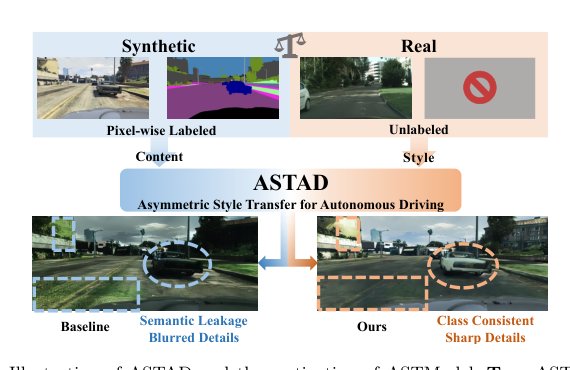
这篇论文解决的不是一般意义上的 image stylization,而是自动驾驶 synthetic-to-real 数据生成中的 annotation asymmetry:synthetic content 有像素级语义标签,real style reference 通常只有图像本身。真正困难点在于,目标图没有语义标签时,style transfer 不能仅靠 appearance similarity,否则 road、vegetation、building、vehicle 之间很容易发生 texture leakage;但如果要求 real reference 也有 dense label,又失去了 synthetic data 降低标注成本的意义。以前的方法卡在 symmetric information assumption:它们可以在有 content mask 和 style mask 时做 class-aware transfer,但这个设定对真实目标域不现实。该任务的核心矛盾是:想利用真实图像的外观统计,却不能信任真实图像中每个像素的语义身份。
Motivation
已有路线不够的原因在于它们把“风格参考图可语义解析”这个问题外包了:training-based domain adaptation 需要目标域训练或 finetune,成本高且域迁移不灵活;training-free attention injection 不需要训练,但缺乏强语义边界,容易把高相似度但语义错误的区域当成有效 correspondence;CACTIF 一类 class-aware 方法看似解决 semantic leakage,但隐含需要 style-side segmentation。作者真正抓住的缺口是:自动驾驶场景中 source-side label 是免费的,target-side label 是昂贵的,因此应该把 source label 当作 anchor 去反推 target reference 的可用语义,而不是假设 target label 已经存在。这个方向的动机很合理,因为它把 synthetic data 的独特优势——精确 label——用于约束 real style 的使用方式。
Core Idea
核心思想是把 style transfer 从“图像到图像的全局外观迁移”改成“由 source semantic prototypes 约束的 class-wise style retrieval”。ASTModel 不是直接相信 diffusion attention 的相似性,而是先构建一个 style-side pseudo semantic map,再用它决定哪些 style features 可以被哪些 content regions 使用。这样信息流从原来的 content-style mutual matching,变成了 source-label-anchored routing:synthetic mask 提供类别锚点,foundation model 提供跨域语义空间,diffusion latent features 提供局部细化。
本质区别在于它引入了一个 conservative semantic bottleneck。prior methods 往往让 style feature 尽可能注入,只在事后或局部做过滤;ASTModel 则倾向于先判断“这个 correspondence 是否语义可信”,不可信就回退到 content。这个 inductive bias 对自动驾驶尤其重要,因为下游感知训练更怕错误语义纹理污染,而不是怕 stylization 不够强。它的可扩展性也来自 training-free 和 foundation-model-based matching:换 reference、换目标风格不需要重新训练,但这也意味着能力上限受预训练表征和参考图覆盖限制。
Method
方法上只需要记住三个机制层面的动作。第一,source-label-guided target parsing:用 synthetic mask 在 DINO feature space 里形成类别 prototype,再对 real reference 做最近邻分配。它解决的是 style image 没有 label 的 cold start,核心变化是把 target semantic inference 绑定到 source label space,而不是引入额外标注。
第二,dynamic conservative refinement:Stage-I pseudo-label 边界粗且会错,因此在 diffusion reverse process 中利用多层 U-Net features 做一致性投票;只有多层都同意的位置才更新 style pseudo-label,否则保留 foundation prior。这个机制不是为了最大化 pseudo-label 召回,而是为了降低错误更新率,符合自动驾驶数据生成里 semantic precision 优先的需求。
第三,semantic-gated style injection:attention filtering 不只看相似度,还要求 content class 与 refined style pseudo class 一致;同时 class-wise AdaIN 的强度由 content/style 像素比例调制,style-side 证据不足时减少统计迁移。它解决的是单张 reference 中类别缺失或稀疏导致的错误 style statistics。核心变化是把 style transfer 从无条件注入变成 evidence-weighted injection。
Key Insight / Why It Works
这篇最重要的 insight 是:在自动驾驶 synthetic-to-real stylization 中,宁可少迁移,也不能错迁移。方法有效的主要原因不是 diffusion backbone 更强,而是它给 style injection 加了一个语义可信度门控,把高风险的 cross-class attention 和不可靠的 class statistics 都压住了。对于下游 segmentation,保结构、保类别边界往往比 photorealism 更重要,因此 conservative transfer 能带来更好的 utility。
最可能的核心贡献是 source-label-anchored pseudo semantic routing:用 synthetic label 去组织 target style 的使用方式。Multi-layer voting 和 MAD filtering 是有用的稳定化手段,但更像工程上合理的 robustness design;真正改变建模方式的是把 style reference 从“无结构图像”变成“带置信度的类别风格 memory”。Pixel-proportion AdaIN 也很关键,因为它承认单参考图的 style statistics 不完整,不再盲目做 class-wise normalization。
从归因看,这更接近 representation alignment + retrieval + test-time compute,而不是学习到新的 domain adaptation model。DINO 提供跨域语义空间,diffusion U-Net 提供可被利用的 latent structure,ASTModel 负责在推理时重组这些已有能力。所谓 generalization 很大程度上依赖 foundation representation 已经覆盖 driving semantics;如果 DINO 对某些长尾类别或天气/夜间场景语义不稳,ASTModel 本身没有学习机制去弥补。速度增益部分可能来自避免 CACTIF 的 dense matching,属于 engineering simplification,但并不削弱其实际价值。
Relation To Prior Work
它最接近 training-free diffusion style transfer、attention injection、class-aware synthetic-to-real stylization,尤其是 CACTIF 这一类用 semantic masks 防止 leakage 的方法。真正不同点不是也用了 attention/AdaIN/prototypes,而是把 style-side mask 从输入条件变成要在 test time 推断和动态修正的 latent variable。这个新增信息来自 source-side synthetic labels 与 foundation-model feature space 的组合。
看似新的若干组件其实是已有思想重组:prototype matching 来自 metric learning / semantic retrieval,multi-layer voting 是一致性过滤,MAD threshold 是 robust statistics,class-wise AdaIN 是已有风格迁移工具。实质创新在于把这些机制组织成一个适合 asymmetric annotation setting 的信息流:source labels → target pseudo semantics → semantic-gated diffusion injection。它属于“training-free foundation-model-assisted domain stylization”谱系,而不是传统 domain adaptation 或生成模型训练路线。
Dataset / Evaluation
评估主要使用 GTA synthetic source 和单张 unlabeled real reference,关注下游 segmentation utility、结构保真和效率。结果能支持一个具体 claim:在单参考、无 style label、training-free 的设定下,ASTModel 比 Cross-Image Attention 和 CACTIF 更能保住语义结构并减少明显 leakage。ablation 也基本验证了 semantic filtering、hybrid AdaIN、voting 的必要性。
但 evaluation 对核心 claim 的支撑仍有限。首先,主文重点是少量 reference scenarios,跨场景、多天气、多城市、多传感器、多任务的覆盖不充分。其次,下游只看 segmentation,不足以证明自动驾驶 perception pipeline 的整体收益,更没有真实车辆或闭环验证。第三,CACTIF 在缺 style label 的设定下如何公平适配需要更细说明;如果 baseline 被迫在非原生设定下运行,优势可能部分来自 problem setting mismatch。第四,pseudo-label refinement 的定量验证需要真实 style labels 或替代标签,文中未充分说明这些标签来源与评估协议,可能存在 hidden supervision 或 evaluation bias 的疑问。
Limitation
最大限制是单张 reference 的类别覆盖天然不足。ASTModel 通过保守回退避免错误注入,但这只是把问题从 semantic leakage 转移为 style incompleteness:缺失类别无法可靠迁移,只能保留 source appearance。因此它更适合安全生成 target-style synthetic data,而不是完整建模目标域分布。
第二,方法严重依赖 foundation model 的语义对齐能力。DINO feature 如果已经能把 synthetic road、real road、building、vegetation 对齐,ASTModel 就能工作;如果遇到长尾物体、夜间强反光、雨雪遮挡、传感器差异或非典型道路结构,prototype matching 可能直接给错先验。多层 voting 是 conservative 的,不一定能纠正系统性错误,只能避免部分低置信噪声。
第三,泛化能力的说法需要谨慎。该方法没有训练目标域模型,也没有学习 domain-level style distribution,本质是 reference-conditioned retrieval and filtering。它的上限由 reference coverage、预训练表征和 diffusion prior 决定。所谓 scalability 更多是工程使用上的 training-free scalability,而不是统计意义上的 domain generalization。
第四,增益归因不完全清楚。attention filtering、pseudo-label refinement、AdaIN modulation、MAD threshold 同时改变了 transfer strength、结构保留和计算路径;下游 mIoU 提升可能来自更少破坏 source semantics,而不一定来自更真实的 target adaptation。换言之,方法可能主要是在减少有害 stylization,而不是显著提升真实域逼真度。
Takeaway
- 1. 对自动驾驶数据生成,semantic safety 应该优先于风格迁移强度;错误纹理比欠迁移更伤下游模型。
- 2. 一个值得迁移的思想是 source-label-anchored target parsing:当 target 没标签但 source 有强监督时,可以用 source prototypes 把 target reference 变成带置信度的 semantic memory。
- 3. Training-free diffusion adaptation 的下一步不一定是更强 injection,而是更可靠的 routing、fallback 和 uncertainty-aware style statistics。
- 4. 真正值得做的后续是 multi-reference / dataset-level style memory:用多张 real images 提供更完整的类别统计,同时保持当前这种 semantic-gated safety。
一句话总结
ASTAD 把自动驾驶 synthetic-to-real 风格迁移从对称语义指导问题推进到无标注 target reference 下的 source-label-anchored semantic routing,本质上是 foundation representation + conservative diffusion injection 的一次实用化重组。