精读笔记
Problem Setting
CellDETR: A Detection-Guided Framework for Scalable Cell Representation Learning from Histopathology Images(arXiv preprint / 2026-06-30)。这篇论文实际在解决的是 WSI 中 cell-level representation learning 的建模单位问题:如何从 patch/slide foundation model 的粗粒度表示,转到可规模化、可迁移的单细胞 embedding。
真正困难点不是“检测细胞”本身,而是检测出来的 cell instance 如何成为一个稳定的 representation unit。patch SSL 的问题是粒度错位:一个 patch 混合了多个细胞、间质、背景和组织结构,无法直接服务 cell-resolved analysis。传统 segmentation/classification 方法虽然输出细胞级预测,但通常优化的是 task-specific mask/class label,不保证 embedding 在跨数据集、跨标签体系、跨组织时仍有意义。
关键矛盾是:cell-level 表示需要 instance-local、morphology-aware、variable-number 的建模;但 scalable pretraining 通常依赖 fixed patch、fixed token、弱语义目标。CellDETR 试图用 DETR 的 object query 机制把这个矛盾折中掉:让模型先产生细胞实例,再围绕实例学习 embedding。
Motivation
已有路线不够的核心原因是 basic unit 选错了。病理 foundation model 的 patch token 对 slide-level task 很有效,但对 cell-cell interaction、TME spatial modeling、cell-resolved interpretation 来说,它不是自然单位。CellViT/HoVer-Net 等方法提供了 cell-level outputs,但其目标仍偏向 segmentation/classification,学到的特征通常绑定在固定类别体系和特定 benchmark 上。
作者的核心观察是:nucleus detection 本身提供了一个可规模化的 instance indexing 机制。只要能把“在哪里”与“是什么”分开,并让 representation query 只读取对应 nucleus 区域,就可以把 detection pipeline 转化成 cell representation pipeline。
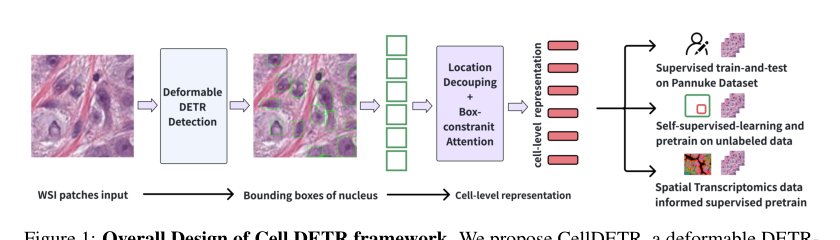
这篇论文补的缺口不是一个更强 detector,而是一个 cell-tokenization 机制:从 WSI patch 中自动产生 variable number of cell embeddings,并允许这些 embeddings 接入 supervised、SSL、ST-informed 三类训练信号。
Core Idea
论文真正的核心思想是 detection-guided representation learning:把 nuclei 作为基本表示单位,而不是把 patch 切成固定 token。Deformable DETR 的 object queries 天然适合 variable-number objects;CellDETR 将其重新解释为 cell embedding slots。这样,cell representation 不再是 patch feature 的后处理,而是检测过程中直接生成的 instance-level 表示。
它引入的关键 inductive bias 是 instance locality:cell identity 应主要来自对应 nucleus/cell region 的 morphology,而不是全 patch 的组织背景、空间坐标或邻近细胞。location-feature decoupling 负责减少位置 shortcut,box-constrained attention 负责限制视觉证据来源。两者共同把信息流从“query 可自由访问 patch feature”改成“query 在检测框约束下读取自己的 morphology”。
和 prior 的本质区别在于,CellDETR 不只是做 segmentation 后 crop feature,也不只是 DETR 加分类头;它试图让 detection query 同时成为 scalable representation carrier。这个方向比 patch-level SSL 更适合 cell-resolved downstream,也比纯 segmentation/classification 更容易扩展到无标签 WSI 或 ST-derived supervision。
Method
关键机制可以压缩为三件事。
1. Detection as cell-token generator:用 Deformable DETR 处理每个 patch 中细胞数量和尺度可变的问题。它解决的是 fixed patch/fixed token 与 variable cells 的结构不匹配。核心变化是把 nuclei boxes/queries 变成 representation learning 的 anchor,而不是只作为检测输出。
2. Localization-representation decoupling:检测 decoder 负责 box,representation decoder 负责 embedding。这个设计针对的是检测任务中位置、尺度、置信度等 shortcut 可能污染 cell identity embedding 的问题。它的价值在于迫使表示更偏 morphology,而不是把“这个细胞在哪”当成分类依据。
3. Box-constrained attention:对 deformable attention offset 加 tanh 并按 box width/height 缩放,使采样点落在目标 box 附近。它解决的是细胞密集场景下 query 容易吸收邻近细胞、间质纹理和背景的问题。核心变化是 attention 的可访问区域从 unconstrained feature map 变成 instance-local region。
SSL 和 ST-informed training 是同一 cell-token 机制上的监督源扩展:SSL 用 box perturbation 构造同一 nucleus 的 local/global pair;ST-informed training 用 Xenium-derived labels 给部分细胞提供 molecularly grounded supervision。它们的机制意义在于证明这个 cell-token interface 可以接不同来源的训练信号。
Key Insight / Why It Works
最可能真正有效的部分是 box-localized object-query representation,而不是“用了 DETR”或“用了 contrastive learning”。DETR 解决 variable-number instance indexing,box-constrained attention 则把 representation 学习的证据范围压回 nucleus region。这相当于给 cell embedding 注入了很强的 object-centric inductive bias。
location decoupling 是合理辅助,但增益来源不清。它可能减少位置 shortcut,也可能只是改变 decoder capacity / optimization dynamics。文中 attention visualization 支持其方向正确,但不足以证明 embedding 中位置信息被系统性移除。
SSL 部分本质上是 instance-level representation alignment:perturbed box 与 original box 对齐,其他 nuclei 作 negatives。它更像 localization-aware contrastive learning,而不是 DINO 式 foundation model training。其有效性可能来自 learning box-stable morphology descriptor;但也可能主要来自预训练数据覆盖和 nuclei segmentation prior。这里存在 hidden supervision:所谓 unlabeled WSI 仍需要 nucleus segmentation/instance boxes,因此不是完全 label-free。
ST-informed 部分的 insight 有潜力:用 spatial transcriptomics 提供 morphology label 之外的 biological supervision。但目前证据较弱。zero-shot 到 PanNuke 表现受限,说明 molecular cell types 与 morphology-defined categories 的 mapping 并不自然。fine-tuning 后变好,可能说明 ST pretraining 提供了有用初始化,也可能只是额外数据和 detection pretraining 的收益。增益归因不清。
从机制归因看,这篇论文不是 test-time compute、planning、memory reuse 或 reasoning 类方法;它主要是 better inductive bias + data coverage + representation alignment。最值得迁移的是“先用结构任务产生实体 token,再在实体 token 上做 SSL/weak supervision”,而不是具体的 DETR 实现。
Relation To Prior Work
它最接近三条线:DETR-style object detection、cell segmentation/classification、pathology SSL/foundation models。
相对于 Mask R-CNN、HoVer-Net、CellViT,这篇的差异不是检测/分割精度,而是目标函数的重心从 predefined cell-type prediction 转向 transferable cell embedding。CellViT 也能产生 cell-level features,但通常是 segmentation/classification pipeline 的副产品;CellDETR 明确把 object query 作为 representation unit。
相对于 UNI、Virchow、GigaPath 等 patch/slide foundation model,CellDETR 的实质新增信息是 cell-instance tokenization。patch foundation models 的强项是大规模 weak supervision/SSL,但它们缺少自然的 cell indexing;CellDETR 用 detection 把可扩展训练接口搬到 cell 粒度。
相对于原始 Deformable DETR,创新主要是 representation decoder 的用途重定向和 box-constrained attention。DETR 本身提供 variable object slots,DAB/Decoupled DETR 已经有 localization/classification disentanglement 的思想;CellDETR 的新意在于把这些 object detection tricks 组合到 histopathology cell representation learning 中,并连接 SSL/ST supervision。它是已有思想的领域化重组,但 box-constrained cell embedding 这个 inductive bias 是实质上有价值的。
Dataset / Evaluation
评估覆盖了 supervised PanNuke、unlabeled WSI pretraining、Xenium-derived ST-informed pretraining 三个设置,形式上对应论文的三类 claim:可监督训练、可无标签扩展、可接 molecular supervision。
但 benchmark 对核心 claim 的支撑有限。PanNuke 证明 CellDETR 是一个强 cell detection/classification model,但不能证明其 embedding 是 general cell representation。unlabeled WSI pretraining 后 fine-tuning 提升,支持 scalability 的初步可能;但 64k patches、三类组织、30 epoch 的规模还远不到 pathology foundation model 的级别。
ST-informed evaluation 是最有野心也最脆弱的部分。Xenium labels 只覆盖部分 nuclei,且由 Tacco annotation、CellViT segmentation、空间配准共同产生,噪声链条较长。zero-shot 到 PanNuke 不强,说明跨 ontology、跨数据集、跨 modality 的泛化还没有被解决。fine-tuning 后接近 SOTA,更像证明 ST pretraining 可作为初始化,而不是证明学到了稳健 biological cell identity。
整体上,实验验证了“这个框架可工作”,但没有充分验证“scalable general cell foundation model”。缺少大规模多中心、多组织、外部真实部署、embedding retrieval/cluster biological validity、跨实验室 staining shift 等更硬的验证。
Limitation
第一,方法强依赖 box/segmentation 质量。CellDETR 把 patch-level 表示问题转成 instance-level 表示问题,但 instance extraction 本身并不免费。SSL setting 仍需要 nuclei segmentation information,这意味着它的 scalability 受制于 detector/segmenter 的覆盖和误差。
第二,cell identity 是否能由 nucleus-local morphology 决定是隐含前提。对很多细胞类型,尤其免疫亚型、功能状态、activation state,仅 H&E morphology 很难区分。box-constrained attention 提高了 locality,但也可能主动丢掉有用 microenvironment context。
第三,泛化 claim 偏乐观。当前主要是 PanNuke 内部 supervised/fine-tuning 结果,以及有限 ST-to-PanNuke transfer。zero-shot 表现说明 ontology mismatch 很严重。所谓 transferability 更像“预训练后更好 fine-tune”,不是无需适配的通用表示。
第四,增益归因不清。CellDETR 相比 Deformable DETR 的提升并不巨大,且不同训练模式下差异有限。改进可能来自 detector quality、decoder capacity、box prior、训练数据规模、pretraining schedule 的混合效应。文中未充分说明各因素的独立贡献。
第五,ST-informed supervision 可能把问题转移到 label construction。Xenium annotation、nucleus segmentation、H&E-ST alignment、cell-type mapping 都可能引入系统性偏差。模型学到的 biological relevance 可能部分来自 noisy label ontology,而不是 morphology-transcriptome 的稳定对应关系。
Takeaway
- 1. 最值得记住的是 cell-tokenization:在病理里,真正可扩展的 cell-level foundation model 可能需要先产生稳定实体 token,而不是从 patch token 中事后解析细胞。
- 2. Detection-guided representation 是一条合理路线:检测提供 instance indexing,box-constrained attention 提供 locality prior,SSL/ST supervision 提供可扩展训练信号。
- 这比单纯改 segmentation head 更有迁移潜力。
- 3. 未来关键不在再堆 DETR 模块,而在解决 cell ontology、label noise、morphology-transcriptome mismatch 和跨中心泛化。
一句话总结
CellDETR 是把 DETR 的 object-query 机制改造成病理细胞级 tokenization 与表示学习接口的一步,真正贡献在于引入 detection-guided、box-localized 的 cell embedding inductive bias,而不是证明了完整意义上的通用 cell foundation model。