精读笔记
Problem Setting
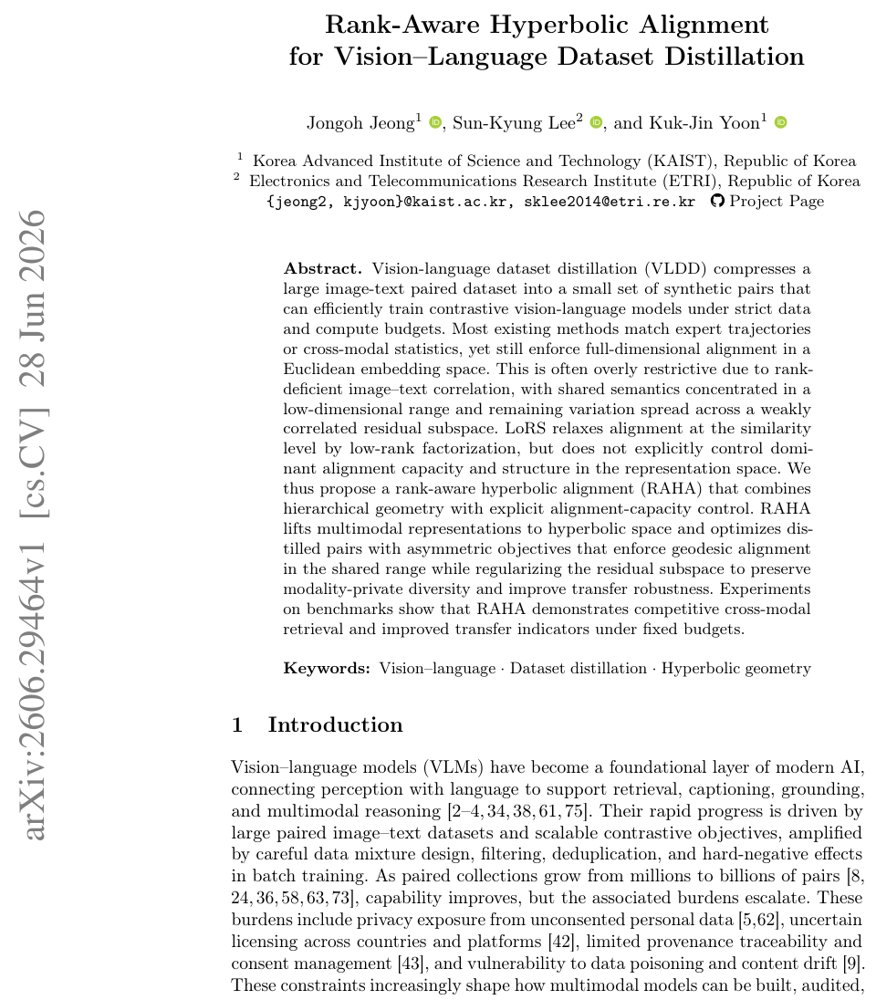
这篇论文实际处理的是 vision-language dataset distillation 在极端压缩下的 alignment capacity allocation 问题:给定很少的 synthetic image-text pairs,如何让它们训练出的 retrieval model 仍保留真实数据中的跨模态 ranking 结构,并且能跨架构迁移。真正困难不在于生成看起来合理的图片或文本 embedding,而在于 synthetic set 必须同时承载 pairwise discriminability、image-text relevance order、modality-private variation 和 teacher encoder 的局部几何。以前方法的瓶颈是 alignment 太“均匀”:CovMatch 匹配 Euclidean cross-covariance,LoRS 在 similarity 层面低秩化,trajectory methods 继承 expert path,但它们都没有明确回答哪些 representation directions 值得对齐、哪些方向应该避免过拟合。这个任务的关键矛盾是:VL representation 中有用共享语义是低维的,但压缩优化很容易把高维 residual 当成信号去拟合。
Motivation
作者认为已有路线不够,是因为它们把跨模态对应关系看成整体统计或整体 similarity,而不是一个有主次、有层级、有 residual 的结构。核心观察有两个:第一,image-text correlation 通常 rank-deficient,dominant subspace 承载稳定共享语义,residual 更多是弱相关、私有或噪声结构;第二,image-text semantics 不是 flat 的,caption 与 image 之间常有 abstraction-level mismatch,强制 Euclidean co-location 可能破坏这种结构。关键缺口是显式控制 alignment capacity:在小预算 synthetic set 中,不应把每个 feature direction 都当成同等重要的跨模态信号。RAHA 的动机因此不是“hyperbolic 更高级”,而是用几何和秩分解共同约束 synthetic data 应该保存什么、放弃什么。
Core Idea
RAHA 的核心思想是把 VLDD 从 full-space Euclidean matching 改成 rank-aware relevance compression:先在 hyperbolic geometry 中表达图文语义的层级/径向结构,再把 real batch 的跨模态 coupling 分解为 dominant range 与 residual complement,只把主要 alignment pressure 放在共享 range 上,residual 只做受控保留和压缩。这样 synthetic set 不再试图复刻真实数据的完整 feature distribution,而是优先复刻最可能影响 retrieval ranking 和 transfer 的低秩共享结构。
本质区别在于它改变了信息流的组织方式。CovMatch 是从 real/synthetic covariance 的整体差异回传信号,LoRS 是在 pairwise similarity 矩阵上低秩近似,RAHA 则先识别跨模态相关的 representation directions,再在这些 directions 上匹配 row-wise relevance distribution。它引入的 inductive bias 是双重的:hyperbolic geometry 偏向 coarse-to-fine semantic organization,rank decomposition 偏向 dominant shared factors。理论上这更适合小预算,因为 synthetic capacity 被集中用于稳定共享语义,而不是消耗在全维 residual fitting 上。
Method
方法上真正必要的机制有三点。第一,hyperbolic lifting + geodesic contrastive loss 解决的是 flat Euclidean alignment 过强的问题:matched image/text 不必在普通向量空间中完全塌缩,而可以保留 radial hierarchy 和 abstraction gap;这给后续 relevance matching 一个非均匀几何。第二,tangent-space SVD decomposition 解决的是 alignment direction 不可区分的问题:用 real cross-covariance 的 singular spectrum 自动选出 dominant coupling rank,把 image-side 和 text-side 的共享方向显式定义出来。第三,range/residual relevance matching 解决的是 synthetic rows 与 real rows 没有一一对应、且 residual 容易污染优化的问题:range 中匹配 row-wise relevance distribution,residual 中允许有限匹配但用 energy ratio 压制其主导性。
这套方法的关键不是每个 loss 的形式,而是 asymmetric pressure:range 被鼓励保留足够 coupling energy,residual 被允许存在但不能超过 dominant shared structure。这个不对称性是 RAHA 相比普通 covariance matching 更有意义的地方。
Key Insight / Why It Works
我认为最可能真正有效的部分是 rank-aware alignment capacity control,而不是 hyperbolic contrastive loss 本身。VLDD 的小预算场景本质上是 capacity bottleneck:synthetic data 不能表示真实分布的全部自由度,因此必须有机制决定优先表示哪些关系。RAHA 用 real cross-covariance 的 top singular subspace 作为“共享语义压缩通道”,这比全维 covariance matching 更符合数据结构,也比 LoRS 的 similarity-level low-rank 更接近 representation-level causal handle。
hyperbolic geometry 的作用更像是有用但未完全被证明的 inductive bias。它可能通过 radial reweighting、非线性 feature concentration 和 geodesic distance 改变了 covariance spectrum,使 dominant range 更清晰;也可能只是提供了一种 regularized nonlinear transform。文中宣称 hierarchy-aware,但实验并没有严格证明 singular directions 对应语义层级;feature visualization 只能作为弱证据。因此“hyperbolic hierarchy”不是铁证,更可靠的解释是:非线性几何 + low-rank decomposition + residual suppression 共同形成了更强的 representation alignment regularizer。
residual branch 的角色也值得判断:单独 residual 弱,说明它不是主信号;它的价值在于给弱相关结构一个出口,同时通过 compression 防止它抢占优化。这和很多 multimodal alignment 中“不要过度消除 modality gap”的经验一致。RAHA 的改进更像 better inductive bias / latent structure compression,而不是 scaling、test-time compute 或 memory reuse。它不是 retrieval trick,但 evaluation 仍主要围绕 retrieval,因此对 captioning、grounding、reasoning 等更复杂 VLM 能力的迁移还没有被验证。
Relation To Prior Work
最接近的路线是 CovMatch、LoRS 和 hyperbolic VL representation。相对 CovMatch,RAHA 不是继续匹配全局二阶统计,而是把 cross-covariance 分解后选择性匹配 relevance;本质差异是从 isotropic statistics matching 到 anisotropic shared-subspace matching。相对 LoRS,RAHA 不是仅在 similarity matrix 上低秩化,而是在 representation coupling space 中显式定义 image/text 两侧的 range basis;这使它能控制 residual,而不仅是降低 similarity rank。相对 MERU/HYPE 等 hyperbolic VL work,RAHA 没有主要贡献新的 hyperbolic representation learning,而是把 hyperbolic inductive bias 移植到 dataset distillation。
看似新的部分中,hyperbolic contrastive learning、SVD low-rank、Sinkhorn set matching 都不是新思想;实质创新在于它们被组合成一个 VLDD-specific 的 alignment allocation mechanism。它属于 distribution/statistics matching 谱系,而不是 trajectory matching 或 generative distillation。真正新增的信息是:在 VLDD 中,显式区分 dominant shared range 与 residual complement 比单纯匹配整体 covariance 更能解释 transfer/robustness 的差异。
Dataset / Evaluation
评估覆盖了标准 image-text retrieval 数据集、不同 synthetic budget、cross-architecture transfer、noise robustness、prompted classification 和一个更大规模 CC3M subset;这比只报 retrieval 主表更能支撑“structured relevance 更可迁移”的 claim。尤其 cross-architecture transfer 是关键,因为它测试 synthetic set 是否只是适配源 encoder geometry。较大 budget 下 RAHA 更强,也符合它需要足够 synthetic capacity 来 materialize decomposed semantic modes 的解释。
但 evaluation 仍有明显边界。第一,主任务仍是 retrieval,不能证明对生成式 VLM、grounding、multimodal reasoning 有直接收益。第二,teacher/backbone 规模较小,和现代 CLIP-scale / SigLIP-scale / LMM pretraining 场景有距离。第三,很多 qualitative evidence 容易受初始化和可视化选择影响。第四,CovMatch reproducibility gap 被讨论了,但这也让部分比较依赖作者重跑设置。整体上,实验支持“RAHA 是一个更结构化的 VLDD objective”,但还不足以支持“hyperbolic hierarchy 是主要增益来源”的强 claim。
Limitation
RAHA 的核心前提是跨模态共享信号集中在稳定低秩子空间;如果有用信号分散在很多弱方向,residual compression 可能直接删掉 long-tail semantics。它还依赖 real batch covariance 的估计稳定性,batch 太小或数据太 noisy 时,SVD basis 可能只是 batch artifact。所谓 hierarchy 也不是免费成立:如果数据集没有明显 coarse-to-fine taxonomy,hyperbolic bias 可能变成无用甚至有害的几何扭曲。
scalability 是实际硬伤。SVD on d×d covariance 加 Sinkhorn matching 显著提高每步成本,虽然是 offline,但对于更大 embedding dimension、更大 batch 或 web-scale distillation 会成为瓶颈。文中说可以优化,但未充分说明优化后是否保持效果。增益归因也不清:hyperbolic lift、rank decomposition、OT matching、residual compression 同时引入,仍可能有未拆开的 confounder。另一个隐含风险是 bias preservation:如果有害 stereotype 位于 dominant singular directions,RAHA 会更忠实地保留下来,而不是缓解它。
Takeaway
- 最值得记住的不是“用 hyperbolic space 做 VLDD”,而是“dataset distillation 应该显式分配 alignment capacity”。
- 在多模态压缩中,全维对齐往往是错的;应该优先保存稳定共享因素,并给 modality-private / weakly-correlated residual 留出受控空间。
- 这个 insight 可迁移到其他问题:CLIP data pruning、multimodal coreset、instruction-image pair condensation、cross-modal adapter training 都可以考虑 range/residual 式 relevance compression。
- 未来真正值得做的是把这种 subspace-aware objective 扩展到更大 VLM、更真实 web data、更便宜的 approximate decomposition,以及加入 bias/fairness auditing。
一句话总结
RAHA 是 VLDD 中从 Euclidean full-space matching 向 geometry-aware、rank-aware shared-relevance compression 演化的一步,真正贡献在于显式控制跨模态对齐容量,而不只是换了一个 hyperbolic similarity。