精读笔记
Problem Setting
这篇论文处理的是 egocentric interaction 视频中的 4D two-hand reconstruction,但真正问题不是“单帧估计 MANO 参数”,而是如何在遮挡、快速运动、出画、双手互遮和手物接触下保持连续、带身份的 metric hand trajectory。
传统 pipeline 的瓶颈很明确:image-based 方法把 detector 作为入口,一旦遮挡导致 detector miss,后面的 pose regressor 没有机会工作;video-based 方法虽然引入 cross-frame attention 或 motion prior,但监督主要来自有限 hand-pose labels,学到的是 hand trajectory statistics,而不是 scene/object-conditioned hidden state。也就是说,困难点不在于网络能否拟合可见手,而在于不可见手的状态需要由视频上下文和物理/交互先验来约束。
这个任务的关键矛盾是:评估和下游机器人学习最需要稳定完整的 hands-as-state signal,但视觉输入中最关键的手部状态经常不可见。已有方法要么在前端检测处断流,要么在后端用 hand-only prior 平滑补洞,二者都没有真正把“手在世界中运动”作为建模对象。
Motivation
作者的动机不是再堆一个 temporal module,而是指出 hand reconstruction 缺的不是局部结构先验,而是大规模视频世界先验。手在 egocentric video 中的可见证据经常不足,单靠 3D hand annotation 学出的 temporal attention 很难覆盖遮挡恢复、物体约束、运动连续性和左右手身份稳定。
核心观察是:视频生成模型为了合成 coherent video,必须隐式解决与 4D hand recovery 相同的一组问题——跨帧 correspondence、遮挡内容补全、3D-ish geometry、motion smoothness、scene-object-hand consistency。这里的关键缺口是,现有 hand methods 没有读取这种 representation;它们仍在 image pretrained backbone 或 hand-only motion prior 上打补丁。
所以论文的真正问题重写是:与其从稀缺 hand labels 中重新学习视频动态,不如复用大规模 video diffusion model 已经学到的世界动态,再把它对齐到 MANO 读出空间。
Core Idea
核心思想是把视频扩散模型当作 hand motion reconstruction 的 foundation representation,而不是当作生成器。ViDiHand 从 full-frame egocentric clip 进入 pretrained Wan2.1-VACE,在中间 denoising / middle DiT layer 读 feature,再训练一个 decoder 输出双手 MANO 与 camera translation。这个设计改变了建模方式:hand state 不再来自手部 crop,而来自包含场景、物体、运动和遮挡关系的全帧视频 latent。
本质区别在于 inductive bias 的来源。prior hand methods 的 bias 来自手模型、检测器、短时 attention 或 3D trajectory prior;ViDiHand 的 bias 来自 video generation pretraining。它引入的是一种“生成式世界模型中的可读隐状态”假设:如果模型能生成遮挡后仍连贯的视频,它的内部 feature 应该包含足够的隐藏几何和时序状态,可被监督 decoder 读出。
这比 prior 更 scalable 的地方在于,hand labels 不再承担学习全部 motion/occlusion/interaction 的任务,而只承担对齐和读出任务。大规模无标注/弱标注视频预训练负责吸收真实世界分布,少量 MANO/2D supervision 负责把 latent structure 映射到具体参数空间。
Method
方法中真正必要的机制不是模块数量,而是三类 alignment。
第一是 representation alignment:hand-overlay rendering 用编辑式目标让 VACE branch 在原视频上叠加手骨架/手网格。它解决的是 pretrained video diffusion feature 对手状态“不够可读”的问题。只训练 VACE branch、冻结 base DiT 的意义在于避免把世界先验灾难性改写,同时把条件路径推向 hand-aware feature。
第二是 structural readout alignment:decoder 将 MANO articulation 与 2D joint localization 分开。MANO pose 是整体结构变量,需要 hand-level token 聚合全局证据;2D joint 是空间局部变量,需要 heatmap 在 token grid 上定位。这个分支设计不是普通 architecture trick,而是在避免用单一 latent 同时承担 holistic pose 和 local correspondence 两种不兼容职责。
第三是 geometric alignment:translation 不完全自由回归,而是回归 depth、用 2D heatmap anchors 和 MANO joints closed-form 解 in-plane shift。它解决 monocular root translation/root pose 的耦合歧义,使 decoder 的像素证据、相机内参和 3D hand geometry 必须一致。
其余训练细节、layer/denoising-step 选择、temporal smoothing loss 更像使读出稳定的工程组件;核心机制仍是 diffusion world prior + hand overlay alignment + geometry-constrained readout。
Key Insight / Why It Works
最重要的 insight 是:遮挡手恢复不是纯 hand problem,而是 video world modeling problem。手被物体挡住时,可见像素不足以决定 pose;真正有用的信息在物体运动、上一帧/下一帧手的位置、接触方式、场景几何和人类操作统计中。视频扩散模型正好在生成任务中被迫学习这些统计,因此其 latent 比 hand-only temporal module 更适合作为 hidden state。
我判断主要增益来源排序大概是:第一,pretrained video diffusion backbone 的 scaling/data coverage;第二,full-frame conditioning 带来的 object/context-aware representation;第三,overlay adaptation 将 latent 对齐到 hand/MANO;第四,decoder 的 heatmap + mixed projection 几何约束。decoder 设计有价值,但从消融看,最不可替代的是 video pretrained representation,而不是某个 decoder block。
所谓“occlusion reasoning”需要谨慎理解。它很可能不是显式推理,而是大规模视频先验下的 statistical completion / retrieval:模型见过足够多手物交互模式,能在遮挡时维持 plausible hand state。对于 reconstruction benchmark,这已经足够有效;但如果环境、物体动力学或动作模式超出预训练分布,plausible 可能不等于 correct。
hand-overlay rendering 的作用更像 representation alignment,而不是让模型学会 hand geometry from scratch。Stage 1a joint overlay 提供大规模 egocentric hand-object motion exposure,Stage 1b mesh overlay 把 feature 对齐到 MANO surface;这解释了为什么它主要改善 2D localization 和 detection,而 temporal smoothness 已经由 pretrained T2V/VACE 提供。
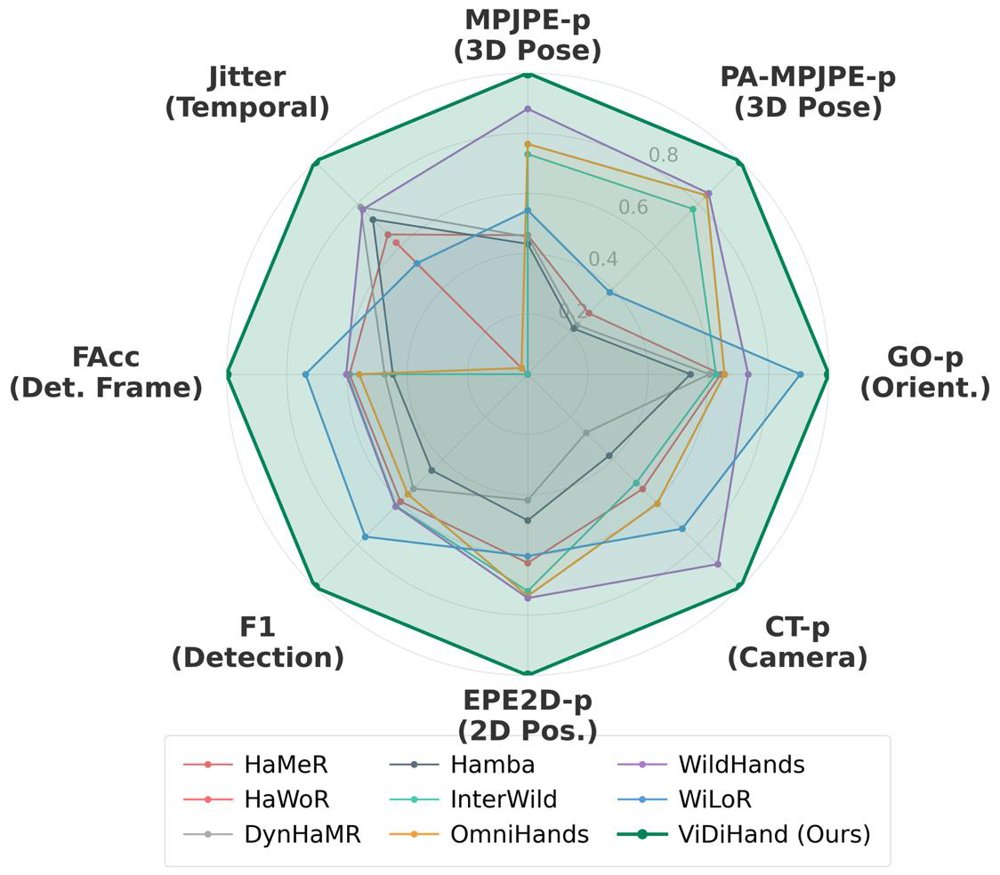
评价上的 penalty protocol 也放大了方法优势,因为它把 missed detections 纳入 pose metrics。这个是合理的,因为下游确实需要完整轨迹;但也意味着部分大幅提升来自“没有 detector failure”的 pipeline 形态,而不完全是每个 true-positive pose 更准。补充 TP-only 比较显示 ViDiHand 仍强,但最大叙事优势来自端到端覆盖率与稳定性。
Relation To Prior Work
它最接近三条线的交汇:monocular hand reconstruction、video hand recovery、diffusion feature repurposing。和 HaMeR/WiLoR/Hamba/WildHands 这类 image-based regressor 的本质差异是输入信息流:不是 detector crop 后单帧回归,而是 full-frame video latent 中读手状态,因此遮挡时不会在 detector 处断流。
和 OmniHands/Deformer 等 temporal attention 方法的差异是 temporal prior 的来源。后者是在 hand-pose supervision 上从头学短时融合;ViDiHand 直接继承 video generation pretraining 学到的时空 correspondence 和 occlusion statistics。它不是简单“加大 temporal transformer”,而是把 temporal modeling 的训练数据来源从 hand labels 扩展到 internet-scale video。
和 HMP/Dyn-HaMR/HaWoR 这类 motion prior/infiller 的差异是是否 scene-conditioned。hand-only trajectory prior 能平滑轨迹,但无法利用物体和场景解释遮挡;ViDiHand 的 hidden state 是 scene/object/hand 联合表征,理论上更适合交互遮挡。
看似新的部分里,dual-branch decoder、heatmap soft-argmax、closed-form projection solve 都有已有思想影子;实质创新在于把 video diffusion editing branch 适配成 hand-aware feature extractor,并证明这种生成模型 latent 对 hand reconstruction 是强 prior。它属于“repurpose generative foundation model for geometric perception”的谱系,而不是传统 hand pose architecture paper。
Dataset / Evaluation
实验覆盖了 ARCTIC、HOT3D、HOI4D,基本覆盖了 egocentric hand reconstruction 中最关键的几类 failure mode:双手/手物遮挡、fisheye/曝光/运动模糊、跨数据集 single-hand/出入画。HOI4D held-out 有一定说服力,尤其能测试 visibility head 是否会 hallucinate absent hand。
评价设计比常规 TP-only pose metric 更贴近实际用途。penalty protocol 将 false negative 计入 pose/orientation/translation/2D error,直接惩罚 detector-driven pipeline 的断流问题。这支持作者关于“end-to-end usable trajectory”的 claim,而不仅是 matched frames 上的 pose quality。
但 evaluation 仍主要是离线 benchmark,不是真实机器人闭环或下游 policy learning 验证。论文声称对 embodied AI scalable annotation 有意义,但没有证明用 ViDiHand 伪标签训练 policy 会优于 prior labels。另一个限制是测试集虽然跨 dataset,但都仍在 egocentric hand-object video 范畴;对更开放的生活场景、异常物体、多人手、严重 motion blur、长时状态一致性的验证不充分。
另外,baseline 与 ViDiHand 的 compute/data/pretraining 不在同一量级。比较证明了“video diffusion foundation prior 很强”,但不完全证明每个方法设计选择相对同等规模 discriminative video foundation model 都必要。
Limitation
最核心限制是问题被转移到了大规模视频生成模型和标注对齐上。ViDiHand 避免了 detector 和 test-time optimization,但代价是依赖 1.3B video diffusion backbone、GPU-heavy offline inference,以及 Stage 1b 的 MANO-annotated video。它不是轻量在线 tracker,而是高成本 annotation system。
泛化的真实性还需要谨慎。HOI4D held-out 说明有跨 benchmark transfer,但预训练视频模型可能已经见过大量相似 egocentric manipulation 分布;核心能力可能主要来自数据覆盖。所谓 hidden occluded hand state 也可能是 plausible completion,而非严格由观测唯一决定的重建。对不可辨识遮挡,模型只能输出先验最可能手势,这在 metric benchmark 上可能有效,但在物理接触细节上未必可靠。
增益归因仍不完全清楚。video pretraining、模型规模、VACE conditioning、overlay curriculum、decoder 几何约束、penalty evaluation 都共同贡献结果。文中没有充分说明如果使用同等规模的 non-generative video foundation model、或者更强的 supervised video backbone,会剩下多少 diffusion-specific advantage。
另一个上限是只恢复 hands,不恢复 manipulated object state/contact force。对于 embodied learning,hand trajectory 是重要监督,但交互的可执行性取决于 object pose、contact、grasp stability。ViDiHand 目前利用 object context 来估手,却没有显式输出 object-interaction state,因此还不是完整 4D interaction reconstruction。
Takeaway
- 1. 这篇最值得记住的是范式变化:遮挡下的 hand reconstruction 应该从 full-frame video world representation 中读状态,而不是在 hand crop 或 hand trajectory prior 上修补。
- 2. 生成模型用于 perception 的关键不一定是生成结果,而是中间 denoising feature 中可读的 latent structure;对几何任务而言,后续重点会是如何选择、压缩、蒸馏和对齐这些 latent。
- 3. hand-overlay rendering 是一个可迁移 insight:如果目标是从 foundation generator 中读出某类结构变量,可以用“编辑/覆盖目标”把隐表征推向该结构,而不必完全监督最终参数。
- 4. 未来真正值得做的不是再堆 hand decoder,而是解耦 scaling/data 与 architecture contribution,并把这种 prior 扩展到 hand-object jointly consistent reconstruction、实时蒸馏和下游 policy label quality 验证。
一句话总结
ViDiHand 是把 4D hand reconstruction 从 detector/hand-prior pipeline 推向 video generative foundation representation readout 的早期范式论文,真正贡献在于证明大规模视频扩散模型的世界先验经适当对齐后能显著提升遮挡场景中的完整性、稳定性和可泛化读出。