精读笔记
Problem Setting
论文标题:FlowAWR: Online Adaptive Flow Reinforcement via Advantage-Weighted Rectification(arXiv preprint / 2026-06-30)。
这篇论文真正处理的是 flow matching / rectified flow 生成模型的 online RL 对齐问题:如何在连续空间里做 policy improvement,而不用显式 trajectory likelihood。难点在于,flow 模型的生成过程通常是 deterministic ODE,没有自回归模型那种逐 token log-prob;如果硬套 PPO/GRPO,就必须把采样过程改造成带噪 SDE,以得到可计算的 transition density。
关键矛盾是:RL 需要可比较、可更新的 policy distribution;flow 模型高效生成依赖 deterministic velocity field。以前方法要么牺牲 flow 的 deterministic consistency,用 SDE 近似概率;要么像 DiffusionNFT 一样绕开概率但用 heuristic velocity correction,缺乏 reward-relative update magnitude。FlowAWR 的目标就是在不引入 SDE likelihood 的情况下,给 velocity update 一个更接近 policy optimization 的理论来源。
Motivation
已有路线的问题不是没有 reward,而是 reward 信号进入 flow model 的方式太粗。FlowGRPO/DDPO 一类方法把连续生成过程离散成 MDP,并用 SDE noise 构造 Gaussian transition,这让训练目标偏离推理时的 ODE trajectory,也保留了 CFG 依赖和计算负担。
DiffusionNFT 的方向更接近作者想要的答案:直接优化 forward velocity field,把 RL 变成监督回归。但它的核心缺口是 correction magnitude 固定,本质是把样本分成正/负方向推拉;group samples 只贡献一个归一化 reward,而没有真正让“同一 prompt 下样本之间好多少/坏多少”决定速度场移动多远。
作者的观察是:KL-regularized RL 的最优策略本来就是 old policy 的 exponential reward reweighting。如果能把这个 optimal terminal distribution 转成 flow path 上的 optimal velocity field,就可以避免 trajectory likelihood,同时保留 policy improvement 的结构。
Core Idea
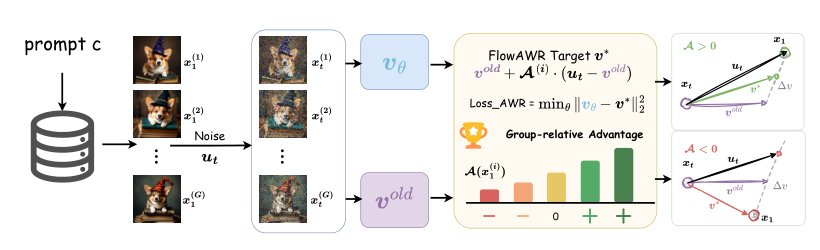
FlowAWR 的核心思想是:不要估计连续轨迹概率,也不要手写 guidance direction,而是从 KL-constrained reward maximization 推出最优终端分布,再解析地得到它对应的 velocity field。这个 velocity field 可以写成 reference velocity 加上 advantage-weighted residual:高 reward 样本把 conditional velocity residual 往自己方向拉,低 reward 样本通过负 advantage 产生排斥。
这改变了建模方式:RL 不再表现为 policy-gradient over sampled transitions,而是表现为 target velocity construction。reward 信号不直接乘在 loss 上,也不是简单挑优样本 SFT,而是调制 old velocity 到 sample conditional velocity 的残差。新的 inductive bias 是 group-relative rectification:同 prompt 多样本形成一个局部 reference distribution,样本质量的相对差异决定 update magnitude。
和 prior 的本质区别在于,DiffusionNFT 是固定幅度、二值化的 push-pull;FlowAWR 是从 exponential policy improvement 推出的连续 advantage rectification。这个差异很重要,因为 flow alignment 的瓶颈通常不是方向完全错,而是每条样本 trajectory 应该被信任多少。
Method
关键机制可以压缩为以下几层。
第一,KL 约束下的 optimal policy:p*(x1|c) ∝ p_old(x1|c) exp(R/γ)。它解决的是“RL update 应该朝哪里去”的问题,把 reward maximization 转成对 old terminal distribution 的 reweighting。
第二,把 terminal optimal distribution 推到 intermediate marginal。由于 flow matching 的 velocity 由 intermediate density / posterior mean 决定,作者用 p*_t 与 p_old_t 的关系建立最优速度场。这一步解决的是“终端 reward 如何作用到每个时间步 velocity”的问题。
第三,advantage-weighted rectification。理论推导表明 v* = v_old + E[A · (u_t - v_old)]。这一步的核心变化是:reward 不再只是 sample weight,而是决定 velocity residual 的方向和幅度。centered advantage 让低质量样本不只是权重小,而是能产生负向校正。
第四,group-based approximation。真实 A(x1, xt) 依赖 xt-conditioned posterior expectation,不可直接算;实践中用同 prompt 下 G 个样本的 exp reward 均值近似 partition function。这是算法可运行的关键,但也是最强近似。
EMA old policy、adaptive γ scaling、CFG-free optimization 是稳定化与工程闭环。它们让方法更可训练,但不构成主要理论创新。
Key Insight / Why It Works
最核心的 insight 是:flow model 的 RL alignment 可以绕过 policy likelihood,因为在 flow matching 视角下,policy improvement 可以被投影成 velocity field improvement。只要能构造一个与 KL-optimal terminal distribution 一致的 velocity target,训练就退化为普通 supervised regression。这比 SDE policy gradient 更 scalable,因为它保留了 flow 模型原生的 deterministic ODE 训练/推理结构。
真正可能带来增益的是 adaptive advantage 的“幅度感知”。DiffusionNFT 的 ±1/β correction 在 reward landscape 平滑或 group 内差异细微时太粗;FlowAWR 用 group softmax-like normalization,相当于在每个 prompt 内做局部 energy-based reweighting,使 update 更像 relative policy improvement。这解释了为什么它可能更快收敛:它不是平均地推所有好样本/拉所有坏样本,而是把梯度预算集中给相对更有信息量的 residual。
但需要直接指出:一部分收益可能只是 better weighting + better stabilization,而不是深层 RL 能力。adaptive γ、EMA reference、multi-stage reward curriculum 都会显著改善稳定性;如果没有严格控制这些 recipe,增益归因不干净。多 reward 结果尤其可能来自 curriculum / expert branching,而不是 AWR 本身天然解决 multi-objective alignment。
这不是 retrieval,也不是 planning;它更像 continuous generative policy 的 representation alignment / inductive bias 改造。所谓 CFG-free 能力也更像把 guidance preference 蒸馏进 velocity field,而不是模型获得了新的推理机制。
Relation To Prior Work
FlowAWR 最接近三条谱系:KL-regularized policy improvement / AWR,flow matching supervised regression,以及 DiffusionNFT 式 likelihood-free velocity optimization。它的新意不是提出 exp reward weighting 本身;这个来自 REPS、AWR、soft RL、DPO/RWR 共同的理论母体。它的新意在于把这个 optimal policy reweighting 映射到 rectified flow 的 intermediate velocity field,并得到一个可训练的 residual rectification 形式。
相对 FlowGRPO / DDPO,它的本质差异是拒绝构造 trajectory likelihood,不把 deterministic flow 强行随机化。相对 RWR,它不是简单对样本做 reward-weighted SFT,因为 centered advantage 允许负向排斥,并且 target 是 old velocity 的 residual correction。相对 DiffusionNFT,它把 heuristic binary correction 解释成 AWR 的硬量化特例,并用 group-normalized continuous advantage 替代固定 β。
看似新的部分中,KL optimal policy、exponential reweighting、advantage-weighted regression 都是已有思想;实质创新是把它们与 flow velocity / Tweedie relation 连接起来,形成一个不需要 density approximation 的 flow RL update。
Dataset / Evaluation
实验覆盖了文生图 alignment 中几类典型目标:偏好 reward、OCR、组合/结构规则,以及 DrawBench 式 out-of-domain 评估。它们基本能测试论文声称的两个方向:单 reward 收敛速度和多 reward 下的稳定性。使用 SD3.5-Medium 也使结果比 toy diffusion 更有说服力。
但 evaluation 仍主要是 offline benchmark + reward-model 指标,没有真实用户反馈闭环,也没有部署场景中的长尾 prompt 分布。PickScore、HPS、ImageReward 这类指标本身与训练 reward 高度相关,容易高估 alignment 泛化。OCR/GenEval 虽有规则性,但仍是有限模板分布,不能证明复杂 spatial reasoning 或真实 compositional robustness。
多 reward 实验支持“recipe 有效”,但不完全支持“方法本身天然 multi-objective”。因为训练中用了 staged curriculum、branching experts 和 reward normalization,这些因素本身就能缓解 reward conflict。文中未充分说明这些工程选择与 AWR 核心公式的贡献拆分。
Limitation
第一,理论优势依赖 group-based partition estimate 的质量。论文中的 A(x1, xt) 理论上是 xt-conditioned advantage,但实际近似基本是 terminal reward 的 group normalization;这会忽略不同时间步、不同 xt posterior 下的 advantage 变化。这个 gap 可能在简单图像 reward 上还能工作,在长程结构生成上会变大。
第二,方法仍高度依赖 reward model 的校准。exponential weighting 对 reward scale 敏感,adaptive γ 用 std 缓解了数值问题,但没有解决 reward hacking 和 reward misspecification。低质量 reward 会被更高效地蒸馏进 velocity field,这既是优点也是风险。
第三,scaling 成本不低。每个 prompt 需要较大 group 才能估计相对 advantage,G 变小会带来偏差,G 变大又显著增加采样成本。FlowAWR 省掉的是 SDE likelihood 和 CFG 推理负担,但把一部分成本转移到了 online group sampling。
第四,CFG-free gain 的来源不完全清楚。它可能来自 AWR 对 guidance 的隐式蒸馏,也可能来自 LoRA fine-tuning、reward dataset 覆盖和 benchmark 分布匹配。文中未充分说明不同 base model、不同 prompt distribution、不同 solver 下是否稳定。
第五,多 reward 部分更像工程 curriculum。它没有从理论上处理 reward conflict 或 Pareto optimality,只是 sequentially align 再 branch expert policies;泛化到真正开放式多约束生成还需要额外证据。
Takeaway
- 1. 值得记住的是:连续生成模型的 RL 不一定要走 trajectory likelihood / SDE policy gradient;可以把 KL policy improvement 投影成 velocity target regression。
- 2. FlowAWR 最有迁移价值的 insight 是“advantage should modulate residual, not just sample weight”。
- 这对 diffusion、flow、consistency model 甚至 video generation 的 reward fine-tuning 都可能适用。
- 3. DiffusionNFT 被解释为 binary quantized AWR 很有启发:很多 guidance / correction heuristic 可能都可以重新写成某种 advantage distribution 的退化形式。
一句话总结
FlowAWR 是把 KL-regularized policy improvement 解析投影到 flow matching velocity field 上的 likelihood-free online RL 方法,真正贡献在于用 group-relative continuous advantage 替代 SDE policy gradient和固定幅度 velocity heuristic。