精读笔记
Problem Setting
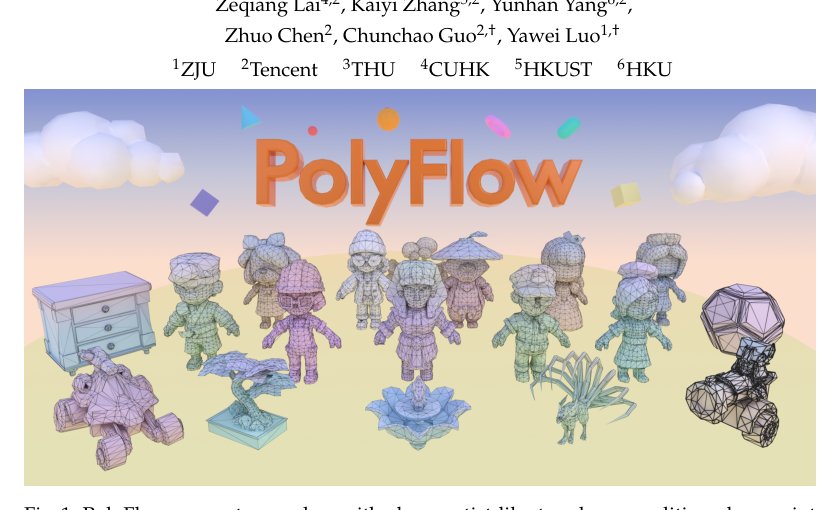
[PolyFlow: Continuous Topology Embedding Flow Matching for Artist-style Mesh Generation](arXiv preprint / 2026)
这篇论文解决的不是一般 3D reconstruction,而是 point-cloud conditioned mesh retopology:输入 dense / sampled surface,输出具有较干净 connectivity、可编辑、可控 vertex count 的 polygon mesh。关键矛盾是:artist-style mesh 的价值主要在 topology,而 topology 是离散结构;但高吞吐生成模型最擅长连续状态的并行 denoising。
已有 AR mesh generation 卡在序列化。它能把 vertex / face / edge token 作为离散语言建模,因此天然适合处理 edge existence 和 face construction;但 mesh 的序列顺序并非自然因果结构,而是人为 traversal / tokenization。结果是模型把一个本可并行的几何对象变成线性解码问题,推理时间随 mesh resolution 增长。
因此真正困难点不是“如何生成更多 vertex”,而是如何在不牺牲 topology cleaness 的情况下,把 mesh connectivity 变成连续生成模型能处理的对象。PolyFlow 的核心问题定义可以概括为:能否找到一种连续 mesh state,使得 topology 不再需要 AR token prediction,但仍可从连续状态可靠恢复。
Motivation
作者的动机比较清楚:AR 路线在 mesh generation 上的瓶颈不是 Transformer capacity,而是 causal decoding 假设本身不适配 mesh。mesh 顶点和面没有语言那种不可逆的时间顺序;把它们排成 token stream 只是为了套用语言模型范式。
另一方面,flow matching / DiT 在图像、点云、3D latent 上已经证明并行 denoising 可以兼顾质量和速度,但它们缺少处理 binary connectivity 的接口。直接对 adjacency matrix 做连续噪声注入会破坏离散约束;直接生成 point cloud 又丢掉 mesh 最关键的拓扑信息。
所以关键缺口是一个“topology-compatible continuous representation”:它既要能承载离散边关系,又要能作为 per-token continuous feature 进入 flow model。PolyFlow 的出发点不是设计更快的 AR,而是换掉 AR 所依赖的离散序列表示。
Core Idea
核心思想是把 topology 从显式离散边集合,改写为每个 vertex 的连续坐标;边不再由 token 分类生成,而由两点 embedding 的 spacetime distance 是否低于阈值决定。这样 mesh state 可以统一成 [xyz, normal, topo-embedding],flow model 只需要做连续向量场回归。
这改变了建模方式:从“生成一个有顺序的 face/edge token 序列”变成“生成一组无显式顺序的 vertex states,再通过几何规则解码 adjacency”。新的 inductive bias 是 topology locality / adjacency recoverability 被压进 embedding metric,而不是交给 Transformer 在 token stream 里学出 edge grammar。
本质区别在于,PolyFlow 不是把 AR 的 token 压缩得更短,也不是单独预测连接后处理;它把 topology 作为 latent coordinate 并入生成状态,使 geometry 和 connectivity 在同一个 flow trajectory 中共同收敛。这一点比单纯加速 AR 更 radical,也更符合 mesh 数据无天然 causal order 的事实。
Method
方法层面只需要抓住三个机制。
第一,topology embedder 解决“离散边如何连续化”。它从 GT vertex position / normal 产生 per-vertex embedding,并用 spacetime distance threshold 重构 adjacency。必要性在于,flow matching 需要连续 target;没有这个 embedding,topology 无法进入 velocity regression。
第二,joint state z=[p,n,e] 解决“几何和拓扑是否分离建模”的问题。若只生成点再后接 triangulation,得到的是 surface reconstruction,不是 artist retopology;若只生成 topology embedding 又缺乏几何锚定。联合 denoising 让 vertex placement 和 connectivity latent 在同一 token 上对齐。
第三,threshold-based edge decoding 和 clique-based face extraction 把生成问题从 neural face prediction 转为 deterministic graph decoding。这个设计降低了推理复杂度和误差累积,但也把质量强烈绑定到 embedding space 是否落在可解码流形上。
normal-guided winding correction 是实用但次级的机制:它补上 face orientation,不是论文核心贡献。DiT、CFG、EMA、Euler steps 更像现代生成模型工程栈,不应被视为本质创新。
Key Insight / Why It Works
最重要的 insight 是:mesh topology 不一定要作为离散 token 直接生成,它可以被表示为连续 metric structure,然后用简单阈值恢复。这使得 flow matching 可以绕开 categorical edge prediction,同时保留 mesh 的显式 connectivity。
方法有效的主要原因有三点。第一,representation alignment:positions、normals、topology embeddings 都是 per-vertex continuous channels,天然适配 Transformer token 和 flow velocity regression。第二,latent structure:spacetime embedding 把 adjacency 约束压缩成 pairwise metric boundary,比直接学习 V×V adjacency 更可控。第三,并行化:vertex token 之间通过 attention 全局交互,但输出不需要按拓扑顺序提交,避免 AR 的 serial error accumulation。
最可能的核心贡献是 topology embedding 进入 generative state,而不是 topology embedder 本身。spacetime distance 来自 SpaceMesh,flow matching / DiT 也不是新东西;新的组合点是把 SpaceMesh 式连续 connectivity representation 作为 flow target,使 retopology 从 discrete sequence modeling 转为 continuous state transport。
不过,性能增益归因不完全干净。文中使用约 5M meshes、大型 frozen point-cloud encoder、Flux-style DiT,这些都可能贡献巨大。CD/HD 提升未必全来自 topology representation,也可能来自更强 conditioner、更大训练集、更强 scaling。所谓“减少 AR 错误累积”在 qualitative 上合理,但论文没有做足够控制实验来隔离这一点。
vertex-count control 是一个真实优势,但也要谨慎理解:它不是模型理解 LOD hierarchy 的充分证据,而是 flow token 数可变带来的结构性能力。能在 250 到 3000 vertex 下保持形状一致,说明模型学到某种 resolution-aware distribution;但是否能满足生产级 LOD 的 edge flow、semantic loop、deformation friendliness,文中未充分说明。
Relation To Prior Work
最接近的谱系有两条:AR artist mesh generation 和 SpaceMesh-style continuous connectivity prediction。PolyFlow 站在二者交叉处:从 AR 继承“目标是 clean artist topology”,从 SpaceMesh 继承“用连续 spacetime embedding 表示 adjacency”,再接入 flow matching 的并行生成范式。
相对 PolyGen / MeshGPT / MeshAnything / BPT / Meshtron,真正差异不是模型更大或 token 更短,而是取消了 mesh serialization 作为生成主轴。AR 方法把 topology grammar 写进序列概率分解;PolyFlow 把 topology grammar 写进 embedding metric 和 deterministic decoding。
相对 SpaceMesh,PolyFlow 的新增信息在于生成式集成。SpaceMesh 更像给定几何后预测 / 表示 connectivity;PolyFlow 把这种 connectivity coordinate 放进数据分布本身,让 generative model 同时生成 geometry 和 topology latent。这个转变是实质创新。
相对 DMesh / PointTriNet / triangulation 类方法,PolyFlow 不依赖 Delaunay 或局部 triangle classifier,因此更有机会表达 artist-intended tessellation。但它仍然没有直接建模更高阶 mesh design rule,例如 edge loops、quad flows、deformation topology,这些只是可能从数据中隐式学到。
Dataset / Evaluation
评估集中在 Toys4K point-cloud conditioned mesh generation。它能验证几何保真和推理速度,但对“artist-style topology”这个 claim 的验证并不充分。CD/HD 主要看 surface distance,不关心 topology 是否可编辑、edge flow 是否合理、valence 是否自然、是否 manifold、是否适合 rigging 或 subdivision。
实验确实支持并行 flow 在速度上优于 AR,并且支持 topology embedding dimension 存在合适瓶颈:过小不能表达 adjacency,过大对下游不一定有利。但缺少更关键的 ablation:同等数据和 conditioner 下的 AR 对照、只生成 xyz/normals 再 triangulate、topology embedding 不冻结、Euclidean embedding vs spacetime embedding、不同训练集规模下的性能曲线。
训练数据约 5M meshes,而 evaluation 只在 Toys4K 上报告,覆盖范围仍偏窄。若训练集包含大量相似 toy-like assets,benchmark 泛化可能被高估。文中未充分说明数据去重、类别 overlap、asset source 与 Toys4K 的分布关系。
此外,真实部署中输入往往来自 image-to-3D 重建、扫描、噪声点云或 non-watertight dense mesh,而论文主要用从 test shape 表面均匀采样的 point cloud 作为 condition。这比真实 pipeline 更干净,可能低估了 conditioner mismatch 和 topology failure。
Limitation
核心限制是表示假设很强:所有目标 topology 都必须能被低维 per-vertex spacetime coordinates 以固定 threshold 可靠表达。训练时 embedder 在 GT mesh 上可重构 adjacency,不等于 flow 生成出的 embedding 一定落在同一个有效流形上;一旦偏离,threshold decoding 可能产生 spurious edges、missing edges 或异常 cliques。
第二,方法把拓扑离散性问题转移了,而不是完全消灭了。edge decoding 仍是 pairwise threshold,face extraction 仍依赖 3-clique 枚举;只是 neural generation 阶段连续化了。对于更高 vertex count,O(V^2) distance evaluation 和 clique extraction 会成为实际上限,论文的 4k 级别不足以证明大规模 production mesh 可扩展。
第三,增益来源不清。大规模数据、frozen Hunyuan3D-Omni condition encoder、Flux-style DiT、CFG、EMA 都可能显著影响结果。没有严格 scaling law 或 controlled baseline,很难判断性能提升究竟来自 topology embedding,还是来自更强 foundation components。
第四,artist-like topology 的语义仍是隐式的。模型可能学到的是训练集中的局部连接统计和表面分布,而不是显式的 topology planning。它是否能稳定生成动画友好的 edge loops、机械结构的 sharp feature loops、语义一致的 LOD hierarchy,文中未充分说明。
第五,泛化可能依赖数据覆盖。若输入形状超出训练 mesh 的拓扑模板分布,flow model 可能更像 retrieval / interpolation of seen topology patterns,而不是真正理解 retopology principles。论文没有提供足够 evidence 排除 implicit memorization 或 benchmark overlap。
Takeaway
- 1. 最值得迁移的 insight:离散结构不一定要直接离散生成,可以先学习一个可逆近似的连续 metric representation,再交给 flow / diffusion 建模。
- 2. 对 mesh generation 来说,未来竞争点可能从“更短 AR tokenization”转向“更好的 topology-aware continuous latent”。
- PolyFlow 是这个方向的早期强信号。
- 3. 真正值得继续做的是 topology 评价与约束:manifoldness、edge flow、valence、editability、deformation suitability,而不是继续只优化 CD/HD。
一句话总结
PolyFlow 是把 SpaceMesh 式连续拓扑嵌入并入 flow-matching 生成状态的一步,核心贡献在于用 topology-aware continuous representation 替代 AR mesh token sequence,从而把 artist mesh generation 从离散串行解码推向并行连续生成。