精读笔记
Problem Setting
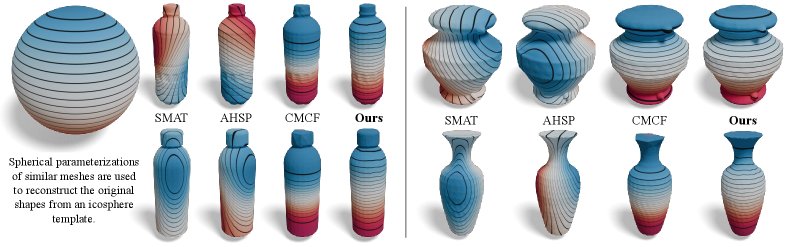
这篇论文实际处理的是 dataset-level spherical parameterization:给一组 genus-0 shapes,不只是为每个 shape 找一个到球面的 bijective / low-distortion map,而是要让这些 map 在跨形状语义上保持一致。真正困难点不是单个 shape 的参数化能否算出来,而是 spherical parameterization 的解空间有 gauge freedom:即便限制 conformal,也仍有 Möbius group;per-shape optimizer 没有理由为相似形状选择同一个 gauge。
以前路线卡在一个矛盾上:优化式方法通常 distortion 好,但跨 shape 不一致;flow-based 方法路径更统一、consistency 相对好,但会牺牲薄结构和高曲率区域的 isometry。GenSP 的目标就是在这个 trade-off 中找一个新的支点:用数据集级别的生成模型来统一 gauge,同时保留局部几何质量。
Motivation
作者的核心动机不是“用深度学习替代几何优化”,而是认为一致参数化需要一个 shape family 上连续且共享的坐标选择机制。单 shape 方法缺少这种机制;pairwise / post-hoc alignment 只能补救 Möbius 自由度,不能保证复杂局部结构的对应一致。
关键观察是 sphere 往往不在实际 shape collection 的自然 latent subspace 里。直接学一个从 sphere 到各种复杂形状的 generator,很容易在中间区域产生无意义形状,导致 correspondence 初始化崩掉。因此缺口不是网络表达能力本身,而是缺少一条可学习、可传播、低变形的 sphere-to-shape 路径。
Core Idea
论文的核心思想是把球面参数化反过来看:不是从每个 surface 优化到 sphere,而是学习一个共享的连续生成器,从 sphere 坐标和 shape latent code 生成对应 surface point。于是每个 shape 的 spherical parameterization 是这个生成器的逆映射。这个建模方式把“跨形状一致性”从额外约束变成了生成器共享坐标系的自然结果。
本质区别在于,它不是求一批独立 maps 后再对齐,而是在 shape space 上学习一个连续 section:sphere 上同一个点经过不同 latent code 映射到不同 shape 的对应点。新的 inductive bias 是 latent-neighborhood deformation smoothness + shared sphere domain + path-based correspondence propagation。它比传统 per-shape 方法更 scalable 的地方在于,测试时只需 encode shape 并 decode sphere samples;但这种 scalable 很大程度上建立在训练阶段已经把形状空间和 correspondence 组织好的前提上。
Method
方法中真正必要的机制不是四阶段流程本身,而是三类约束如何共同固定 gauge。
第一,data augmentation 用 CMCF 生成从输入 shape 到 sphere 的中间形状。它解决的是 sphere 与真实 shape manifold 断裂的问题。没有这些 bridge samples,generator 需要在未观测区域外推,容易学出拓扑上可行但几何上无意义的 deformation。这里的核心变化是把 hard extrapolation 改成 curriculum-style interpolation。
第二,implicit AE 不是最终参数化模型,而是为 correspondence propagation 构造 latent geometry。latent regularization 让相似形状靠近,deformation regularization 让 latent interpolation 的中间形状更可注册。它解决的是初始化问题:最终 mesh generator 需要 dense correspondence,而从 sphere 到复杂 shape 直接配准太难。
第三,沿 latent minimum spanning tree 传播 correspondence 是方法的关键工程-几何混合点。它把一次大变形拆成多次小变形,用相近形状之间的 registration 组合出 sphere-to-shape correspondence。这比直接 sphere-to-target matching 稳定得多,但也意味着最终结果强依赖 tree 上局部边的质量。
第四,最终 continuous sphere-to-surface generator 和 Jacobian/deformation regularization 负责把离散 correspondence 初始化变成平滑、低失真的连续参数化。这里避免了固定 mesh generator 在 conformal factor 强变化下的不稳定,同时把 isometry/conformality 偏置注入统一模型。
Key Insight / Why It Works
最核心的贡献是把 spherical parameterization 的 gauge selection 问题转化为 shape generative model 的 coordinate sharing 问题。这个转化很有效,因为 consistency 本来就是一个跨样本约束;用单样本优化去做,天然信息不足。共享 generator 让 sphere 上的点成为全数据集的共同坐标,latent continuity 则让相近形状的参数化不能任意漂移。
真正起作用的很可能不是“生成模型”这个标签,而是 bridge data + local correspondence propagation + deformation prior 三者组合。Data augmentation 提供 coverage,MST propagation 提供 reliable initialization,regularization 提供局部几何 bias。换句话说,GenSP 更像是把一个困难的全局匹配问题拆成有训练数据支撑的局部 registration chain,再用 neural field 压缩成一个可快速查询的参数化器。
其中最像实质创新的是:把 shape-space path 用于初始化 consistent spherical parameterization,并用 continuous generator 固化这些 correspondence。隐式模型阶段和 regularization 有价值,但更像支撑机制。CMCF augmentation 本身不是新思想,MST/path composition 也接近 joint matching;新的地方在于把这些组织成一个 sphere parameterization pipeline,并让最终结果由统一 generator 输出。
需要直接指出:这篇的“泛化”更可能是 manifold interpolation,而不是开放集合上的真正 extrapolation。测试集如果落在训练增强后的 shape manifold 附近,方法会非常强;但遇到薄结构、稀有拓扑几何、或 latent tree 没覆盖的形变路径,能力上限会暴露。这里不存在强语义推理,更多是 data coverage + representation alignment + correspondence memory reuse。
Relation To Prior Work
它最接近三条线:flow-based spherical parameterization、joint shape matching / correspondence propagation、以及 deformation-regularized shape generative models。和 per-shape spherical parameterization 的本质差异是优化对象从单个 map 变成整个 shape family 的生成坐标系;和 CMCF 等 flow 方法的差异是路径不再由固定 PDE 决定,而由数据增强后的 shape graph 和 learned latent space 决定。
和 GenCorres / generative correspondence 工作相比,GenSP 的问题更特殊:一端是没有可识别 keypoint 的 sphere,另一端是 heterogeneous genus-0 shapes。它借用了生成模型和 deformation regularization 的思想,但实质新增信息在于如何把 sphere 纳入 shape manifold,并通过 augmented flow samples + spanning tree propagation 获得可用初始化。
看似新的部分里,很多是已有思想重组:ARAP/ACAP regularization、implicit SDF AE、latent interpolation、MST propagation 都不是概念上全新。实质创新在组合后的 problem reframing:把 consistent spherical parameterization 做成一个数据驱动的 canonical coordinate learning 问题。
Dataset / Evaluation
评估主要在 ShapeNet genus-0 子集和 D-FAUST 上,覆盖了跨类别物体和人体形变两个场景,但仍是离线、清洁、拓扑受控的数据。它支持作者关于“consistency + distortion trade-off 改善”的核心 claim,尤其是相对于 per-shape optimization 和 CMCF 的互补优势。
但 evaluation 的边界也明显。首先,所有数据都满足 genus-0 且经过归一化,真实扫描、拓扑噪声、非水密 mesh 没有系统验证。其次,consistency metric 依赖 KeypointNet / ground-truth-like mappings 和近邻图,是否能完全代表实际 dense semantic correspondence 仍有限。第三,baseline 需要 Möbius registration 后评估,而 GenSP 的 gauge 已由训练集固定,这个比较是合理的,但也说明任务收益部分来自 dataset-level supervision / memory,而不是单 shape 能力。
实验数字不需要过度解读。最重要的是 ablation 方向一致:去掉 data augmentation、路径传播或 geometric regularization 都会明显退化。这说明核心 claim 被支持,但增益的精确归因仍不完全清楚,尤其是 data coverage 和 neural regularization 各自贡献多少。
Limitation
最大限制是方法把参数化问题转移成了 shape manifold construction 问题。只要 sphere-to-shape bridge 不可靠、latent space 邻接关系错误、或训练集覆盖不足,最终 generator 会继承这些错误。它没有形式化 bijectivity 保证,只是经验上接近 bijective;对于薄结构失败也说明局部几何极端区域仍是硬伤。
第二,scalability 有两面性。推理很快,但训练阶段很重:需要 CMCF augmentation、implicit model、registration propagation、mesh generator training。它适合 amortized setting,即同一类/同一分布上大量查询;如果每次面对全新分布,都要重建 shape space,成本并不低。
第三,泛化可能主要来自数据覆盖。论文展示的 test-time generalization 更像在训练增强 manifold 上插值,而不是对未知几何族的外推。若 benchmark 与训练分布高度重叠,性能会很好;分布外、局部结构未覆盖或存在不稳定 symmetry 时,所谓 consistent parameterization 可能退化为错误但平滑的 correspondence。
第四,方法是 extrinsic generative model,而 spherical parameterization 本质上更 intrinsic。这会带来对姿态、尺度、ambient alignment 的依赖,也可能让 latent distance 与真正的 intrinsic deformation difficulty 不一致。文中未充分说明这种 mismatch 在复杂类别上的系统影响。
Takeaway
- 1. 值得记住的不是“用生成模型做球面参数化”,而是把 gauge fixing 从 per-shape 后处理提升为 dataset-level coordinate learning。
- 2. 对这类没有天然 canonical map 的几何问题,bridge samples / curriculum shape space 可能比更强网络更关键;先让路径可学,再谈生成。
- 3. Consistency 的来源往往不是单个 loss,而是信息流设计:局部可靠 correspondence 沿 shape graph 传播,再被统一模型压缩和正则化。
- 4. 未来真正值得做的是 intrinsic generative parameterization、可证 bijectivity、以及对稀疏/噪声/分布外 shape collections 的鲁棒 path construction,而不是继续堆更大 decoder。
一句话总结
GenSP 是把一致球面参数化从单形状几何优化推进到数据集级 canonical coordinate learning 的方法,真正贡献在于用增强的 shape-space 路径和共享生成器固定跨形状 gauge,而不是单纯引入一个 neural generator。