精读笔记
Problem Setting
这篇论文真正解决的不是一般 OOD detection,也不是普通 CDP fake detection,而是多 authentic P&D 类别下的统一认证问题:一个系统要同时接受多个可信打印/扫描设备产生的 authentic CDP,并拒绝由模板估计和重打印生成的 counterfeit。难点在于 authentic 与 counterfeit 在宏观结构上几乎完全重合,binary template 本身不是判别信号;真正的判别信息藏在很弱的 P&D residual 中。以前方法卡住的地方主要是 score calibration:很多方法在单个 printer family 内可以区分真假,但不同 authentic class 的 score range 不一致,导致一个全局阈值不可用。关键矛盾是:模型必须学习 class-specific normal manifold,但输出又必须 class-agnostic enough,能用统一 anomaly score 做部署级决策。
Motivation
已有路线缺的是“多类正常性”的建模能力。模板相似度/NCC 类方法过度依赖 image-level structure,容易被高质量模板估计攻击绕过;analytical P&D model 假设过强,难覆盖真实设备的非均匀 artifact;Pix2Pix/U-Net 等生成式方法通常按 printer 训练或按单 channel 建模,scalability 差;supervised fake detector 又依赖已知攻击分布。作者的核心观察是:如果 counterfeit 的本质是偏离 trusted P&D manifold,那么认证应当从“识别 fake 类型”改成“判断是否能被某个 authentic class 条件解释”。因此关键缺口不是更强 classifier,而是一个能同时容纳多个 authentic manifold、并产生可比较异常分数的 generative normality model。
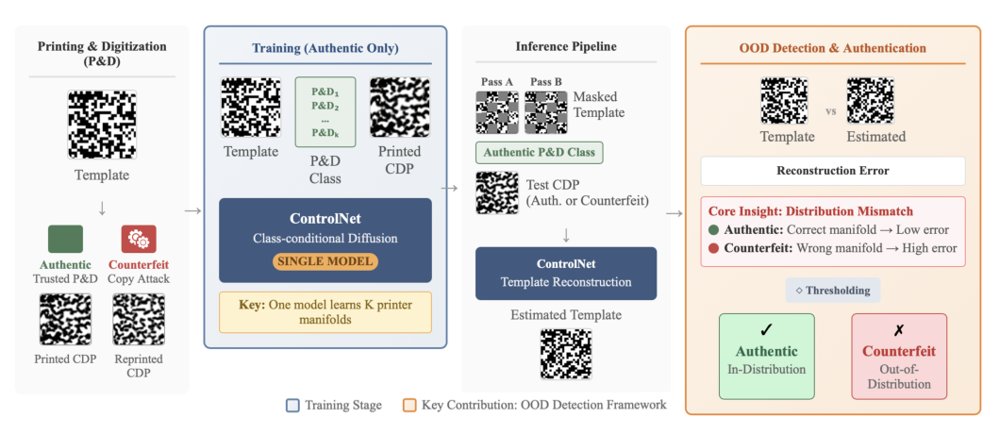
Core Idea
论文的核心思想是用一个 class-conditional diffusion/ControlNet 作为多类 authentic manifold 的共享正常性模型。模型只看 authentic 样本,条件包括 printed CDP 的空间信息和 authentic printer prompt;测试时先在 authentic prompt 集合中选择最能解释输入的 class,再看在该 class 条件下重建模板的误差。如果样本是 counterfeit,即便它保留某个 source printer family 的残余特征,额外 reprinting 也会使其偏离对应 authentic manifold,从而在条件重建中暴露出来。
本质区别在于它不把 printer class 当最终预测目标,也不为每个 printer 训练独立 detector,而是把 class label 用作 normal manifold selector。这样引入的 inductive bias 是:不同 printer 的 P&D signature 可以通过共享 diffusion backbone + class conditioning 表示为同一 latent normality space 中的多个 mode;异常分数则来自“条件一致性失败”,而不是显式 fake 分类。dual-mask 进一步改变信息流:模型不能只利用完整 binary template 的可见结构完成重建,而要在 withheld pixels 上依赖 printed CDP 与 authentic prompt 的一致性。
Method
方法层面真正关键的机制有三类。
第一,authentic-only class-conditional diffusion training 解决的是多类正常域建模问题。它让一个模型同时学习 HP55/HP76 等 authentic P&D manifold,而不是为每类训练单独模型。核心变化是把 class prompt 作为 normal manifold 的索引,同时共享生成参数以增强跨类 score alignment。
第二,test-time prompt inference 解决的是部署时不知道 candidate 属于哪个 trusted device 的问题。模型只在 authentic prompts 内做 diffusion-classifier 式选择,不引入 counterfeit label。这一步的意义不是分类本身,而是为后续 reconstruction score 找到最有利的 authentic explanation;如果在最有利解释下仍然 reconstruction error 高,OOD 判断更有说服力。
第三,dual template masking 解决的是 reconstruction-based OOD 中的 shortcut 问题。完整模板太强,会让误差主要反映二值结构复制能力,而不是 P&D signature mismatch。互补 checkerboard 两次重建并只在被遮住像素上计分,本质上把任务转成 conditional inpainting consistency test,使 score 更依赖局部 P&D 线索与 class conditioning 的匹配。
Key Insight / Why It Works
最可能真正有效的部分不是 diffusion architecture 本身,而是“class-conditioned normality + global score calibration”的组合。对于 CDP 这种结构固定、异常差异微弱的任务,直接分类 fake 很容易学到攻击分布或模板统计;而在 authentic-only 条件下做 reconstruction,相当于问一个更稳定的问题:这个样本是否能被某个可信 P&D process 解释。这个 formulation 比 supervised fake detection 更接近部署需求。
dual-mask 是本文最有迁移价值的 inductive bias。它抑制了 reconstruction 模型在已知模板上的 trivial copying,使 OOD score 更接近条件生成模型对缺失区域的 posterior consistency。对于“正常与异常共享大部分结构,只在微弱物理残差上不同”的问题,这类遮蔽式 scoring 往往比 full reconstruction 更可靠。
但需要直说:结果中相当一部分能力可能来自 pretrained latent diffusion/ControlNet 的容量、数据增强和 prior work [18] 已经证明的 printer signature conditioning,而不是本文提出了全新的 OOD 原理。multi-class normality 的实验只覆盖 K=2 authentic classes,所谓 scalability 还没有被真正压力测试。prompt inference 也不是严格的语义推理,更像利用 diffusion loss 做 nearest authentic manifold retrieval。它能工作,是因为 counterfeit 仍保留 source-family signature,同时 reprinting 又足以造成 residual mismatch;如果攻击者优化到 mimic trusted P&D residual,这个机制可能失效。
Relation To Prior Work
这篇最接近三条谱系:reconstruction-based OOD/diffusion inpainting OOD、CDP generative print synthesis、printer-conditioned diffusion authentication。它的新意不是发明 diffusion OOD,也不是发明 masking,而是把这些已有思想组织成 CDP 多类 authentic normality 的部署形式。
相对 Pix2Pix/U-Net print synthesis,它的本质差异是从 per-printer synthesis 转向 shared conditional normality:目标不再是生成某个 printer 的图像,而是输出跨 printer 可比较的 normality score。相对 analytical P&D model,它放弃显式物理假设,用数据驱动的 conditional generative prior 捕获空间非均匀 artifact。相对 Siamese/metric learning,它不直接学习真假边界,而是利用 authentic manifold 的可解释性失败作为异常证据。相对 Chapus 的 energy-based authentic-only OOD,关键差异在于 class conditioning 和 score calibration:后者可能有 per-family discrimination,但 score range 跨 authentic class 不对齐。
看似新的部分中,dual-mask 明显借鉴 diffusion inpainting OOD;diffusion classifier prompt inference 也来自已有工作。实质创新在于把这些组件放进一个“多 authentic class、无 counterfeit calibration、单全局阈值”的认证框架,并明确把 evaluation 重点从 per-family AUROC 转到 cross-class score calibration。
Dataset / Evaluation
评价最能支持的 claim 是:在 Indigo 1×1 Base 上,两个 authentic printer 构成的多类正常域可以用一个 diffusion model 和一个全局阈值处理,并且优于若干 adapted baselines。作者没有只报 per-family ROC,而是分析 global threshold 下的 score distribution,这是正确的,因为本文核心 claim 就是 multi-class calibration。
但 benchmark 覆盖范围很窄。authentic class 只有 HP55 和 HP76,counterfeit pipeline 也是固定的 template estimation + reprinting 组合;这不足以证明方法在真实供应链中面对多 printer、多 scanner、多批次材料、老化、环境变化时仍然稳定。数据是 template-level split,避免了最直接的模板泄漏,这点合理;但仍可能存在设备/流程级统计特征被模型充分利用,导致结果更像 benchmark-specific printer texture retrieval。文中没有展示跨数据集、跨设备新增、跨采集条件迁移,因此 generalization 证据有限。
Limitation
最大限制是方法把认证问题转移成“训练集 authentic P&D manifold 覆盖是否充分”的问题。只要真实 authentic 变异超出训练覆盖,模型可能把合法样本判为 OOD;反过来,只要攻击者能模拟 trusted P&D residual,reconstruction error 可能下降。它不是从原理上证明 counterfeit 不可伪造,而是用当前攻击分布下的 residual mismatch 做检测。
scalability 也未被充分验证。K=2 不能说明几十个 printer class 下仍能保持 compact authentic score distribution;class prompt 是否会造成 mode interference、score drift 或 prompt imbalance,文中未充分说明。global threshold 的稳定性可能高度依赖 validation authentic 的代表性。
增益归因不完全清楚。dual-mask 有 ablation,但 full-template 已经很强,提升幅度不大;因此主要增益可能来自 [18] 风格的 printer-conditioned diffusion backbone、augmentation 和高容量模型,而不是 masking 本身。文中也没有充分拆分 VAE fine-tuning、ControlNet conditioning、prompt inference accuracy、mask pattern 对最终 OOD score 的贡献。
另一个 deployment gap 是模板可用性和绑定安全被默认假设。如果 binary template 本身被泄漏或 product-template association 被攻击,方法只处理图像认证的一部分,不处理系统级安全闭环。
Takeaway
- 1. 对多类正常域 OOD,真正难点往往不是 per-class discrimination,而是跨 class score calibration;这篇论文把这个问题在 CDP 场景中说清楚了。
- 2. 对“异常与正常共享结构、差异在细微物理残差”的任务,masked conditional reconstruction 是比 full reconstruction 更干净的 scoring 方式;这个 insight 可迁移到文档取证、工业表面、传感器指纹等场景。
- 3. class conditioning 的价值不是分类,而是提供 normal manifold selector;测试时选择最接近的 authentic explanation,再看解释失败程度,是一种实用的 generative OOD pattern。
- 4. 未来真正值得做的不是继续堆 diffusion,而是验证跨设备/跨采集条件/新增 authentic class 下的 calibration,以及面对 adaptive counterfeit 时 P&D residual 是否仍有安全 margin。
一句话总结
这篇论文把 CDP 认证从单 printer 生成/相似度检测推进到 class-conditioned diffusion multi-normality OOD,真正贡献在于用共享条件生成模型和遮蔽式重建分数解决跨 authentic class 的全局校准问题,但其泛化与安全上限仍主要受 authentic P&D 覆盖和攻击分布约束。