精读笔记
Problem Setting
【LeVLJEPA: End-to-End Vision-Language Pretraining Without Negatives】(arXiv preprint / 2026)
这篇论文真正解决的问题是:视觉语言预训练是否必须依赖 contrastive negatives,尤其是在 encoder 被用作 frozen dense visual backbone 而不是 zero-shot classifier 的场景下。困难点不在于写一个不用 negatives 的 loss,而在于不用 negatives 后,跨模态 matched-pair supervision 很容易变成退化的 latent regression:图像和文本只对齐 caption 覆盖的粗语义,共同丢掉大量视觉细节。
以前方法卡在两个方向:CLIP/SigLIP 有强全局 image-text alignment,但主要监督 pooled embedding;vision-only non-contrastive 方法能学 dense representation,但没有解决跨模态配对数据下如何稳定对齐。关键矛盾是:caption 是低带宽、语义选择性的监督,而下游 VLM 需要高带宽、空间化的 patch representation。直接让图像表示去服从 caption discrimination,可能天然损害 dense feature。
Motivation
作者的核心动机是重新质疑 VLP 的 evaluation-target mismatch:主流训练目标优化 zero-shot/retrieval 需要的全局匹配,但当前大量系统实际消费的是 patch-token sequence。换句话说,CLIP 成功解决的是“图像和文本是否匹配”,但未必解决“视觉 token 是否携带可被下游模型直接读取的局部语义结构”。
这个观察是成立的,而且是本文最有价值的切入点。已有路线缺的不是更大的 batch 或更好的 negatives,而是一个不把视觉表示压缩到 pooled alignment 的训练范式。作者因此借用 JEPA/LeJEPA 的思想:用预测学习提供配对约束,用分布正则提供 anti-collapse,而不是用 negatives 提供几何结构。
Core Idea
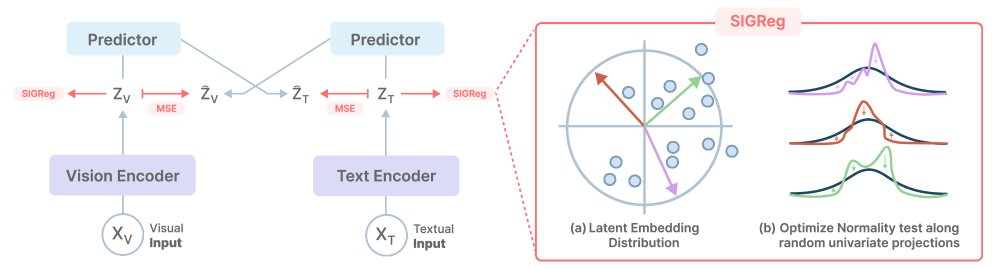
核心思想是把 vision-language learning 从 contrastive discrimination 改成 non-contrastive cross-modal prediction。图像 latent 不需要在 batch 内区分正确 caption 与错误 caption,而是通过 predictor 预测其匹配 caption 的 stop-gradient latent;文本侧也对称做 text-to-image prediction。这样 alignment 来自 matched pair 内部的 latent predictability,而不是来自 batch 内 negative classification。
本质区别在于 inductive bias:contrastive VLP 构造的是一个全局可检索的 shared embedding space,目标偏向样本级判别;LeVLJEPA 构造的是两个被独立正则化的 modality marginals,再用非对称 predictor 在它们之间建立可预测关系。它没有强迫两个 encoder 直接共享同一个低维公共语义子空间,而是允许 predictor 承担跨模态信息不对称。这一点对图像侧尤其重要,因为图像包含比 caption 多得多的空间与对象细节。
Method
方法上真正重要的机制有三个。
第一,直接 image-text MSE 会塌缩或学到很差的几何结构。原因是对称回归让两个 encoder 同时向对方移动,而 paired caption 只提供粗粒度语义,最后容易收敛到低维 shared signal。SIGReg 单独加在 direct MSE 上也不够,因为它只能改善 marginal rank,不能修复跨模态回归的信息瓶颈。
第二,predictor + stop-gradient 是核心稳定机制。stop-gradient 让目标侧 encoder 不被当前 prediction loss 反向拉动,避免两个 modality 相互追逐;predictor 则吸收 image/text 之间的信息量和统计结构差异。这里的 predictor 更像一个跨模态 adapter,而不是普通 head。
第三,SIGReg 是 anti-collapse 与 representation geometry 的来源。它分别约束视觉和文本 embedding marginal 接近 isotropic Gaussian,使表示保持高秩、分散、可线性读取。它替代了 negatives 在 contrastive learning 中提供的“不要全挤在一起”的作用,但不是通过样本间排斥,而是通过分布级约束。
Key Insight / Why It Works
最关键的 insight 是:zero-shot alignment 和 dense visual backbone quality 不是同一个表示属性,甚至可能存在目标冲突。CLIP/SigLIP 的优势来自 matched-vs-unmatched discrimination,这非常适合 zero-shot classification/retrieval;但这种监督集中在 pooled embedding 上,patch tokens 只是被间接塑形。LeVLJEPA 牺牲一部分全局判别 alignment,换来更少被 caption-level discrimination 压缩的视觉 token structure。
我认为真正有效的部分是 stop-gradient asymmetry + per-modality distribution regularization 的组合。stop-gradient 解决跨模态 regression 的动态不稳定,SIGReg 解决无 negatives 下的几何退化;两者缺一不可。predictor depth、dropout、projection head 更像必要工程条件,贡献可能主要是让这个机制可训练,而不是提供新的语义能力。
这不是 retrieval scaling,也不是 hidden test-time compute;更像是 better inductive bias for latent structure。它把学习压力从“batch 内排他性匹配”转移到“保持高秩 modality latent,并学习 matched-pair 可预测性”。因此 dense feature 更好是合理的:模型不必为了区分 batch negatives 把图像压成最有判别力的全局 caption-compatible code。
但增益归因仍有不清楚的地方。文中证明 full objective 比 ablation 好,但没有充分拆开 SIGReg 的 distributional bias 与 predictor/stop-gradient 对 patch-token structure 的单独贡献。还有一个潜在问题:VLM bridge 实验可能偏向那些 patch tokens 更线性可投影到 LLM embedding 的 encoder,而这当然重要,但不等同于完整 VLM finetuning 下的最终能力。
Relation To Prior Work
它最接近三条线:CLIP/SigLIP 的 paired image-text pretraining、BYOL/SimSiam 的 predictor + stop-gradient 非对比学习、LeJEPA/SIGReg 的 distributional anti-collapse。看似是新 VLP objective,实质上是把 vision-only non-contrastive SSL 的稳定机制移植到 paired image-caption setting,并针对跨模态信息不对称做了重新组织。
和 CLIP/SigLIP 的本质差异不是有没有 negatives 这么简单,而是学习几何不同:contrastive 方法用 negatives 定义相对位置,强制形成检索空间;LeVLJEPA 用 marginal isotropy 定义单模态几何,再用 prediction 建立跨模态映射。和 VL-JEPA 相比,它更彻底,因为 VL-JEPA 虽然用 JEPA framing,但 anti-collapse 仍依赖 InfoNCE negatives;LeVLJEPA 才真正把 negatives 从训练机制中拿掉。
实质创新在于证明这套非对比机制能在端到端 VLP 中稳定工作,并且 dense-token evaluation 上有系统优势。思想组件本身并不全新,新增信息是:在 vision-language setting 下,去掉 negatives 不是性能降级版 CLIP,而可能学到另一类更适合 frozen backbone 的视觉表示。
Dataset / Evaluation
evaluation 设计总体支持核心 claim,因为它没有只停留在 zero-shot,而是刻意区分 global readout 与 dense-token readout。zero-shot、linear probing、background robustness、linear segmentation、frozen VLM bridge 共同构成了一个相对清楚的诊断:global class feature 不差,global alignment 较弱,dense patch feature 更强。
最有说服力的是 frozen encoder + frozen LLM + only bridge training。这个 protocol 把下游可训练容量压低,使差异更可能来自视觉 backbone 本身。两个不同 LLM 下排序一致,也降低了“只适配某个语言模型”的可能性。
但 evaluation 仍有限。没有真实机器人、真实交互、多轮 grounding 或强 instruction tuning;dense segmentation 只有 linear head,能证明 token 可线性读出,不等于证明复杂 downstream 中一定更优。Datacomp-L 因 link rot 只剩约 92M 可下载样本,也让绝对性能和跨论文比较不稳定。更重要的是,所有主结果集中在 ViT-B/16,scaling 到更大 backbone 后 contrastive 与 non-contrastive 的相对排序文中未充分说明。
Limitation
第一,方法成立依赖 caption-image paired data 中存在足够 matched-pair predictability,同时 caption 又不能完全支配视觉表示。若 caption 质量差、噪声高、或语义覆盖过窄,cross-modal prediction 可能只学到弱 alignment;若 caption 过强或数据高度模板化,也可能重新压缩视觉表示。
第二,zero-shot gap 是实质限制,不是小缺陷。LeVLJEPA 没有 negatives,因此缺少直接优化 matched-vs-unmatched discrimination 的机制;如果目标是 retrieval、open-vocabulary classification 或 prompt-based transfer,它不是 CLIP/SigLIP 的直接替代。
第三,dense advantage 的上限不清楚。当前结论建立在 frozen-transfer 设定上;实际 VLM 通常会训练 projector,甚至 finetune vision tower 或 LLM。下游训练容量变大后,contrastive backbone 的弱 patch structure 可能被补偿,LeVLJEPA 的优势可能缩小。
第四,增益来源不完全可归因。SIGReg、stop-gradient、predictor、projection head、batch-size invariance 同时变化,虽然 ablation 说明 full objective 必要,但没有充分证明哪一个机制直接导致 dense semantic improvement。部分效果可能是 engineering / regularization,而非非对比 VLP 本身的必然结果。
第五,scaling 外推不足。ViT-B/16、约 819M samples seen、92M data pool 只能说明中等规模可行;在 billion-scale data、更大 ViT、stronger text encoder、更强 prompt engineering 下,contrastive 方法的优势可能重新扩大。
Takeaway
- 最值得记住的不是“VLP 可以不用 negatives”,而是“用于 zero-shot 的好 encoder”和“用于 frozen VLM backbone 的好 encoder”可能不是同一种东西。
- 这篇论文推动了一个更合理的评价方向:如果视觉语言 encoder 的下游消费对象是 patch tokens,就应该直接评价 dense token semantics,而不是继续把 zero-shot accuracy 当代理指标。
- 可迁移的 insight 是:跨模态学习中,直接共享空间对齐可能会损失高带宽 modality 的内部结构;用 asymmetric prediction + per-modality regularization 可以在保留 modality-specific structure 的同时建立对齐。
- 未来真正值得做的是 hybrid objective:保留 LeVLJEPA 的 dense-token inductive bias,同时加入某种轻量 alignment/retrieval 机制,避免 zero-shot 能力明显落后。
一句话总结
LeVLJEPA 是把 BYOL/SimSiam 式非对称预测与 LeJEPA/SIGReg 式分布正则迁移到视觉语言预训练中的一次有效重组,它真正贡献的是证明 non-contrastive VLP 更适合作为 dense visual backbone objective,而不是作为 CLIP 式 zero-shot alignment 的直接替代。