精读笔记
Problem Setting
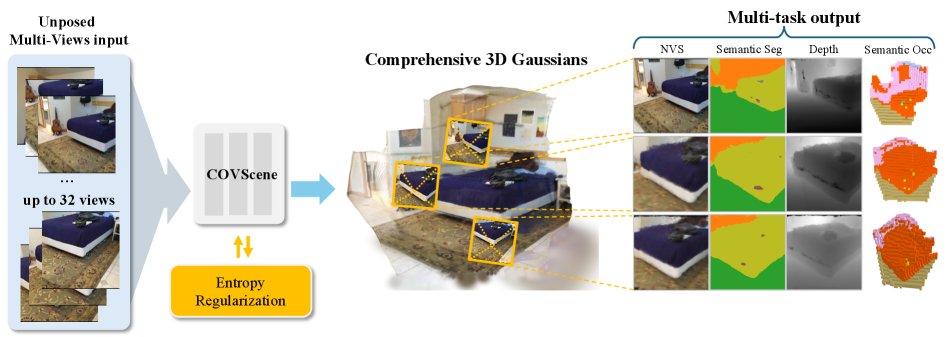
这篇论文要解决的不是单纯的 3DGS 重建,也不是常规 semantic occupancy prediction,而是一个更尴尬的交叉设定:输入是稀疏、未定姿图像,输出却要同时服务 NVS、open-vocabulary segmentation 和 dense semantic occupancy。关键矛盾在于,Gaussian splatting 天然是 surface/rendering-oriented representation,而 occupancy 需要 free-space reasoning 和体空间一致性。以前 pose-free Gaussian 方法卡在这里:只要投影到训练视角合理,模型就可以在 3D 中放置不物理的半透明 density、floaters 或 hollow structure;image-space loss 对这些错误不敏感。后处理 voxelization 不能解决这个问题,因为训练完的 Gaussians 已经学成了一个投影正确但体结构不一定正确的解。
Motivation
已有路线缺的是 train-time volumetric feedback,而不是又一个 occupancy 输出接口。semantic Gaussian 已经能把 CLIP/LSeg/SAM 类特征挂到 Gaussians 上,pose-free reconstruction 也能借助 DUSt3R/VGGT 类模型估计相机和深度,但这些信号大多仍停留在视图投影层面。作者的核心观察是:如果 occupancy 只是从 Gaussians 推出来用于评估,它对 Gaussian 参数没有反作用;而真正需要修的是 primitive placement、opacity 和 covariance。于是这篇论文把 occupancy 变成训练图里的 regularizer,让体空间的 free/occupied prior 直接塑形 Gaussian 表示。
Core Idea
核心思想可以概括为:不要把 3D Gaussians 当作只服务渲染的 surface primitives,而要把它们看作可以诱导出 dense volumetric field 的 latent carriers。COVScene 用可微 lifting 将每个 voxel 的 occupancy 定义为局部 Gaussians density 的 transmittance-style accumulation,同时用 density-weighted semantic feature aggregation 得到 voxel feature。这样 occupancy loss 不作用在一个独立 voxel head 上,而是反向更新同一批 Gaussian 的 center、scale、rotation、opacity 和 semantic embedding。
这个建模方式引入的 inductive bias 是“可渲染表面必须同时解释体空间占据状态”。相比 prior,它重新组织了信息流:2D rendering / semantic alignment 提供可见表面监督,geometry teacher 提供 unposed scaffold,volume lifting 把这些 surface primitives 拉回到 3D 空间中接受 free/occupied regularization。它理论上更 generalizable 的原因不是 occupancy 本身,而是 feed-forward Gaussian 表示仍保留跨场景预测能力,同时体空间 prior 在训练时约束了解空间,减少了未观测区域的等价解。
Method
方法里真正关键的不是模块数量,而是三条约束链。第一,semantic-aware Geometry Transformer 解决未定姿输入下的几何初始化问题;没有这个 scaffold,后面的 Gaussian-volume coupling 没有稳定坐标系,ablation 也显示去掉 pose distillation 后几何几乎崩掉。第二,differentiable volumetric lifting 把 Gaussian set 映射为 occupancy probability 和 voxel semantic feature;它的必要性在于让 occupancy 不再是 detached evaluation product,而是能反向塑形 Gaussian primitives 的中间表示。第三,occupancy entropy regularization 不是监督语义 occupancy,而是在 induced occupancy field 上施加 bimodal physical prior,压制 0.5 附近的模糊密度。photometric loss 和 semantic feature alignment 则维持 NVS 与 open-vocabulary querying;它们重要但不是本文相对 prior 的本质新增。
Key Insight / Why It Works
最可能有效的核心贡献是 train-time Gaussian-volume coupling,而不是 open-vocabulary feature rendering。rendering loss 的问题是视角投影下多解太多,尤其 sparse/unposed 输入下,错误 3D density 仍能产生合理 RGB/feature map;volume lifting 加 entropy prior 相当于给这个解空间加了一个低熵物理约束,使 primitive 更倾向于形成明确 occupied/free 区域。这个 bias 对 floaters 和 hollow artifacts 有直接约束,因此比后处理 voxelization 更合理。
但需要直说:方法的几何能力很大一部分可能来自 VGGT distillation,而不是 occupancy regularization 自己学会了 3D。去掉 pose distillation 后性能大幅崩溃,说明 foundation geometry teacher 是核心支柱。open-vocabulary 部分也主要是 representation alignment:把 2D language-aligned feature 蒸馏到 Gaussian/voxel feature field,再通过 text embedding similarity 查询;这不是新的语义推理,更像已有 2D/3D feature lifting 的组合。occupancy entropy 本身只是 sharpen prior,不知道哪里该 occupied,只会把已有不确定性推向 confident state;如果前面的 geometry scaffold 错,它也可能 confidently wrong。增益中哪些来自 volumetric coupling、哪些来自 VGGT、数据规模、multi-task training,文中归因仍不完全干净。
Relation To Prior Work
它最接近 LSM / Uni3R / AnySplat / semantic 3DGS / GaussianOcc 这些路线的交叉点。和 pose-free Gaussian reconstruction 相比,本质差异是从 surface-centric rendering representation 变成 occupancy-grounded Gaussian representation;和 semantic Gaussian 相比,差异不是挂了语言特征,而是语言特征和 occupancy 都由同一批 Gaussians 诱导;和 voxel-centric occupancy prediction 相比,它不是直接预测 dense voxel grid,而是从 feed-forward Gaussians lift 出 occupancy。
看似新的部分有不少是已有思想重组:CLIP-style feature alignment、foundation model distillation、entropy minimization、Gaussian density accumulation 都不是新概念。实质创新在于把这些放进同一条可微闭环,使 occupancy regularization 直接更新 renderable Gaussians。它属于“generalizable Gaussian reconstruction + foundation geometry prior + volumetric regularization”的技术谱系,而不是一个纯 occupancy model 或纯 open-vocabulary 3D model。
Dataset / Evaluation
评估覆盖了 NVS、open-vocabulary segmentation 和 semantic occupancy,能较好对应论文的 multi-task claim。ScanNet / ScanNet++ 的跨场景设置比单场景 optimization 更有说服力,也能检验 feed-forward generalization。但它仍主要是静态室内 benchmark,没有真实机器人在线部署、动态场景或大范围开放环境验证。
最支持核心 claim 的证据是 post-voxelization 对照:同样把 Gaussians 转 occupancy,只在 evaluation 做明显弱于 train-time lifting,这说明改进不只是输出格式变化。occupancy 与 SelfOcc 的差距说明弱监督设置下有收益,但与 fully supervised 方法差距仍大,不能解读成已解决 semantic occupancy。文中未充分说明 occupancy pseudo annotation 构造、grid resolution、threshold、类别 vocabulary 对结果的影响,这些都可能影响 semantic occupancy mIoU。整体 evaluation 支持“volumetric feedback 有用”,但不足以证明开放域泛化或真实物理可用性。
Limitation
第一,方法成立强依赖 geometry foundation distillation。论文表述是无外部 SfM / no voxel labels,但实际上几何 teacher 提供了强先验和隐式监督;如果 teacher 在目标域失效,COVScene 很可能跟着失效。第二,entropy regularization 只鼓励低熵,不保证正确拓扑、正确尺度或真实 free space;它可能把错误几何变得更 confident。第三,dense lifting 的计算和内存上限明显,尤其当场景尺度、Gaussian 数量、voxel 分辨率增加时,top-k support 只是工程折中。
第四,open-vocabulary semantic occupancy 的真实性需要谨慎。语义来自 2D vision-language feature alignment,本质上更像跨视角 feature aggregation,而不是 3D 语义推理;小物体、遮挡物体、未见区域的语义可能主要依赖数据分布和 benchmark prior。第五,增益来源不清:VGGT 初始化、ScanNet 数据覆盖、多任务训练、volumetric coupling 都可能贡献较大,当前 ablation 还不足以完全隔离。第六,真实 deployment 中相机轨迹噪声、动态物体、在线增量更新、闭环一致性都没有被验证。
Takeaway
- 1. 值得记住的不是“Gaussian 可以做 occupancy”,而是 occupancy 必须进入训练闭环,才能反向约束 renderable primitives。
- 2. 对 sparse/unposed 3D reconstruction,单纯 image-space supervision 已经到瓶颈,下一步关键是给 representation 加体空间物理先验。
- 3. foundation geometry model 正在变成这类 feed-forward 3D 系统的隐式 SfM;未来论文需要更诚实地区分模型创新和 teacher prior。
- 4. 可迁移的 insight 是:如果一个显式 representation 同时服务 rendering 和 reasoning,那么 reasoning-side 的约束应当直接作用于同一个 latent carrier,而不是接一个 detached head。
一句话总结
COVScene 是一篇把 pose-free semantic Gaussian 从“可渲染表面表示”推进到“由体空间反馈约束的统一 3D 表示”的工作,真正贡献在于训练时 Gaussian-volume 闭环,而非单纯增加 open-vocabulary 或 occupancy 输出。