精读笔记
Problem Setting
论文实际处理的是 few-step diffusion distillation 的机制归因问题,而不是加速采样或提升图像质量。few-step student 的质量差距通常被压缩成 FID、CLIP 或人评标量,但这些标量无法告诉我们退化发生在文本条件注入、latent trajectory,还是 score prediction;更无法区分这是 architecture effect、prediction-type effect,还是 distillation objective effect。真正困难点在于这些因素在公开模型里高度纠缠:UNet/DiT/MMDiT、CLIP/T5 conditioning、epsilon/velocity/rectified-flow prediction、ADD/LCM/DMD/Hyper 等 recipe 往往同时变化。该论文试图建立一个“响应坐标系”,让同一个生成输出分布被拆成几个机制轴来读。
Motivation
已有路线缺的是可归因的诊断工具。FID/CLIP 适合报告端到端质量,但不适合回答研究者真正关心的问题:student 是丢了 prompt sensitivity,还是 latent dynamics 被蒸馏改写,还是 score head 对扰动变钝?作者的核心观察是 forward pass 的不同层位天然对应不同功能角色:prompt hidden state 更接近条件通道,denoiser input 更接近状态/trajectory parameterization,denoiser output 更接近训练目标约束下的 score/velocity response。如果在这些层位施加受控扰动,并用同一统计量读取输出分布变化,就可能把原本混合在一个质量数字里的因素拆开。关键缺口不是“更多 benchmark”,而是“能跨 backbone 对齐的机制读数”。
Core Idea
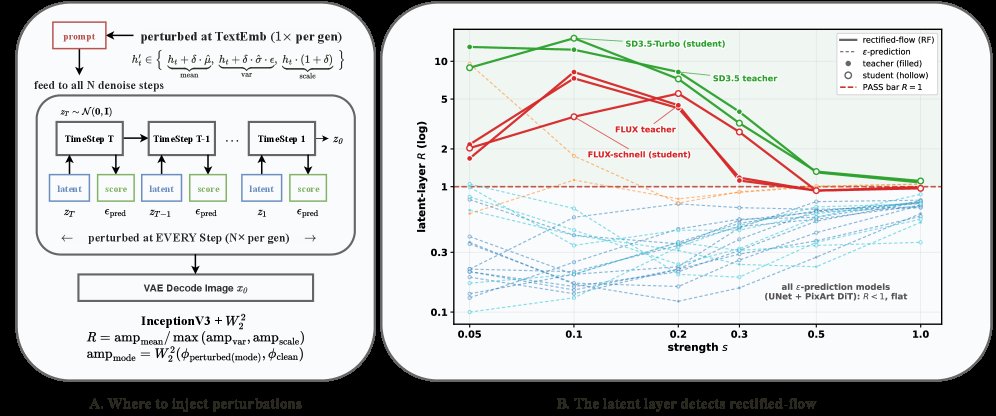
核心思想是把 diffusion model 当成一个可局部激励的系统来做 system identification:在 prompt、latent、score 三个位置分别注入 mean、variance、scale 三类扰动,然后看最终图像分布相对 clean 分布的 Bures-W2 响应。它关心的不是扰动后图像好不好,而是哪种统计方向的扰动在某个层位最能改变输出分布。selectivity ratio 本质上是在问:该层对 distribution mean shift 是否比对 variance/scale shift 更敏感。
这和 prior 的本质区别是评估对象变了:不是用一个标量评估生成器整体质量,而是构造一个 layer-mode resolved fingerprint。这个 fingerprint 引入的 inductive bias 是“不同机制因素会在不同 injection layer 上显影”。如果这个假设成立,probe 就比 end-to-end metric 更可扩展:它不依赖具体 architecture 的模块命名,只需要找到文本编码器 hidden state、denoiser input、denoiser output 这三个语义位置;也不依赖训练 recipe 可见,因为它从响应行为反推 recipe 痕迹。
Method
方法上真正必要的部分只有几件事。第一,三层注入解决因果混叠:prompt layer 用作 sanity channel,latent layer 读 prediction type,score layer 读 distillation objective;没有这个分层,RF 指纹和 ADD 指纹会被同一个输出分布距离混在一起。第二,mean / variance / scale 三种扰动不是为了模拟真实噪声,而是为了构造统计对照:如果 mean perturbation 相比 higher-moment perturbation 更能移动图像分布,说明该层存在 mean-selective response。第三,ratio 而不是 raw distance 是为了降低模型整体敏感度、分辨率、feature scale 对跨模型比较的影响。第四,bootstrap-median true Bures-W2 是为了让 point estimate 和 CI 来自同一统计对象;在 n 与 feature dimension 接近的 regime 下,plug-in covariance functional bias 不可忽略。这里最重要的是 matched estimator,而不是某个具体强度或 hook 实现。
Key Insight / Why It Works
最有价值的 insight 是:不同层位确实读出了不同机制轴,而不是同一个质量退化的三个 noisy proxy。prompt layer 几乎对所有模型都 mean-selective,因此它不是 discriminator,而是 sanity check;这反而说明 probe 没有把所有层都强行解释成有用信号。latent layer 的 sustained band 最可能是核心贡献,因为它把 rectified-flow / epsilon-prediction 这个 parameterization 差异显著投影到了 denoiser input response 上。直觉上,RF/flow-matching 学到的是从噪声到数据的 velocity field,latent state 的 mean shift 更直接改变 trajectory geometry;epsilon-prediction UNet/DiT 对同类 mean perturbation 的输出分布响应则更容易被噪声预测和 scheduler 结构吸收或压平。
score layer 的 ADD 低响应更像 objective fingerprint:adversarial-dominant distillation 可能把最终 perceptual distribution 对局部 score perturbation 的 mean selectivity 压低,使 score output 更像被对抗目标塑形后的压缩接口。trajectory-rollout early spike 也合理:这类 loss 直接约束短轨迹一致性或 backward simulation,因此小扰动下的 score response 会在早期强度处局部放大。但这里我会更谨慎:score-layer 发现很可能混有 step count、scheduler、student capacity 和 objective 的共同效应,不应被读成干净的 paradigm taxonomy。
这篇论文不是 scaling paper,也不是通过更多数据得到更好生成质量;它的贡献更接近 better diagnostic inductive bias。可能只是 engineering 的部分包括 forward hook grid、strength sweep、表格 release;真正的新东西是把 perturbation response 组织成可比较的机制坐标,并证明至少在这个 sweep 中该坐标能分离 prediction type 与 distillation objective。
Relation To Prior Work
它最接近三条线:generative model metrics、few-step diffusion distillation、inference-time intervention / probing。和 FID/CLIP/IS/Vendi 这类 metric 的差异在于,它不试图给模型一个质量分,而是给模型一个机制响应剖面。和 ADD、LCM、DMD、Hyper-SD 等 distillation work 的关系也不是提出新蒸馏算法,而是把这些算法在 student 中留下的行为痕迹拆出来。和 PAG、FreeU、AYS 等 test-time intervention 的相似点是都通过 forward path 操作模型;本质差异是这里的 intervention 不用于改善采样,而用于诊断。
看似新的部分里,controlled perturbation、本征 feature distance、bootstrap CI 都不是新概念;实质创新是组合方式:在统一 estimator 下跨 backbone、prediction type、distillation paradigm 做 layer-mode response mapping。该工作属于“mechanistic evaluation / behavioral fingerprinting for generative models”的谱系,而不是 diffusion architecture 或 sampler design 的谱系。真正新增的信息是:latent input response 可能是 prediction parameterization 的稳定读数,score output response 可能携带 distillation objective 的痕迹。
Dataset / Evaluation
评估覆盖 23 个公开 T2I checkpoints,包含 SDXL、SD1.5、SD3.5、PixArt-α、FLUX,横跨 UNet、DiT、MMDiT,以及多个 distillation paradigm。这个 sweep 对论文核心 claim 是基本够用的,尤其是 PixArt-α 作为 T5-conditioned epsilon-prediction control 很关键,否则 RF 指纹很容易被误读为 wide T5 conditioning。FLUX 28/50 step 一致也帮助排除简单 step-count artefact。
但 evaluation 仍是机制归因,不是严格因果实验。公开 checkpoint 的变量无法完全正交控制;non-UNet student 太少,RF 只有 ADD student,没有 non-ADD RF student,因此 latent conclusion 比 score conclusion 更强。MS-COCO caption bank 和 Inception feature Bures-W2 只验证图像分布响应,不验证真实 deployment 下的用户 prompt、多风格 prompt、长文本 compositionality 或 failure modes。CI 主要是 prompt resampling CI,不是 full uncertainty。benchmark 支持“在该 sweep 下可分离”,不支持“普适 detector”。
Limitation
方法成立依赖几个强前提。第一,三个 injection site 必须在不同 backbone 间语义可对齐;对更复杂的 multi-encoder、多阶段、adapter-heavy pipeline,这个前提可能变弱。第二,Inception feature Gaussian Bures-W2 必须足以承载这些响应差异;如果某些机制只体现在 text-image alignment、layout、fine-grained attributes 或 diversity tail,当前 metric 可能看不见。第三,公开模型 sweep 中 prediction type、训练数据、scheduler、normalization、guidance/distillation lineage 仍有共变,文中未充分说明如何完全排除这些 hidden confound。
scalability 上限也明确:这是白盒 probe,需要权重和 forward hooks;它不能做 image-only attribution。它的泛化并没有真正证明,只是在 public checkpoint grid 上表现稳定。score-layer claim 尤其依赖 step-matched comparison;跨 step 直接比较会把 objective effect 和 NFE effect 混在一起。所谓“score layer reads distillation objective”目前更像一个有用经验读数,而不是已建立的机制定律。增益来源不是数据或 scaling,但结论可信度高度依赖 sweep 设计是否覆盖了足够多的反事实模型;目前反事实还不够密。
Takeaway
- 最值得记住的不是某个具体 ratio,而是评估范式:few-step diffusion student 不能只用端到端质量标量读,应该用可分解响应指纹读。
- latent perturbation response 可能是区分 prediction parameterization 的强信号,这个 insight 可以迁移到 flow/diffusion hybrid、consistency model、video diffusion 的机制诊断。
- score-layer response 有潜力用于蒸馏 recipe auditing,但需要更密集的 non-UNet / RF / non-ADD 网格验证。
- 未来真正值得做的是把这类 probe 从 post-hoc analysis 变成 training-time diagnostic:如果某个 layer-mode fingerprint 能预测下游 collapse,就可以反过来约束 distillation。
一句话总结
这篇论文把 few-step diffusion 的评估从黑盒质量标量推进到白盒层位扰动指纹,真正贡献是证明 prompt、latent、score response 在一个公共模型 sweep 中可分别读出通用条件响应、prediction type 和部分 distillation objective 痕迹。