精读笔记
Problem Setting
这篇论文处理的是 Brownian Bridge Diffusion Models 在图像 inverse problem 中的 schedule design:BBDM 从 clean signal 桥接到 degraded observation,反向过程从观测 y 出发,因此 schedule 决定的是“从观测回到干净图像”的随机路径,而不是传统 diffusion 的 data-to-noise 路径。
真正困难点是:schedule 的影响不是局部的。它通过每一步 denoiser、bridge variance、reverse noise 累积到最终 reconstruction law。单 Gaussian prior 下可以把整个链写成 affine recursion;但 MoG prior 下,Bayes-optimal denoiser 是多个 affine posterior mean 的 state-dependent mixture,responsibilities 依赖当前 latent x_s。于是 oracle denoiser 虽然闭式存在,整条 reverse chain 却失去可组合的线性结构。
以前方法主要卡在两个层面:BBDM 原始 schedule 带有端点独立式 variance-preserving 直觉,但 inverse problem 里 x_0 与 y 显然相关;已有 analytical schedule design 多停留在 single Gaussian 或共同频域基假设,难以覆盖更真实的多模态 prior 和一般线性 degradation。关键矛盾是:MSE 希望 sampler 收缩到 posterior mean,perceptual quality 希望 sampler 保持 posterior spread;同一个 bridge schedule 不可能同时极致满足二者。
Motivation
作者的核心观察是:BBDM 的 schedule 本质上在塑造 conditional reconstruction distribution,而不是只是控制噪声强弱。若能写出 schedule 诱导的输出分布,就可以把 schedule search 从经验调参变成 posterior matching 或 distortion minimization。
缺口在于 BBDM 目前没有一个 method-agnostic 的 analytical lens 来回答“某个 schedule 最终到底改变了什么”。尤其在 inverse problem 中,观测 y 同时是条件信息和 bridge endpoint,传统 DDPM/DDIM 的噪声日程直觉不能直接迁移。作者选择 MoG 不是为了声称图像真的是 MoG,而是为了在比 single Gaussian 更丰富的多模态先验下仍保留 posterior closed form,从而暴露 schedule 与 posterior covariance 的关系。
这条路线的动机很清楚:如果 schedule 的主要作用可以归结为 covariance shaping,那么 distortion-perception tradeoff 就不再只是经验现象,而可以从 sampler-induced variance 的角度解释。
Core Idea
论文最核心的思想是把 BBDM schedule design 重写成“在 posterior component 内调节采样方差”的问题。MoG prior 给出真实 posterior:每个 component 内是 Gaussian,component weights 由 y 和 x_s 决定。精确 MoG denoiser 是合法的,但它让 reverse dynamics 非线性化。作者的 selected-label approximation 直接冻结这个离散不确定性:先从 measurement posterior p(C|y) 抽一个 label,然后整条 reverse chain 都使用该 component 的 posterior mean。
这个近似改变了建模方式:它不再追踪每一步 latent 对 component responsibility 的反馈,而是假设 measurement 已经提供足够强的 component identification。这样多模态性被保留在 mixture label 层面,连续 reverse dynamics 在每个 label 内恢复 affine Gaussian。新的 inductive bias 是“先做全局模式选择,再在该模式内做线性-Gaussian posterior refinement”。这比 single Gaussian 分析更 general,因为每个 component 可以有自己的 posterior basis,也不要求 degradation 与 prior covariance 共享一个全局频域基。
理论上它可能有效的原因是:在高维、component separation 足够强时,p(C|y) 往往接近 one-hot;沿着 frozen-label chain,状态仍落在该 component 高责任区域,exact MoG denoiser 与 frozen denoiser 的差异变小。于是 schedule 对最终 law 的主导影响确实来自 component-wise covariance deficit,而不是 label switching。
Method
1. MoG posterior / MMSE denoiser:它解决的是“BBDM 理想 denoiser 在多模态 prior 下是什么”。作者推导 p(x_0|x_s,y) 仍是 MoG,component posterior mean 是 affine,weights 是 state-dependent。必要性在于先建立 oracle baseline;核心变化是把 denoiser 的非线性明确定位到 responsibilities,而不是均值估计本身。
2. Loss of global affinity:这一部分的价值是负结果。把 exact MMSE denoiser 放入 BBDM reverse update 后,系数依赖 γ_{r|s}(x_s,y),不能像 single Gaussian 那样 unroll。它说明后续 surrogate 不是任意简化,而是为恢复可解析 reconstruction law 必须切断 state-dependent label feedback。
3. Selected-label surrogate:先按 γ_{r|y}(y) 选 label,再固定 label 运行反向链。它解决可解析性问题,同时保留 measurement posterior 的 mixture uncertainty。核心变化是从“每步重新软分配 component”变成“每个样本一次性选择 component”。这会牺牲部分 posterior covariance,但换来 component-wise affine recursion。
4. Component-wise basis:对每个 component 的 Σ_{r|y}^{-1} 对角化。由于 Σ_{r|s}^{-1}=Σ_{r|y}^{-1}+scalar·I,所有 step covariance 在同一 component basis 下同时对角化。这个机制消除了 shared global basis 假设,使一般 H 和 component covariance 可被纳入分析。
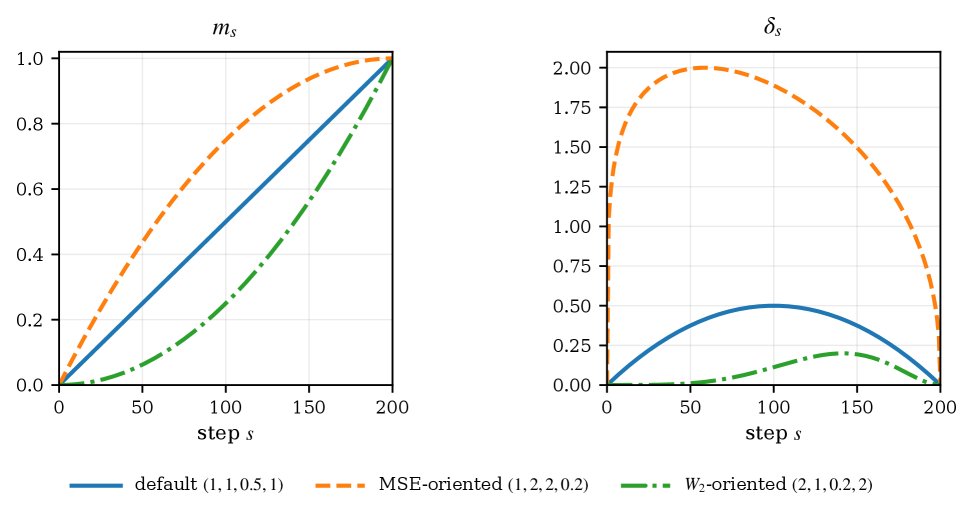
5. Schedule objectives:mean-exactness 证明输出均值等于 μ_{r|y},covariance deficit 证明输出方差不超过 posterior covariance。于是 W2 objective 只需让 sampler std 接近 posterior std;MSE objective 则惩罚 sampler variance 本身。核心变化是把 schedule design 转成每个 eigen-direction 的方差目标,而不是黑箱指标搜索。
Key Insight / Why It Works
最重要的 insight 是:BBDM schedule 的主要可控自由度不是“生成质量”本身,而是 posterior spread 的保留程度。selected-label surrogate 下,均值已经精确;剩下的误差全部落在 covariance。于是 MSE schedule 倾向把输出压向 posterior mean,W2 schedule 倾向恢复 posterior variance。这给 distortion-perception tradeoff 一个非常干净的 sampler-side 解释。
我认为真正的核心贡献是 covariance-deficient view:BBDM reverse chain 在使用 posterior mean denoiser 时天然会低估 posterior uncertainty;schedule 只能在 0 与 posterior covariance 上界之间调节采样方差。这个结论比具体四参数 schedule 更有迁移价值,因为它解释了为什么同一模型换 schedule 就能沿 PSNR/FID 两端移动。
selected-label approximation 是关键但也是最脆弱的一步。它本质上假设 discrete mode uncertainty 可以由 y 一次性解决,后续 latent 不需要重新修正 label。这个假设在高维分离 MoG 中合理;在真实图像中是否成立,文中只能间接支持。若 posterior 是多解且 mode ambiguity 需要逐步消解,冻结 label 可能低估真正的 mode switching 行为。
哪些部分可能只是 engineering / scaling:FFHQ 上的 MSE/W2 schedules 实际是 MoG-free edge heuristics,不是从真实图像 MoG posterior 直接优化出来的。因此真实图像增益很可能主要来自改变 reverse stochasticity 的强弱,而不是高维 MoG surrogate 精确建模。换句话说,理论解释了方向,但实验中的 schedule 选择有相当一部分是低维参数族边界搜索/启发式。
这不是 retrieval、memory reuse 或 test-time compute 方法;它更像 better inductive bias for sampler design。它把 schedule 从不可解释的训练/采样超参数,变成一个控制 posterior covariance 的旋钮。
Relation To Prior Work
最接近的是三条线:BBDM / stochastic bridge,inverse-problem diffusion,以及 Gaussian analytical schedule design。和 BBDM 原作相比,这篇不是提出新 bridge architecture,而是解释 bridge schedule 如何影响 reconstruction law。和 DPS/PiGDM/DDRM/RePaint 等 posterior/inverse sampling 方法相比,它关注的是 measurement 作为 bridge endpoint 时 schedule 的作用,而不是额外 guidance 或 measurement projection。
和 Benita et al. 的 single-Gaussian spectral analysis 最接近。真正新增的信息有两点:第一,从 single Gaussian 推到 MoG,显式处理多模态 posterior;第二,不要求 prior covariance 与 degradation operator 共享全局 diagonal basis,而是在每个 component 的 posterior precision basis 中分析。这是实质创新。
但也要说清楚:selected-label surrogate 本质上是“hard/early assignment + within-component Gaussian analysis”,这在 mixture model 语境下并不陌生;新意在于把它嵌入 BBDM reverse dynamics,并用它导出 schedule-level W2/MSE tradeoff。W2/MSE 对应 perception-distortion 的解释也不是新理论,但这里给出了 BBDM schedule 层面的闭式归因。
它属于 analytical diffusion design 的谱系,而不是 architecture-driven generative modeling。价值在于提供一个可迁移的分析框架:先找 tractable posterior,再写 sampler-induced law,再以 law matching 设计 schedule。
Dataset / Evaluation
实验覆盖了 controlled MoG、MNIST 和 FFHQ 上的 blur/super-resolution/inpainting,任务跨度足够支撑“schedule 控制 distortion-perception tradeoff”这一主张。合成 MoG 是最干净的验证:posterior 与 oracle chain 可得,因此能直接检验 selected-label approximation 和 objective trend。MNIST 用 fitted MoG 连接理论 surrogate 与 trained BBDM,验证 schedule ranking 而不是绝对误差,这个定位合理。
FFHQ 实验更接近真实图像,但也最弱。因为高维 MoG 不可行,作者没有真正用 J_MOG^W2 或 J_MOG^MSE 优化 FFHQ schedule,而是使用 Appendix F 的 MoG-free edge heuristic。结果确实呈现预期:MSE schedule 提升 PSNR/SSIM,W2 schedule 改善 FID/LPIPS。但这只能证明 heuristic direction 有效,不能证明 MoG surrogate 精确刻画真实图像 posterior。
conditional DDIM baseline 是有价值的,因为它说明默认 BBDM schedule 并不天然优于常规 conditional DDIM;BBDM 的优势需要合适 schedule 才显现。评价没有真实部署或真机问题,也没有复杂非线性/未知 degradation。benchmark 没有明显 leakage 风险,但 perceptual metric 仍是 FID/LPIPS 这类 proxy,不能完全证明 posterior matching。
Limitation
核心前提一:MoG prior 是分析工具,不是高维自然图像的可操作模型。真实 FFHQ 部分无法可靠估计 component covariance,因此理论目标与实际 schedule 之间断了一层。作者也承认未来需要直接优化 full schedule space 或找到高维 covariance criterion 的替代。
核心前提二:selected-label 依赖 measurement posterior 足够集中。高维 shared-covariance separated MoG 下可以证明,但真实 inverse problem 常常存在多个 plausible restorations;此时 label 可能不是一次观测即可固定,逐步 latent refinement 可能改变 mode belief。文中未充分说明在强 ambiguity 下该近似的失效边界。
核心前提三:分析把 denoiser 当作 Bayes-optimal/posterior mean,但训练好的 BBDM denoiser不一定等价于该 oracle。schedule 改变还会影响训练分布、网络误差、finite-step discretization,这些与理论 covariance shaping 混在一起。增益来源不清:FFHQ 上提升可能主要来自 schedule 改变输出方差,而不是理论 surrogate 的精确性。
所谓 universal schedule 需要谨慎理解。它是在受限四参数 bounded family 和 MoG-free variance-bound heuristic 下的边界方向,不是对任意 degradation/prior/full schedule space 的严格全局最优。尤其 W2-oriented schedule 文中更明确是 heuristic,而不是 certificate。
scalability 上限很明显:若要真正使用 MoG objectives,需要 posterior precision spectra λ_{r,k};这在高维图像上估计成本和统计可靠性都成问题。方法把一部分难题从 schedule search 转移到了 prior/covariance estimation。
Takeaway
- 1. 最值得迁移的观点:conditional diffusion / bridge sampler 的 schedule 可以被看成 posterior covariance controller,而不是简单噪声日程。
- 很多 restoration 方法的 distortion-perception tradeoff 可能都能用类似 sampler-induced variance 解释。
- 2. MoG 不是最终模型,而是一个分析中间层。
- 它的价值在于揭示 discrete mode selection 与 within-mode covariance shaping 的分工。
一句话总结
这篇论文把 BBDM schedule design 从经验调参推进到 posterior covariance shaping 的分析框架,真正贡献是用 MoG + selected-label surrogate 揭示 bridge schedule 如何控制 distortion-perception tradeoff。