精读笔记
Problem Setting
这篇论文实际处理的是 STAD 中最容易被低估的部分:不是单帧能不能检测到人,也不是 backbone 能不能编码视频,而是 frame-level evidence 如何被组织成稳定的 actor tube,并且 tube 的时间边界如何不碎。真正困难点在于 STAD 的误差是级联的:box jitter 会污染 actor token,slot mismatch 会破坏 temporal state,actionness 的局部波动会导致 tube fragmentation,最终 video-mAP 大幅下降。以前方法常用 heavy spatio-temporal transformer、3D backbone、optical flow 或离线 tube linking 来补这个问题,但这些路线要么算力重,要么把 association 错误留给后处理。关键矛盾是:STAD 需要跨时间一致性,但 dense global temporal modeling 对 actor 数有限、短 clip、部署友好的场景可能是过度建模。
Motivation
作者的核心动机是反对一个默认假设:video-level STAD 的主要瓶颈一定是更强的时空视觉表征。论文更像是在说,很多失败来自 representation organization,而不是 representation capacity。已有路线缺的是一种便宜但结构化的 tube prior:检测框要连续,actor 表征要围绕同一实例积累,动作边界要被显式监督,而不是期望 transformer 自己从 dense tokens 中学出来。这个方向的合理性在于 UCF101-24 和 MultiSports 的动作通常发生在少数 actor 上,局部连续性和 boundary alignment 比全局 long-range attention 更直接地对应评价指标。换句话说,TubeLite 的动机不是“更轻的 transformer”,而是“少做 dense 时空建模,把预算花在 tube 稳定性上”。
Core Idea
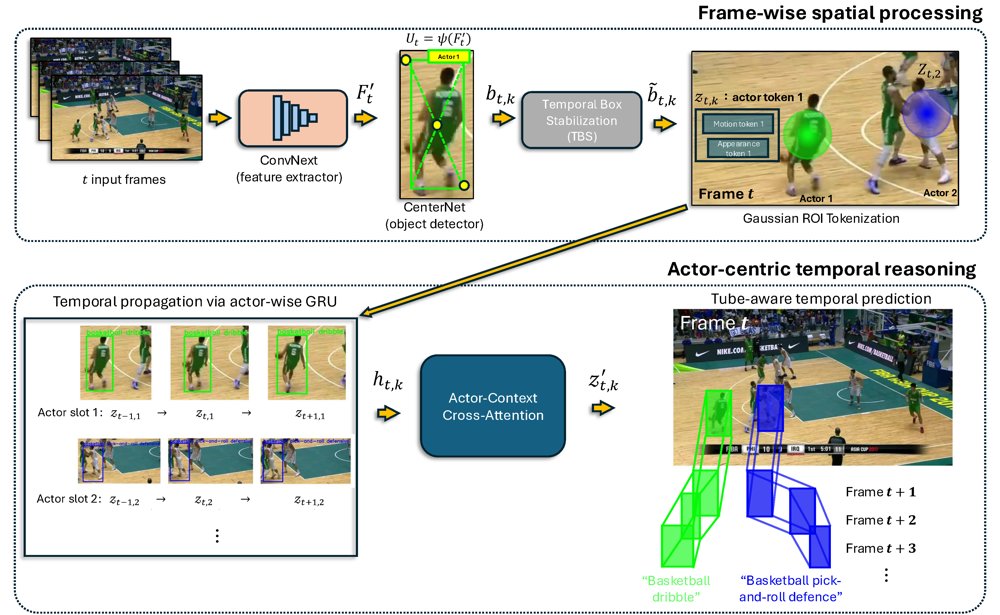
TubeLite 的核心思想是把 STAD 从 frame-wise detection + post-hoc linking,或 dense spatio-temporal attention,改成 actor-centric tube state estimation。每个 actor slot 是一个短期 tube proxy:空间上由稳定检测框锚定,表征上由 Gaussian ROI token 提取局部证据,时间上由 GRU 维持状态,输出上由 boundary-aware head 直接对齐动作区间。这个建模改变了信息流:先压缩到 actor token,再做时间传播,而不是在所有空间位置和所有帧之间做昂贵交互。
这个设计的 inductive bias 很强:同一 actor 的局部连续轨迹是 STAD 的主结构,跨 actor/global context 只是辅助信号。相比 transformer-heavy prior,它牺牲了任意 token 交互的表达力,换来更低计算、更少噪声传播和更直接的 tube-level optimization。理论上它不会在需要复杂长期关系推理的任务上占优,但在短窗口、多 actor 但 actor 数有限的 action tube benchmark 上,这个 bias 很可能更接近任务本身。
Method
关键机制可以压缩成几条。第一,低抖动 detector + temporal box stabilization 解决的是 actor anchor 不稳定的问题;它的作用不是提升单帧检测上限,而是降低后续 token extraction 的输入噪声。第二,Gaussian ROI tokenization 解决的是 actor 表征对 box jitter 和背景污染敏感的问题;用软局部池化替代硬 ROI 或 dense attention,本质上是在做 spatial low-pass filtering。第三,feature residual motion cue 解决的是不用 optical flow 时缺少短期动态的问题;它可能是廉价 motion prior,而不是强运动理解。
第四,actor-wise GRU 解决的是同一 slot 的时间记忆问题;它带来的核心变化是把 temporal modeling 限定在 actor tube 内,减少 crowded scene 中早期 cross-actor mixing 导致的 identity drift。第五,actor-context latent token 解决的是完全独立 actor state 缺少 frame-level context 的问题;它是低秩/瓶颈式 interaction,而不是 full relation modeling。第六,boundary-aware temporal head 和 tube loss 解决的是 video-mAP 真正关心的 segment coherence;这部分把训练目标从“每帧分类正确”推向“tube 的开始、结束和 actionness 连续”。
Key Insight / Why It Works
最可能的有效来源是更好的 inductive bias,而不是 scaling。TubeLite 把 STAD 中高维、稀疏、噪声大的 dense video modeling 问题,转成少量 actor slots 上的短期状态估计问题;这会显著降低优化难度和噪声传播。对于 actor 数小、动作片段较短、标注以 tube 为核心的 benchmark,actor-centric smoothing + boundary supervision 直接打中 video-mAP 的弱点,因此能在不提升 frame-mAP 上限的情况下提升 video-mAP。
最核心贡献可能不是某个模块,而是组合后的优化对齐:Gaussian ROI 让 actor token 稳,GRU 让 token history 稳,tube loss 让 box/actionness 稳,boundary head 让时间端点稳。这是一套围绕“减少 fragmentation”的机制。actor-context cross-attention 的消融掉点最大,但这里增益来源不清:它可能确实提供了 multi-actor context,也可能只是作为额外 capacity / regularizer / learned dataset prior 在起作用。Temporal losses 的作用更可信,因为其提升主要体现在 video-mAP 而非 frame-mAP。
哪些可能只是 engineering:ConvNeXt-Tiny + CenterNet、shared conv tower、log-space box regression、AMP、固定 loss weights 都不是概念创新;TBS 也是经典 smoothing。真正有迁移价值的是把 temporal action detection 的 boundary supervision 移植到 actor-conditioned tube 上,并用轻量 recurrent state 替代 dense temporal attention。它本质上不是 retrieval、不是 test-time compute,也不是明显的 data scaling;更像 latent structure + representation alignment + task-metric alignment。需要警惕的是,若 clip overlap、boundary aggregation、post-processing 没有充分公开,video-level gain 的一部分可能来自 evaluation pipeline engineering。
Relation To Prior Work
TubeLite 最接近三条谱系的交叉:CenterNet/YOWO/MOC 这类 anchor-free action detector,TubeR/MeMViT 这类 tube/transformer STAD,和 BSN/BMN/ActionFormer 这类 boundary-sensitive temporal localization。它的本质差异不是提出了全新算子,而是拒绝用 dense spatio-temporal attention 来解决 tube instability,改用 actor slot 上的局部状态传播和显式边界监督。
看似新的部分大多是已有思想重组:Gaussian attention 来自 A2-Nets,GRU 是经典 recurrence,latent bottleneck/cross-attention 类似 Perceiver/ViT pooling,Hungarian/Sinkhorn assignment 来自 DETR/OT,boundary losses 来自 temporal proposal literature。实质创新在于组合的位置:这些机制被放在 actor tube 这个中间表示上,而不是 image proposal、video patch 或后处理 tracking 上。它属于“structured lightweight STAD”路线:用任务结构先验替代模型规模。
Dataset / Evaluation
评估主要覆盖 UCF101-24 和 MultiSports,二者确实能检验 action tube stability:UCF101-24 有动作边界和相机运动问题,MultiSports 有多 actor 和快速运动。结果中 video-mAP 的提升比 frame-mAP 更突出,基本支持作者关于 temporal coherence / boundary localization 的主张。但这仍是离线 benchmark 证据,不是真实部署证据;H100 上的 runtime 也不能直接说明边缘端实时性。
评估的 limitation 很明显。第一,benchmark actor 数有限,K=5 的 fixed slot 假设没有被真正挑战。第二,clip-based inference 使用未来上下文,和 online STAD/监控场景存在鸿沟。第三,文中没有充分展开 clip 间 tube stitching、overlap inference、NMS/thresholding 等细节,而这些会显著影响 video-mAP。第四,没有 AVA 或更长时、多标签、弱边界场景,无法证明该机制是通用 STAD 解法。当前实验更能证明“在这类 tube benchmark 上,轻量结构化 temporal smoothing 很有效”,而不是证明它替代了通用 spatio-temporal reasoning。
Limitation
最深层限制是 TubeLite 把问题从 heavy temporal modeling 转移成 actor slot stability 问题;如果 slot 不稳定、actor 数超出上界、遮挡导致 identity 长时间断裂,后续 GRU 和 tube loss 只会平滑错误。固定 K 适合 UCF101-24/MultiSports,但对 crowd scene、开放世界视频和动态进入/退出频繁的场景上限明显。TBS 使用 t+1 帧,本质上不是 causal;严格 online 部署需要重写这部分,性能是否保持未知。
另一个限制是长时建模能力。GRU 在 16-frame clip 内足够便宜,但它没有真正跨 clip memory;所谓 long-range temporal modeling 在文中其实很有限。对需要长期意图、复杂交互、事件级上下文的动作,TubeLite 可能只是稳定了局部证据,并没有形成高层 temporal reasoning。增益归因也不够干净:actor-context cross-attention、Sinkhorn consistency、boundary aggregation、overlap clip inference 的贡献没有被完全拆开。文中未充分说明这些工程选择是否对最终 video-mAP 有关键影响。
Takeaway
- 最值得记住的第一点:STAD 的轻量化不一定要从压缩 transformer 开始,可以从重新定义中间表示开始;actor tube 是比 dense video token 更贴合指标的计算单位。
- 第二点:video-level mAP 的提升往往来自减少 fragmentation,而不是提升单帧分类能力;因此 boundary-aware supervision 和 tube smoothness 是高性价比工具。
- 第三点:对 actor 数有限的任务,强 inductive bias 可能比大规模全局 attention 更有效、更可控。
- 第四点:未来真正值得做的是动态 slot allocation、跨 clip memory、causal stabilization,以及更干净地分离 temporal smoothing、identity association 和 boundary estimation 的贡献。
一句话总结
TubeLite 是一篇把 STAD 从重型 dense 时空建模拉回到 actor-centric tube 稳定化的工作,真正贡献在于用结构化轻量先验对齐 video-level tube localization,而不是提出新的通用视频表征模型。