精读笔记
Problem Setting
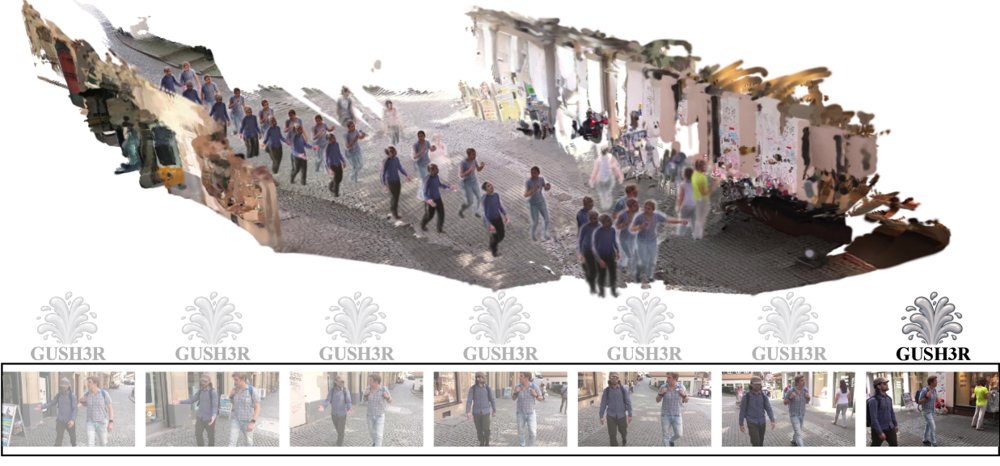
GUSH3R 处理的是 monocular video 下的 dynamic human-scene reconstruction,但它真正瞄准的不是“恢复人体和场景”这个宽泛任务,而是把二者恢复成同一坐标系中可实时渲染、可持续累积的 3D Gaussian representation。难点在于三个约束同时成立:camera/scene geometry 要跨帧一致,human 是非刚体且多人动态,输出还必须 photorealistic enough for NVS。已有路线通常只能满足其中两项:优化式 NeRF/3DGS 有画质但每场景优化慢;feed-forward geometry 有速度但输出 point/mesh 不够 renderable;human-scene reconstruction 有人体结构先验但 scene/human 表示异构。关键矛盾是:如何在不做 per-scene optimization 的情况下,把强几何 prior 转成足够好的 radiance representation,同时不让动态人体污染静态场景。
Motivation
作者的核心观察是,Human3R 这类 human-scene foundation model 已经把最难的结构问题——camera、scene points、human detection、SMPL-X pose、person tokens——做到了可用水平,但它输出的是几何 scaffold,不是可渲染世界。另一方面,AnySplat/VGGT 系列说明 feed-forward 3DGS 可以从强几何 prior 中获益,但它们默认场景静态,遇到动态人体会把 motion 当作几何噪声。真正缺的是一个把“动态人体结构先验”和“静态场景 Gaussian splatting”接起来的中间层:既不重新优化整场景,也不把人和背景分开重建再硬拼。GUSH3R 的动机因此很明确:利用 Human3R 的结构化中间表示作为 low-entropy bottleneck,把 photorealistic rendering 问题降维成 Gaussian attribute prediction。
Core Idea
核心思想是:不要从视频直接学习完整 4D radiance field,而是先用 pretrained human-scene model 决定几何和语义分解,再在这些几何锚点上预测 Gaussian appearance/shape 参数。scene Gaussians 锚定在 point map 上,human Gaussians 锚定在 SMPL-X canonical vertices 上;二者最终被放回同一个 metric space 渲染。这样做改变了建模方式:动态性不再由通用 deformation field 或 time-conditioned radiance field 承担,而由 SMPL-X/LBS 结构吸收;静态背景不再重复优化,而是 streaming voxel accumulation。
这个 inductive bias 很强,也很现实:人体被限制在人类 body prior 上,场景被限制在 feed-forward geometry prior 上,3DGS 只负责补 appearance 和局部可见性。和 prior 的本质区别不是“用了两个 decoder”,而是把 heterogeneous outputs——point cloud 和 parametric mesh——提升为同构 renderable primitives。它的 scalability 来自避免 test-time optimization;generalization 则主要来自复用 Human3R 和训练数据覆盖,而不是 GUSH3R 本身学到了通用 4D reasoning。
Method
关键机制一是冻结 Human3R,把它作为 geometry/state oracle。它解决的是 monocular dynamic scene 中几何歧义太大、直接训练 3DGS predictor 不稳定的问题;核心变化是把学习目标从“估计几何+外观”改成“在可信几何锚点上估计 Gaussian attributes”。这也意味着系统上限被 Human3R 明确锁住。
关键机制二是 scene Gaussian streaming accumulation。每帧 point map 生成背景 Gaussians,再用 confidence 和 human masks 去掉动态区域,并通过 voxelization 保持固定尺度的累积表示。它解决的是长视频 memory growth 和动态人污染背景的问题;核心变化是 scene 被当作一个随时间增量更新的静态 map,而不是 batch-level global reconstruction。
关键机制三是 human Gaussian canonicalization。人体 Gaussians 不直接放在 posed mesh 上学,而是以 SMPL-X canonical vertices 为 anchors,通过 LBS 变到当前姿态。它解决的是非刚体运动导致跨帧 appearance 无法对齐的问题;核心变化是把时间变化从 appearance learning 中剥离,转移到已知 body kinematics。
关键机制四是 cross-attention 和 memory token。cross-attention 把 image token 中的外观转移到 canonical body vertices;memory token 试图保留 person-level appearance。消融显示 cross-attention 是最关键的人体模块;memory token 增益较小,可能更多是 temporal smoothing,而非强长期身份建模。
Key Insight / Why It Works
这篇论文有效的主要原因不是某个 decoder 设计很新,而是它把表示对齐做对了:Human3R 给出的 scene points 与 SMPL-X vertices 已经处在同一 camera/metric coordinate frame,GUSH3R 只需把它们统一变成 Gaussians,就避免了 decomposition pipeline 中最脆弱的 alignment/compositing step。AnySplat+LHM 这类 baseline 即使用 GT pose,也仍然会有边界、遮挡、尺度和坐标拼接问题;GUSH3R 的收益很大部分来自“joint representation before rendering”,不是来自更强的人体生成能力。
最可能的核心贡献是:把 human-scene foundation model 的 structured latent/geometry prior 显式转成 3DGS primitives,并让 scene/human 在同一 renderer 中竞争可见性。这个机制直接针对 dynamic human-scene NVS 的失败模式:人体区域不再作为 scene outlier,背景也不再和 avatar 后期合成。
哪些部分可能只是辅助:depth loss、scale regularization、partial LPIPS、Motion-X++、DL3DV 都更像提升稳定性/覆盖度的工程项。DL3DV 在消融中增益很小;partial LPIPS 对常规指标影响有限;memory token 的增益也不强。真正不可替代的是 geometry anchor + cross-attention appearance transfer + unified Gaussian rendering。
从归因看,这不是纯粹的 scaling paper,但也不是完全 novel formulation。它更像 representation alignment paper:把已有 feed-forward geometry prior、SMPL-X human prior、3DGS renderer 以正确的信息流组织起来。泛化能力很可能主要来自 Human3R/DINOv2/Multi-HMR 以及训练数据覆盖;GUSH3R 本体学习的是 conditional Gaussian attribute prediction。文中未充分说明如果换掉 Human3R、减少 synthetic human data、或面对非 SMPL-X 可解释动态物体时还能保留多少能力。
Relation To Prior Work
它最接近三条路线的交叉:Human3R/HAMSt3R/JOSH3R 这类 feed-forward human-scene geometry,AnySplat/YoNoSplat 这类 feed-forward 3DGS,以及 HSR/Vid2Avatar/HUGS 这类优化式 human-scene radiance reconstruction。和 Human3R 的本质差异是输出从 point cloud + SMPL-X mesh 变成 unified renderable Gaussians;和 AnySplat 的差异是显式把动态人体从静态 scene 中剥离,并用 SMPL-X canonical prior 建模;和 HSR 的差异是用 learned prior 替代 per-scene optimization。
看似新的地方——scene decoder、人 decoder、memory token、voxelization——大多是已有思想重组。实质创新在于将这些模块放在一个 human-scene streaming pipeline 中,并利用 Human3R 的结构化 tokens/outputs 实现坐标一致的 Gaussian lifting。技术谱系上,它属于“foundation reconstruction model + structured neural rendering head”的演化,而不是传统 4D reconstruction 或 generative human avatar 的延伸。
Dataset / Evaluation
评估覆盖了 single-human、multi-human、static background、depth consistency,基本能验证论文的主 claim:在动态人体场景中,统一 feed-forward Gaussian 表示比后处理组合 baseline 更协调,并且比优化式方法快。但 benchmark 仍偏向人体重建常见数据分布,尤其 BEDLAM 是 synthetic-heavy 且与 Human3R 训练范式高度相关;NeuMan/EMDB 也不是非常开放的真实世界 deployment 场景。
实验最有说服力的部分是 decomposition baseline 即使使用 LHM 和 Human3R/GT pose 仍不稳定,说明问题不只是单个模块精度,而是 representation/composition mismatch。较弱的部分是:与 batch feed-forward scene methods 的比较显示 GUSH3R 在纯背景 NVS 上并不占优,这暴露了 streaming/joint modeling 的代价。FPS claim 成立,但不是实时;且 HSR 没有 FPS,optimization baseline 的速度优势只能定性理解。文中未充分验证长序列、多遮挡、多人身份交换、真实手机视频中的鲁棒性。
Limitation
最大前提是 Human3R 必须可靠。GUSH3R 没有真正解决 monocular dynamic reconstruction 的根本歧义,而是把歧义交给 pretrained geometry/human prior;当 camera pose、depth scale、human detection、SMPL-X fitting 或 ID matching 失败时,Gaussian head 没有机制纠正。换句话说,它把问题从 test-time optimization 转移到了 pretraining/data/prior quality。
第二个上限来自 SMPL-X anchoring。人体 Gaussian 被绑定在 canonical body vertices 上,这对裸人体/贴身衣物合理,但对宽松衣服、头发、手持物、人与物体接触、非人体动态物体都不是自然表示。所谓 dynamic human-scene reconstruction 实际是“SMPL-X-explainable humans + mostly static background”。
第三,scalability 不是无代价的。voxelization 控制 memory,但也可能丢掉细节和多观察一致性;streaming inference 无法像 batch AnySplat 一样全局利用多视角约束。长期视频中 camera drift 和 voxel merge error 会累积,文中未充分说明 loop closure 或 global correction。
第四,增益归因不完全清晰。训练依赖 BEDLAM、Motion-X++、DL3DV、GT mask、GT depth supervision;foundation backbone 冻结但本身很强。核心能力可能主要来自数据覆盖和 Human3R prior,而 Gaussian decoders 更多是在把 prior renderable 化。真实泛化是否超过 benchmark distribution,仍需要更硬的 out-of-domain evaluation。
Takeaway
- 第一,dynamic human-scene NVS 的关键不一定是更复杂的 4D field,而是先把人和场景放进同一可渲染表示,避免后期拼接。
- representation alignment 比单模块画质更重要。
- 第二,未来 feed-forward reconstruction 很可能沿着“foundation geometry model + task-specific rendering head”演化:几何由大模型/先验提供,渲染头负责把结构化中间表示变成 3DGS/mesh/radiance primitives。
- 第三,SMPL-X canonical Gaussian 是一个可迁移 insight:只要某类动态对象有稳定 canonical template,就可以把非刚体 NVS 降维为 template-anchored appearance prediction,而不是直接学 unconstrained 4D deformation。
一句话总结
GUSH3R 是把 Human3R 式 feed-forward human-scene geometry prior 升级为统一 3DGS 渲染表示的代表性工作,真正贡献在于 representation alignment 和 streaming Gaussian lifting,而不是发明新的动态重建范式。