精读笔记
Problem Setting
这篇论文不是在解决一般的 diffusion planning,而是在解决一个更具体也更尖锐的问题:只有短 horizon offline trajectories,但测试时需要完成长距离 start-goal navigation,并且还要经过指定 waypoints、保持整体 route 短。
真正困难点有两个层级。低层是 bridge search:短片段 diffusion model 可以生成局部可行动作/轨迹,但多个短片段拼起来后,搜索越多路径越可能短,搜索越少就容易得到可达但绕远的 bridge。高层是 route composition:waypoint ordering 需要比较 start / goal / waypoint 之间的 pairwise travel cost,但这些 cost 在没有地图、没有 roadmap、没有预计算 cost matrix 的 offline setting 中并不存在,只能边规划边估计。
以前方法卡在一个解耦假设上:diffusion planner 假设目标是生成可达长轨迹,routing / mTSP 假设 pairwise cost 已知。ChronoForest 处理的是两者都不成立的中间地带:cost 要通过 inference-time bridge search 才能显现,而 search budget 又应该由当前 route hypothesis 决定。
关键矛盾是:route ordering 需要 cost evidence,但 cost evidence 的获取本身代价高;如果盲目穷举所有 anchor pairs,计算爆炸;如果只相信 temporal distance,远距离误差会把 ordering 带偏。
Motivation
已有 diffusion-based long-horizon planners 大多沿着两个方向走:要么训练/采样更长序列,要么通过 compositional stitching 把短片段接起来。这些方法主要优化 plausibility、goal-reaching 或 sample efficiency,很少把“路径是否短”作为显式 route-level objective。它们可以成功到达,但成功路径可能不是 route-efficient。
Temporal distance / quasimetric representation 给了一个 reachability-aware heuristic,但作者的核心观察是:它适合局部 guidance,不适合直接当全局 cost oracle。尤其在 AntMaze 这类瓶颈拓扑里,远距离 temporal estimate 容易把局部可达性和全局最短路混在一起,导致 waypoint ordering 错。
另一方面,经典 mTSP / navigation-coupled routing 的缺口在于它们假设 cost matrix 已知。这里 cost matrix 是搜索产物,不是输入。于是问题不再是“给定 cost 后求最优 route”,而是“在有限 edge-evaluation budget 下,边估 cost、边重排 route”。
所以 ChronoForest 的动机可以概括为:缺的不是更强的单次生成,而是一个闭环机制,把局部 bridge evidence 转化成全局 route correction,再把全局 route uncertainty 转化成下一轮局部搜索预算。
Core Idea
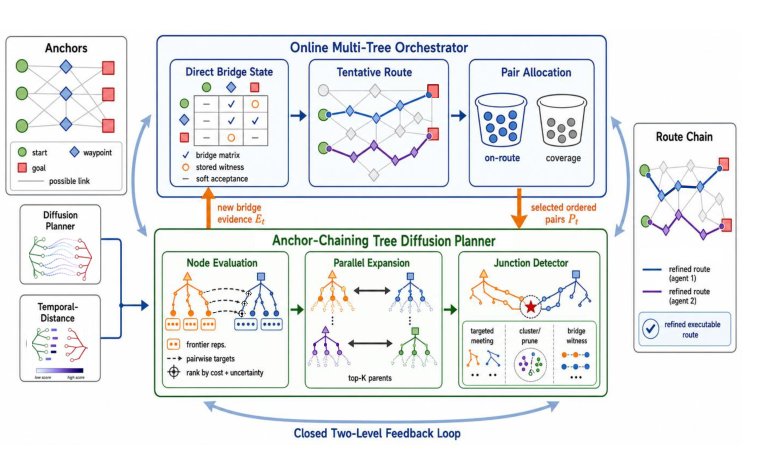
ChronoForest 的核心思想是把长程 offline navigation 重写成 closed-loop expensive-edge evaluation problem。每个 anchor pair 的真实 cost 不预先存在,而是由多树 diffusion bridge search 在测试时逐步揭示;高层 route solver 不等待完整 cost matrix,而是在当前 direct bridge matrix 的 Floyd-Warshall closure 上持续重解 tentative route。
这个设计改变了建模方式:prior 工作通常把 diffusion model 当作 long-horizon trajectory generator;ChronoForest 把它降级为 local bridge proposal generator,把长程结构交给 route-level search/re-solving。这个降级反而是关键,因为短 horizon offline data 对局部 proposal 更可信,对长程 route cost 不可信。
它引入的 inductive bias 是“局部 learned distance + 全局证据闭环”。Temporal distance 只负责短程 direction、node ranking 和 gap estimate;一旦涉及远距离 ordering,就必须靠实际 bridge evidence 修正。这比直接用 temporal distance 排 waypoint 更稳,也比 exhaustive pair search 更省。
和 prior 的本质区别不在于用了 diffusion、tree search 或 temporal distance,而在于信息流被重新组织了:低层搜索不是 route 执行器,而是 cost matrix 的在线观测器;高层 routing 不是后处理,而是搜索预算分配器。
Method
1. 多树 bridge search:每个 anchor 维护一棵 tree,而不是只从 start 单向扩展。它解决的是长程拼接时前缀复用和双向接近的问题。核心变化是把 trajectory sampling 变成多 anchor frontier expansion,允许不同 anchor pair 共享已有局部证据。
2. Pair-conditioned target selection:同一个 tree node 面对不同 counterpart tree 时,目标节点不同。它解决的是全局共享目标会混淆不同 bridge hypothesis 的问题。核心变化是局部扩散采样不再只是 toward goal,而是 toward 当前 route-relevant counterpart evidence。
3. Temporal-distance-guided denoising:扩散模型仍然只生成短 lookahead,但在 denoised trajectory space 用 temporal-distance score 推 endpoint。它解决的是短片段如何朝目标树生长。这里的关键不是 guidance 本身,而是 guidance 只在 clean trajectory / sparse boundary 上施加,避免 noisy latent 中的非局部扰动破坏 stitching locality。
4. Node scoring = estimated route cost + uncertainty penalty:它解决的是扩展哪些 leaves 的问题。cost term 鼓励短 bridge,uncertainty term 避免 stochastic proposal 的 endpoint dispersion 被忽略。这个机制本质上是 test-time compute allocation,而不是学习新能力。
5. Direct bridge matrix + closure route solving:低层产生的 pair-conditioned score 写入 C_t,高层对其 closure 重新求 route。它解决的是 direct evidence 不完整时仍能比较 multi-hop connectivity。核心变化是把 route ordering 变成可随 evidence 更新的对象。
6. Current-route exploitation + off-route floor:大部分预算给当前 tentative route 上 unresolved/high-gap adjacencies,小部分保留给 off-route pairs。它解决的是 exploitation 过早收敛与 exhaustive search 过贵之间的折中。这里更像 lazy edge evaluation / combinatorial pure exploration 的启发式实现。
Key Insight / Why It Works
最重要的有效性来源不是 diffusion model 更强,而是把 temporal distance 的使用范围限制在它相对可靠的局部区域,并用搜索证据替代其长程判断。这个判断很关键:很多 offline goal-conditioned 方法失败不是因为完全不知道哪里可达,而是因为把一个长程 miscalibrated value 当作全局 metric 用。
ChronoForest 有效的第二个原因是 memory reuse。多树结构把已生成 prefix、representatives、meeting witnesses 都缓存下来,后续 route re-solving 可以复用这些证据。这本质上是 test-time search memory,而不是模型参数里的 planning ability。成功很可能来自“offline 数据覆盖 + learned local proposal + aggressive test-time compute reuse”的组合。
第三个原因是 route solver 提供了强 inductive bias。Waypoint ordering 是组合优化问题,扩散模型本身不擅长隐式学出这种离散结构。ChronoForest 明确把 ordering 抽出来,用 closure cost 做重排,因此避免了让生成模型同时承担局部动力学、长程拓扑和组合排序。
最可能是核心贡献的部分:closed-loop bridge evidence ↔ route re-solving ↔ budget allocation。这个机制直接针对 pairwise cost unknown 的问题。相比之下,多样本 lookahead、KDE support pruning、quadratic TD correction、uncertainty rank 等更像必要但可替换的 engineering。它们会显著影响结果,但不是概念核心。
需要保持怀疑的是,AntMaze 上的高成功率可能很大程度依赖数据覆盖和 maze topology。Diffusion proposal 在这种 benchmark 中更像从 offline fragments 中 retrieval / stitching 可行走廊,而不是产生真正 novel long-horizon behavior。所谓 reasoning 更接近 lazy graph construction + online routing,而不是模型内部推理。
增益归因也不完全干净。ChronoForest-single 掉得很厉害,说明多样本扩展很关键;Start-tree-only / L2-root ablation 也说明 bidirectional search 和 temporal-distance ranking 贡献很大。但 closed-loop route re-solving 与更多 test-time compute、更多 candidate diversity、更多 pruning heuristic 之间的相对贡献,文中未充分隔离。
Relation To Prior Work
它最接近三条线的交叉:diffusion trajectory planning、temporal-distance / quasimetric representation、lazy expensive-edge routing。
相对 Diffuser / Replan / Diffusion Forcing / compositional diffusion,ChronoForest 的不同点不是会生成更长轨迹,而是拒绝把长程结构完全交给生成模型。扩散模型只负责短程 proposal,route-level ordering 由显式 combinatorial solver 处理。这是实质差异。
相对 MCTD / tree-guided diffusion,ChronoForest 的 tree search 不是单纯为了 sampling-time exploration,而是为了收集 anchor-pair cost evidence,并让这些 evidence 改变下一轮 route hypothesis。也就是说 tree 的价值不只是找到一条轨迹,而是维护一个可更新的 implicit graph。
相对 temporal-distance / quasimetric 方法,它没有把 learned distance 当成最终 metric。Temporal distance 被降格为 heuristic / local evaluator,这一点反而更合理。很多看似新颖的公式,如 quadratic correction、threshold certification,本质上是 calibration heuristic,而不是新的 representation learning。
相对 mTSP / LazySP,ChronoForest 的新意在于 edge evaluation 不是调用真实 collision checker 或 roadmap oracle,而是调用 diffusion bridge search;edge cost 的观测带有 learned-model bias 和 stochasticity。因此它属于“generative planner as online edge evaluator”的技术谱系。
哪些是重组:Floyd-Warshall closure、bidirectional search、TopK frontier、off-route exploration floor、denoised-space guidance都不是单独新思想。实质创新在于把它们组织成一个闭环,使 route re-solving 成为 test-time compute allocation 的中心。
Dataset / Evaluation
评估集中在 OGBench AntMaze-Stitch / Teleport。它覆盖了 medium / large / giant maze 和一些 waypoint route-composition 设置,能检验 short-fragment stitching、long-horizon reachability、以及 temporal-distance ordering 错误时的在线纠偏。
它确实支持核心 claim 的一部分:ChronoForest 在 maze-style offline navigation 中能用短片段规划出高成功率且较短的路线;Hamiltonian mismatch 分析也比单纯 success rate 更接近作者声称的 route efficiency。
但评估范围仍然窄。没有真实机器人,没有视觉输入,没有动态障碍,没有跨环境泛化,也没有大 waypoint set 下的系统性 scaling 曲线。AntMaze 是强结构化拓扑,且 offline dataset 与测试环境共享同一 maze family,因而很难证明 general long-horizon reasoning。
另一个问题是 baseline 对比部分来自 cross-paper reported numbers,训练数据、compute budget、implementation fidelity 不完全统一。论文内部 ablation 有帮助,但还不足以完全说明增益主要来自 closed-loop routing,而不是更多 sampling、更复杂 search、更强 temporal representation 或后处理。
Hamiltonian route-composition 使用 graph-fixed reference 来展示 route quality,这对分析很有价值,但也暴露了 benchmark 特性:真实 hidden graph 存在且相对简单。若环境没有这种低维拓扑结构,closure-based correction 是否仍有效未被验证。
Limitation
第一,方法成立依赖 learned temporal-distance prior 至少局部可用。如果局部 TD 方向都错,扩散 guidance、node ranking、bridge score、route budget allocation 会一起错。作者承认远距离 TD 不可靠,但实际系统仍严重依赖 TD 作为搜索启发。
第二,scalability 上限明显。Anchor 数增加后,ordered pair 数二次增长,closure、route solving、coverage floor、pair-conditioned target selection都会变重。文中只在小 anchor set / fixed-endpoint Hamiltonian 设置下评估;大规模 waypoint routing 仍未证明。
第三,泛化能力存疑。AntMaze 中轨迹空间低维、拓扑离散、offline coverage 强,扩散模型可以像 fragment retriever。换到高维 manipulation、contact-rich dynamics、partial observability 或真实机器人,bridge evidence 的可靠性和 meeting detection 都会变难。
第四,理论保证较弱。Appendix 的 theorem 主要针对 relaxed all-hop closure route,并且依赖 upper-envelope calibration、candidate support、prefix consistency 等强假设。它解释了为什么 threshold / budget split 合理,但不证明整个 closed-loop planner 会找到 executable optimal route。
第五,执行可行性和 route comparison 分离。Closure 可以通过 intermediate anchors 得到较低 cost,但实际 accepted edge 需要 meeting witness;这中间存在 gap。E_soft 是 revocable 的工程机制,不是严格的全局可行性证明。
第六,增益来源不清。多树、双向、multiple samples、uncertainty、KDE support、TD calibration、online re-solving都同时存在。虽然有 ablation,但还不够细到判断哪一项贡献了主要性能。可能主要来自 scaling / test-time compute 与良好的 benchmark coverage,而不完全是新的 planning principle。
Takeaway
- 1. 最值得迁移的 insight:不要把 learned temporal distance 当全局 cost oracle;把它作为局部 proposal / guidance,再用在线 evidence 修正长程结构。
- 2. Generative planner 在长程任务中的更合理角色可能不是 end-to-end plan generator,而是 expensive edge evaluator / local connector。
- 组合结构应显式交给 graph / route solver。
- 3. Test-time planning 的关键不只是多采样,而是采样预算由当前 global objective 反向调度。
一句话总结
ChronoForest 是一篇把 diffusion planner 从“长轨迹生成器”重新定位为“在线 bridge evidence 采集器”的工作,其真正贡献在于用闭环 route re-solving 和预算分配把短片段生成、temporal-distance heuristic 与 lazy mTSP-style planning 组织成一个可纠错的长程组合系统。