精读笔记
Problem Setting
论文标题:IDDMBSE: Integrating Data-Driven and Model-Based Systems Engineering for Trusted Autonomous Cyber-Physical Systems(arXiv preprint / 2026)。
这篇论文实际在处理 autonomous cyber-physical systems 的工程断裂问题:现代机器人系统由 model-based 部分和 data-driven/learned 部分共同构成,但现有 SE/MBSE 流程不能原生表达、评估和验证这种混合系统。真正困难不是把 ROS 跑起来,也不是把 SysML 图画出来,而是如何让 requirements、architecture、ML component、simulation evidence、formal proof、runtime monitor 之间保持同一条可追踪语义链。
以前方法卡在两个方向:MBSE/digital engineering 有 traceability,但 learned component 通常只是被挂在架构图上的 opaque block;robotics benchmarking/DSE 有 empirical coverage,但和 requirement allocation、formal assurance、design rationale 脱节。关键矛盾是:可信 autonomy 需要可证明/可追踪的系统级 assurance,但 learned autonomy 的行为只能通过数据和环境覆盖来逼近。IDDMBSE 试图把这个矛盾转化为“用模型剪枝,用数据补盲区”的工程闭环。
Motivation
作者的动机不是提出更好的 planner、detector 或 verifier,而是指出 autonomous CPS 的瓶颈已经从单点算法变成系统工程方法。工业上常见做法是先做 ML/AI subsystem,再把它接进 MBSE scaffold,最后补一个 certification story;这会导致需求优先级、实验设计、仿真数据和验证证据都不是同源生成的。
核心观察是:MBSE 和 ML/AI 回答的问题互补。MBSE 问“系统是什么、需求如何分解、接口如何约束”;ML/AI/仿真问“系统在野外分布下实际如何表现”。已有路线缺的是把这两个问题放在同一个 V-process 中,并且让数据采集由 requirement uncertainty 驱动,而不是由 benchmark convenience 驱动。换句话说,缺口是 methodology-level integration,而不是又一个 AI-for-SysML authoring assistant。
Core Idea
核心思想可以压缩为一句:把 MBSE V-process 变成一个 requirements-driven hybrid inference process。模型先给出结构化 prior:系统组成、接口、参数、需求分配、可解析约束和形式化性质;数据驱动部分只在 prior 不足以判断 requirement satisfaction 的地方介入,通过仿真/实验/运行时监控更新证据。这样做的直觉是,autonomous CPS 的设计空间太大,不能靠纯数据 sweep;但 learned components 又太不确定,不能靠纯模型证明。因此最合理的资源分配是先用模型缩小问题,再用数据评估剩余不确定区域。
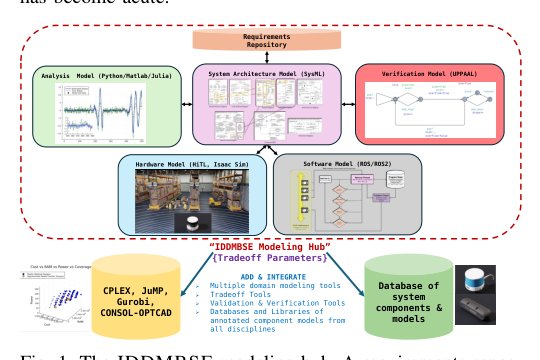
它和 prior 的本质区别在信息流组织方式:不是“SysML model 导出 simulation script”,也不是“simulation result 附到 report”,而是要求 architecture、DSE、V&V 都围绕同一个 SysML hub 和 requirements repository 循环。新的 inductive bias 是:需求结构和系统模型应该决定数据采样位置;数据不是泛化地增加,而是用于修正 model-based prior 的盲区。这使方法理论上更 scalable,因为它避免了全组合仿真;也更容易形成 assurance case,因为所有 evidence 都能回到同一需求节点。
Method
方法的关键机制有四个。
1. Autonomy stack first-class modeling:把 perception-planning-control stack 表达为 SysML block,并绑定结构、行为、参数、接口和实现。这解决的是 learned autonomy 无法进入 digital thread 的问题。核心变化是 ML/AI component 不再是外部黑盒,而是可被需求分配、实验配置和验证证据引用的架构元素。
2. Requirement-driven data loop:每个 V-step 都引入 data-driven augmentation,但不是无差别加数据。结构/行为建模可被数据补全,需求优先级可通过敏感度分析量化,trade-off 可在模型不确定区域采样,V&V 可由 runtime/statistical evidence 补 formal gap。这解决的是数据预算稀缺和仿真爆炸的问题。
3. Hybrid design-space exploration:Trades-X 先用 model-based optimization 产生 Pareto frontier 或可行候选,再用 Perfect 对幸存者做 empirical evaluation,最后用 MAVF 按 stakeholder preference 排序。必要性在于 autonomous CPS 的变量包含硬件、算法、环境和任务,纯模型不够真实,纯数据不够可扩展。
4. Multi-modal assurance:Veritas 把 formal model checking、data-driven failure estimation 和 runtime STL/MITL monitoring 合在一个 assurance workflow。它解决的是单一验证范式失效的问题:formal proof 有 fidelity gap,simulation 没有完备性,runtime monitor 太晚。组合后不是获得绝对 safety,而是获得更可审计的 evidence composition。
Perfect 是支撑层:SysML-to-ROS/Isaac/Gazebo 的自动 campaign orchestration。它的机制意义在于保证 empirical evidence 可复现、可追踪、可回写;算法新意有限,但工程上是闭环成立的前提。
Key Insight / Why It Works
最重要的 insight 是:在 autonomous CPS 中,scalability 不是来自更强的 verifier 或更大的 benchmark,而是来自把 design/evaluation space 按 requirements 和 model prior 重构。模型负责提供低成本 inductive bias,数据负责覆盖模型不可置信的区域。这个分工非常合理,也解释了为什么 sensor-suite case 能把大量组合压到少量仿真:收益主要来自 structured pruning,而不是某个 data-driven optimizer 的神奇能力。
真正核心贡献可能是 representation alignment:SysML requirements/architecture 与 ROS execution、simulation metrics、formal contracts、runtime robustness 被放到同一 hub 中。很多单点技术本身并不新:CVaR planning、conformal prediction、BT-to-automata、STL robustness、MILP synthesis、distributed simulation 都有现成谱系。新东西是把它们组织成一条 requirement-to-evidence pipeline,使得每个结果都能被追踪回设计决策。
需要直接判断的是:论文中相当一部分增益可能主要来自 engineering / scaling / orchestration,而非新的理论突破。Perfect 的价值是 automation 和 throughput;Trades-X 的价值是 model-based pruning + selective simulation;Veritas 的价值是 evidence aggregation。它们共同形成一个有用系统,但论文没有证明这种组合在一般 autonomous CPS 上有严格最优性或稳健泛化。所谓 data-driven loop 更接近 active evaluation / experiment management,而不是学习出新的系统级 reasoning 能力。
此外,formal + data-driven + runtime 的组合听起来完整,但保证边界很清楚:formal proof 只对抽象模型有效,statistical evidence 只对采样分布有效,runtime monitor 只对已形式化性质有效。方法有效的前提是 requirements 能被正确形式化、仿真环境足够代表 deployment、模型 prior 不会误导剪枝。否则闭环只是把错误以更可追踪的方式传播。
Relation To Prior Work
这篇属于 MBSE / digital engineering / autonomous CPS V&V 的谱系,而不是传统 robotics algorithm paper。最接近的路线包括:SysML-based MBSE/digital twin framework、model-driven design-space exploration、robotics benchmarking、formal verification for ROS/autonomy、以及 task-driven sensor/perception codesign。
和 classical MBSE 的差别在于它把 ML/AI stack 和 empirical evidence 放进 V-process,而不是把它们作为外部实现细节。和 robotics benchmarking 的差别在于 benchmark 结果不是孤立性能表,而是回写到 requirements 和 architecture。和 digital-twin V&V 的差别在于它不只做仿真验证,还引入 formal proof 和 runtime monitoring,并把 learned component 作为 first-class element。和 AI-for-SE 的差别在于它不是辅助画模型/问答,而是连接 executable stack 和 assurance workflow。
但也要看到,很多“新”其实是已有思想重组:model-based pruning 后 data-driven evaluation 是 DSE 中常见范式;formal + simulation + runtime monitoring 的组合也是 CPS assurance 的自然路线;conformal prediction 和 STL robustness 都不是本文贡献。实质创新在于 requirements-driven composition 和 toolchain-level digital thread,而非单个算法模块。
Dataset / Evaluation
评估更像 end-to-end case study,而不是严格 benchmark。任务覆盖面较广:硬件传感器组合选择、规划器评估、行为树验证、鲁棒感知、多机器人协调,且都落在 trusted autonomous ground robot 场景中。Isaac Sim contested-terrain range 提供了可控地形、障碍密度、物理参数和多传感器配置,这对可复现实验有价值。
但 evaluation 是否完全支撑核心 claim,要谨慎。它能支撑“这个 toolchain 可以把若干 autonomous robotics lifecycle tasks 串起来”,也能支撑“model-based pruning 能减少 data-driven evaluation 负担”。它不能充分支撑“这是通用 trusted autonomy engineering methodology”的强 claim,因为缺少跨平台、跨组织、真实 field deployment、长期系统演化和和工业 MBSE baseline 的系统对照。
真实世界/真机证据在给定文本中不充分,主要是 simulation-driven。conformal perception 的 calibration 数据、closed-loop distribution coverage、多机器人执行偏差等都依赖仿真环境代表性。benchmark 没有明显 leakage 问题,但存在 evaluation bias:所有案例都较适合展示 IDDMBSE 的优势,因为它们天然可被 requirements、simulation 和 formal specs 表达;对更开放、更语义化、更难形式化的 autonomy task,文中未充分说明。
Limitation
最深层限制不是 SysML v1 GUI-bound plumbing,虽然这是现实工程痛点;更深的是方法把若干难问题转移到了 requirements formalization、model validity 和 simulation coverage 上。
1. Requirement formalization 是瓶颈。高层任务如何可靠转成 contracts、STL/MITL、MAVF 权重、failure metrics,文中没有给出可泛化机制。这里一旦人工假设错,整个 traceability 只会让错误更系统化。
2. Model-based pruning 有误删风险。Trades-X 依赖 model prior 先缩小候选,如果 first-principles model 对 learned component 或复杂环境交互建模不足,可能直接删掉 empirically superior 的设计。文中未充分说明如何检测 prior misspecification。
3. 数据覆盖决定上限。Perfect 能 scale simulation campaign,但 statistical assurance 的可信度仍由场景分布、domain randomization、label quality 和 closed-loop state coverage 决定。核心能力可能主要来自数据覆盖和仿真规模,而不是方法本身。
4. Formal assurance 的 fidelity gap 仍在。UPPAAL/PRISM/Lean 等 proof 对抽象模型成立,不能自动转移到 ROS stack、物理仿真或真机。Veritas 是 evidence aggregator,不是 fidelity gap 消除器。
5. SysML 作为 central hub 可能成为表达瓶颈。复杂 learned models 的 training data lineage、OOD behavior、uncertainty calibration、model updates 和 online adaptation 很难自然塞进传统 architecture diagrams。SysML v2/KerML 能改善 API 和 composability,但不自动解决 ML semantics。
6. 增益归因不清。论文没有足够 ablation 来区分:收益来自 requirements-driven methodology、Perfect 的 distributed scaling、已有算法质量,还是案例本身设计空间可剪枝。
Takeaway
- 1. 这篇真正推动的是 autonomous CPS 的 engineering representation:把 ML/AI component、simulation evidence、formal proof 和 runtime monitor 拉回同一 requirements-driven digital thread。
- 2. 最可迁移的 insight 是“数据预算应由 requirement uncertainty 分配”。
- 在任何 expensive-evaluation 系统设计问题中,都可以先用 model prior 剪枝,再对不确定且需求敏感的区域做 targeted empirical evaluation。
- 3. 未来真正有价值的方向不是继续堆工具名,而是研究 evidence composition 的语义:formal proof、statistical guarantee、runtime robustness、human-defined requirement 之间如何一致、冲突时如何仲裁、如何量化 confidence。
一句话总结
IDDMBSE 是一篇以 MBSE 为骨架、以数据驱动评估补足 learned autonomy 不确定性的系统工程方法论文,其实质贡献是 requirements-centered digital thread 和 hybrid evidence orchestration,而不是新的机器人单点算法。