精读笔记
Problem Setting
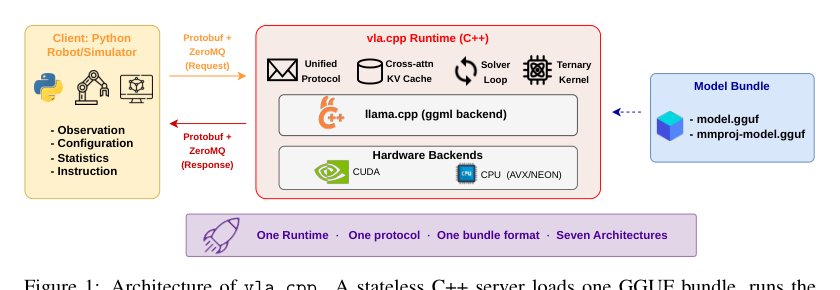
《vla.cpp: A Unified Inference Runtime for Vision–Language–Action Models》(arXiv preprint / 2026)实际处理的是 VLA 的部署语义问题,而不是 VLA 的学习算法问题。现代 VLA 的推理路径已经从 OpenVLA 式 autoregressive action tokens 转向“VLM prefix + continuous flow/diffusion action head + chunked control”。这个路径对 runtime 的要求和 LLM serving 很不同:prefix 是固定 observation context,action head 在多个 solver steps 中反复 cross-attend 它,输出的是连续 action chunk 而不是 token stream。
真正困难点在于这个模式夹在两个世界之间:从模型侧看,它依赖 PyTorch 中大量 per-model glue code、hidden-state tap、mask convention、normalization 和 solver loop;从机器人侧看,它必须在内存紧、batch=1、低延迟、硬件异构的边缘设备上稳定运行。以前方法要么只支持 autoregressive VLA,要么统一 policy API 但仍依赖 PyTorch,要么用 vendor compiler 针对单模型单硬件重编译。关键矛盾是:VLA 推理的结构越来越特化,而部署栈仍按 LLM/VLM 的通用生成假设来设计。
Motivation
已有路线不够的原因不是缺少又一个加速 trick,而是缺少正确的执行抽象。llama.cpp/ggml 的优势是 portable bundle、低依赖、跨硬件执行,但其原生抽象是 token-by-token decoding;它没有“固定 multimodal prefix 被连续动作专家多次读取”的 cache 生命周期。PyTorch eager 能表达任意模型,但 batch-1 robot loop 下大量小 kernel 和 Python dispatch 造成 utilization 很差,并且内存 footprint 与依赖栈不适合 Jetson。torch.compile/CUDA graph 可以部分缓解 launch overhead,但动态 cross-attention cache、外部 attention kernel、Jetson 支持都会卡住。TensorRT 类工具能为特定模型生成高性能 engine,但跨模型/跨硬件/无需重编译这一点不成立。
作者真正看到的缺口是:主流 VLA 架构虽然名字不同,但共享一个可抽象的推理骨架。只要把这个骨架下沉到 runtime,很多 deployment 问题就从“为每个模型写一套服务代码”变成“把模型组件映射到统一控制流”。这也是本文比单纯 quantization 或 single-model Jetson port 更有价值的地方。
Core Idea
核心思想是把 flow/diffusion VLA 的推理模式变成 ggml-class runtime 的第一类 primitive:先构造一个数百 token 的 bidirectional multimodal prefix,再缓存它面向 action head 的 cross-attention K/V,最后用连续动作 solver 在多个时间步中重复查询这个 prefix。这里改变的不是 policy 的建模假设,而是 execution graph 的信息组织方式:observation context 从 PyTorch 临时 tensor 变成显式 cache;action generation 从 LLM decoding 分离出来,保留连续控制头的结构。
这个思路直觉上有效,因为现代 VLA 的计算天然有两个相反阶段:prefix 阶段 token 多、权重复用高、接近 compute-bound;action expert token 少、solver 多步、cross-attention 重复访问同一 context。把 prefix cache 显式化可以避免重复构图和错误 mask,把 solver loop 固化可以减少 Python overhead,把 bundle 化可以减少 deployment mismatch。和 prior 的本质区别不是“也用了 C++”或“也量化”,而是它没有把 VLA 降格成 autoregressive LLM,也没有把每个 VLA 当作一次性编译工程,而是抽象出一个可复用的 VLA inference protocol。
Method
第一,prefix hidden-state 暴露。action head 需要的是整段 multimodal representation,而不是语言模型 logits 或 pooled embedding;如果 runtime 只提供 text-generation 接口,就无法忠实执行这些 VLA。因此 vla.cpp 在 LM 输出投影前取 final hidden states,作为 action head 的条件源。这解决的是信息接口错误的问题。
第二,bidirectional prefix mask。VLA 的 observation prefix 不是要自回归生成的文本上下文,图像、语言、状态之间应自由交互。若沿用 causal mask,cache 中的 K/V 会被系统性污染,而且这种错误可能不会报错,只表现为行为偏移。这解决的是 LLM runtime 默认因果结构与 VLA 表征结构不一致的问题。
第三,独立 cross-attention cache lifecycle。LLM KV-cache 表达的是逐 token 增长的 self-attention history;VLA action head 需要的是固定 prefix 在多个 denoising steps 中被重复读取。二者生命周期不同,不能复用同一抽象。vla.cpp 把 prefix K/V 计算一次并在 solver 内复用,核心变化是把 test-time compute 的重复模式显式化。
第四,统一 bundle 与 parity gating。模型权重、action normalization、架构配置、head solver 都被封进 artifact,并在构建期对齐 PyTorch reference。它解决的是 deployment 中最危险的 silent mismatch,尤其是 normalization、precision、position embedding 这类不会触发异常但会改变动作的细节。
第五,BitVLA 的 IMMA W2A8 GEMM。ternary 权重本身主要省内存,不必然加速;如果仍走 dp4a/CUDA cores,tensor cores 闲置。IMMA kernel 的作用是把同样的低比特矩阵乘搬到更高吞吐的整数 tensor core 上。这是 utilization 层面的优化,而不是新的 VLA 算法。
Key Insight / Why It Works
本文最重要的 insight 是把 VLA deployment 的两个瓶颈拆开:footprint 主要由内存容量决定,latency 在 batch-1 prefix-dominated regime 下主要由 arithmetic utilization 决定。很多工作默认 quantization 会同时解决二者,但文中 BitVLA 的分析说明低比特权重只保证模型装得下,不保证跑得快;如果 kernel 没有用对硬件单元,latency 几乎不变。这个判断很有迁移价值:对边缘 VLA,先问模型是否 fit,再问主导阶段是否 compute-bound,最后优化 utilization,而不是盲目追 bandwidth 或文件大小。
第二个关键点是 memory reuse 不是普通 cache optimization,而是 VLA 语义正确性的一部分。flow/diffusion head 多步积分时反复读同一个 observation-conditioned prefix;如果 runtime 没有这个生命周期,就会要么重复算、要么错误复用、要么退回 PyTorch glue code。这里的贡献更接近“为一类模型建立正确执行语义”,而不是单点工程加速。
第三个值得注意的 insight 是 reduced precision fragility。作者展示 position-index rounding 这种看似微小的数值差异可以经由 vision prefix 进入 flow field,并在 solver steps 中累积成 robot-space action displacement。这说明 VLA deployment 的 parity 不能只看 logits relative error 或单层误差,而要 gate 到 action chunk 甚至 denoising step。这个结论比具体 runtime 更重要:机器人控制中 silent numerical mismatch 的代价远高于 NLP generation。
哪些可能只是 engineering?ZeroMQ/Protobuf server、GGUF packaging、支持七个架构的大量 adapter 都是重要工程,但不构成新的建模贡献。PyTorch eager speedup 中也有一部分来自静态图/launch overhead amortization,属于 runtime engineering;文中通过 graph-captured baseline 部分隔离了这一点,但不同架构上增益并不一致。真核心是 VLA-specific cache/mask/hidden-state abstraction + roofline-guided utilization,而不是“C++ 比 Python 快”。
这篇论文不提供新的 reasoning、planning 或泛化能力。LIBERO 高分不能说明 VLA 更聪明,更多是 reference fidelity 与 deployment correctness。真实机器人上成功率提升更像 latency-staleness trade-off 的系统效应,而不是 policy 认知能力提升。
Relation To Prior Work
它最接近三条线:一是 llama.cpp/ggml/MLC/vLLM 这类 portable LLM runtime;二是 LiteVLA-Edge、Reflex、VLAgents、OxyGen 等 VLA deployment infrastructure;三是 VLA-Perf/edge characterization 这类性能建模工作。
相对 LLM runtime,真正新增的信息是 VLA 的 action-stage execution primitive:bidirectional multimodal prefix、final hidden-state exposure、cross-attention cache、flow/diffusion solver、continuous action denormalization。LLM serving 的 prefill/decode 抽象不能直接覆盖这些。
相对 LiteVLA-Edge,它不是把单个 autoregressive VLA 量化后塞进 llama.cpp,而是服务当前主流 continuous action head。相对 VLAgents/Reflex,它不是统一接口或 PyTorch parity harness,而是替换底层执行引擎。相对 OxyGen,它更偏单请求 edge runtime 与 bundle portability,而不是多任务并发 cache 管理。
相对 TensorRT-LLM / TensorRT Edge-LLM,差异不是绝对性能,而是 portability axis:vendor compiler 追求单模型单硬件最优,vla.cpp 追求一个 binary/bundle 格式覆盖多个 VLA 架构和较旧 Orin 设备。若未来 vendor stack 原生支持 flow/diffusion head 和动态 cross-attention cache,vla.cpp 的性能优势可能被压缩,但其 open ggml ecosystem 与跨架构统一仍有价值。
从技术谱系看,这篇更像“VLA 时代的 llama.cpp extension + systems characterization”,不是 model paper。实质创新在 runtime abstraction 和低比特 kernel utilization;许多周边设计是已有系统思想在机器人 VLA 上的重组。
Dataset / Evaluation
评估基本能支撑作者的核心 claim,但不能支撑更宽的泛化 claim。LIBERO-Object 及附录中的其他 LIBERO suites 主要用于验证 behavioral fidelity:同一 checkpoint 在 vla.cpp 与 PyTorch reference 下是否行为一致。这个设置合理,因为本文目标是 deployment parity,而不是训练新 policy。近饱和 benchmark 的问题作者也承认:它可能高估泛化,但低方差有利于发现一两个 episode 的 fidelity gap。
跨硬件 profiling 覆盖 RTX 3060、AGX Orin、8GB Orin Nano,比较贴近实际 robot deployment,尤其是统一内存容量约束的分析比单机 GPU benchmark 更有说服力。roofline 分析与 per-component breakdown 支持“prefix compute-bound、action expert memory-bound”的结构性判断,但这个结论依赖当前 batch=1、prefix 数百 token、solver steps 较少/中等的 regime;当模型结构变化或异步 pipeline 引入后可能改变。
真实 ALOHA 实验是本文最有说服力的 deployment evidence,因为它把 latency 转化为 observation staleness 和闭环成功率差异。但规模仍小,任务和 checkpoint 单一,且 PyTorch baseline 是否经过同等程度系统优化仍可能影响结论。它证明了 runtime latency 在真实闭环中会改变成功率,不证明 vla.cpp 一般性提高所有 robot tasks。
整体上,evaluation 对“统一 runtime、reference parity、edge feasibility、latency-staleness relevance”支持较强;对“跨任务泛化、更强策略能力、长期规划”没有证据,也不应这样解读。
Limitation
第一,方法成立依赖一个隐含结构假设:目标 VLA 必须能分解为 VLM prefix 和 action head,并且 action head 通过 cross-attention 或等价接口消费 prefix。未来如果 VLA 引入长期 memory、latent world model、hierarchical planner、online adaptation 或复杂 recurrent state,这个 canonical flow 可能不够。
第二,它没有解决大模型在小设备上的根本 capacity 上限。GR00T-N1.6/N1.7 在 8GB Orin Nano 上装不下,π0/GR00T-N1.5 还需要 offload simulator。runtime 降低了 glue overhead,但没有 dynamic weight staging、activation offload、分层加载或模型切分,因此 scaling 到更大 backbone 的路线不清。
第三,低比特能力目前不通用。BitVLA ternary path 很亮眼,但 native low-bit quantization 主要限于该配置;对 4-bit/8-bit 混合量化、vision tower quantization、action head quantization 的系统结论文中未充分说明。IMMA kernel 的增益来自用对硬件单元,不应泛化成“低比特 VLA 自动加速”。
第四,增益归因在部分场景仍不完全清晰。SmolVLA 相对 eager PyTorch 的大幅加速很大程度来自静态图与 kernel launch amortization;graph-captured baseline 缩小了差距。GR00T-N1.7 上 vla.cpp 与 eager 几乎持平,说明统一 runtime 不必然带来速度优势。真实机器人成功率差异虽然与 latency-staleness 机制一致,但是否还包含调度、通信、baseline implementation 差异,文中未充分说明。
第五,数值 fragility 是系统性风险。parity gating 是正确做法,但随着支持架构增加,mask convention、position embedding、normalization、dtype promotion 等 silent mismatch 的组合空间会快速扩大。这个方法把模型部署问题从 Python runtime 转移到了 C++ runtime correctness 和持续维护问题上。
第六,benchmark 本身不能检验推理或长期状态建模。LIBERO/SimplerEnv 高成功率很可能仍受 demonstration coverage、task template、benchmark overlap 或 implicit memorization 影响;本文没有、也不应被理解为证明 VLA 具备更强泛化或规划能力。
Takeaway
- 1. 现代 VLA 需要自己的 serving primitive:cached multimodal prefix + iterative continuous action head 不是 LLM decode 的小变体,而是不同的 runtime abstraction。
- 2. 对 edge VLA,quantization 首先是 capacity lever,不是 latency lever;真正的 latency lever 往往是 arithmetic-unit utilization、kernel launch amortization 和 solver/pipeline scheduling。
- 3. Deployment fidelity 应该被 action-space parity gating,而不是只看 tensor relative error。
- 机器人系统里一个 silent dtype/index mismatch 可以直接变成失败动作。
一句话总结
vla.cpp 是一篇 VLA deployment systems paper:它把主流 flow/diffusion VLA 的“cached prefix + continuous action expert”推理模式下沉为 portable runtime primitive,并用 roofline 与真机实验说明边缘 VLA 的核心瓶颈正在从模型表达转向内存容量、算力利用率和数值一致性。