精读笔记
Problem Setting
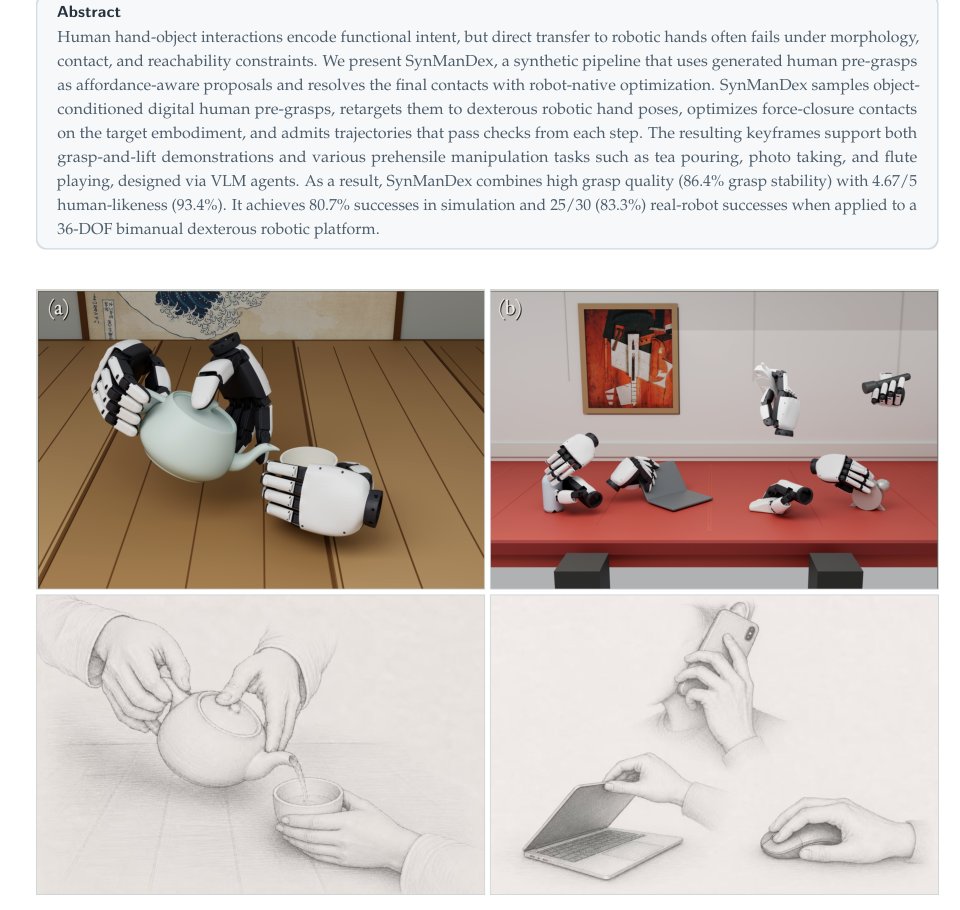
这篇论文不是在做一般的 dexterous grasp generation,而是在解决一个更具体也更实用的问题:如何从人类 hand-object interaction prior 生成机器人可执行的双手灵巧抓取与操作数据。
关键矛盾是:人类抓取包含功能意图,但人手接触状态不能直接转移到机器人;机器人 force-closure 优化能找到稳定接触,但往往不知道“该怎么抓才符合物体用途”。因此真正困难点不是 grasp pose 的表示,而是 functional intent 与 robot-native physical validity 的解耦与重新耦合。
以前方法通常卡在两端:retargeting / human imitation 保留语义但在接触、穿透、可达性上失败;physics-first optimization 可以稳定但容易收敛到功能错误或非人类的局部最优;VLM/affordance 方法能说出区域或任务,但粒度不够到 finger-level contact。SynManDex 试图填的是这三者之间的接口缺口。
Motivation
作者的动机可以概括为一句话:不要把人类 grasp 当 label,而要把它当 proposal distribution。
这背后的观察很重要。MANO-space 的最终接触对机器人来说通常是错误监督,因为 morphology、finger length、joint limits、palm geometry 都不同;但 pre-grasp 阶段的信息——从哪边接近、手腕如何朝向、哪个手负责稳定、哪些手指倾向参与——反而更稳定、更可迁移。这些信息定义的是搜索 basin,而不是最终解。
所以缺的不是更强的人类生成模型,也不是更强的 force-closure optimizer,而是一个把两者放在正确阶段的 pipeline:human model 负责语义和 affordance,robot optimizer 负责接触真实性,executor 负责 arm-hand reachability。这个 motivation 是论文最有价值的地方。
Core Idea
SynManDex 的核心思想是 staged proposal-grounding-admission。先在 MANO/human space 生成 object-conditioned pre-grasp,作为 affordance-aware seed;再 retarget 到机器人 open-hand pre-grasp;随后完全在目标机器人形态上做 contact / collision / force-closure refinement;最后只有通过 IK、lift rollout、possession 等 gate 的样本才进入 demonstration data。
本质区别在于它改变了 human prior 的角色。prior 不再是 trajectory label,也不是 contact supervision,而是 test-time search initialization。这使得 human prior 不必满足机器人接触可行性,robot optimizer 也不必从随机空间中寻找功能性局部最优。信息流被重新组织为:语义先验缩小搜索空间,物理优化重写最终接触,执行验证裁剪数据分布。
这个建模方式比直接 imitation 更 scalable,因为不需要为每个机器人形态采集人机对应轨迹;也比纯优化更 generalizable,因为初始分布已经被人类交互数据偏置到 object-function relevant regions。
Method
方法层面真正必要的机制只有几件事。
第一,human pre-grasp generation 解决“从哪里开始搜索”的问题。它生成的是 first-contact 前的手势,而不是接触状态。这一点避免了把人类接触错误地硬迁移到机器人,是整个 pipeline 成立的关键。
第二,geometric retargeting 解决 morphology bridge,但它只产生 open-hand seed。这个设计很克制:retargeting 不负责最终接触,因此其错误不会直接成为物理失败的最终来源。它保留的是 keypoint-level 的 approach、pinch tendency 和 hand coordination。
第三,robot-native force-closure optimization 解决“谁对物理负责”的问题。最终 contact、penetration、force-closure margin 都在 XHand / Shadow 等目标 embodiment 上计算。这一步把 human-like proposal 转化为 load-bearing grasp。
第四,admission gate 解决 synthetic data contamination。只有通过 collision、FC、IK、lift 或 task possession 的轨迹才被收录。这个 gate 比模型结构本身更重要,因为它决定了 imitation policy 看到的是经过执行筛选的数据,而不是视觉上合理的 pose。
第五,VLM agent 只是把 validated keyframe 变成 object-relative task proposal。它不直接控制机器人,也不替代物理验证。这里更像一个语义 task-spec generator,而不是 dexterous planning 的核心贡献。
Key Insight / Why It Works
这篇论文真正有效的原因不是某个单独模块,而是把不同错误模式隔离开了。
Retarget-only 的主要失败是“semantic correct but physically invalid”:看起来像人,但 fingertip 没有形成承重接触,或者穿透/腕部不可达。Optimization-only 的主要失败是“physically plausible but semantically wrong”:能抓住,但抓法不像人,也不符合对象功能。SynManDex 的 staged formulation 正好把二者互补起来:human prior 负责进入正确 basin,robot optimization 在 basin 内找物理可行点。
我认为核心贡献是 representation alignment / search-basin shaping,而不是 diffusion model 本身,也不是 force-closure metric 本身。扩散模型提供的是 data-driven affordance prior;force-closure 优化提供的是 embodiment-specific projection;admission gate 提供的是 synthetic data curation。这三者组合后,本质上是一个强 test-time compute + filtering 的数据生成系统。
其中最可能贡献最大的部分是“pre-grasp 而非 grasp”的选择。这个 temporal offset 把人类数据中最不稳定的 contact supervision 去掉,只保留更可迁移的 approach geometry。这是一个可以迁移到很多 human-to-robot transfer 问题的 insight。
相对地,VLM agent、policy architecture、PointNet++ action-query 等更像辅助 engineering。它们有用,但不是论文机制上的核心。尤其 VLM task generation 的推理能力不应高估:它被 primitive library、schema 和 executor gate 强约束,更像 semantic retrieval / proposal,再由 deterministic validator 筛选。
实验增益也可能部分来自 scaling / data filtering:每个对象固定 240 candidates,多阶段 admission,本质上使用了相当多 test-time sampling 和 rejection。文中没有充分拆清“human prior 质量”与“更多有效 candidate + 更严格 filtering”之间的贡献比例。若 optimization-only 的 seed budget 或 proposal diversity 显著增大,差距会不会缩小,仍不清楚。
Relation To Prior Work
这篇最接近三条线:human-to-robot retargeting、physics-first dexterous grasp optimization、synthetic bimanual grasp data generation。
相对 DexMV / DexPilot / DexH2R / ManipTrans 一类 human transfer 方法,SynManDex 的本质差异是拒绝直接执行 human contact。它只转移 pre-contact prior,然后让机器人自己决定最终接触。这是比“更好 retargeting”更根本的变化。
相对 DexGraspNet / BODex / GraspQP / UltraDexGrasp 等物理或优化驱动方法,SynManDex 的新增信息是 object-function-biased initialization。它不是重新定义 force closure,而是改变优化器进入的 basin,因此减少稳定但语义错误的局部最优。
相对 affordance / language-guided grasp 方法,SynManDex 的区别在于语义不是停留在 region 或 language label,而是通过 human pre-grasp 分布隐式编码到 wrist pose、finger coordination、bimanual role 中。这个 prior 比 VLM bounding region 更细,但又不要求精确接触。
看似新的部分有不少是已有思想重组:diffusion HOI、GeoRT-style retargeting、force-closure optimization、IK rollout、synthetic policy training 都不是新概念。实质创新在于把这些模块组织成一个“proposal not label”的人类先验接口,并证明这个接口在双手灵巧抓取数据生成中有效。
Dataset / Evaluation
评估覆盖了静态 grasp quality、human-likeness、IK/lift admission、policy learning、selected manipulation transitions、真机 tabletop trials 和一个 Shadow Hand seed diagnostic。整体证据链比普通 grasp paper 更完整,尤其 ablation 能说明 retarget-only 与 optimization-only 的互补失败。
但 evaluation 仍有明显边界。对象规模是数百级、类别有限;真机只有三个对象的 30 次定量 trial,更多功能任务主要是 qualitative 或 selected stress tests。VLM task generation 的成功更像在受控 primitive library 下验证 keyframe utility,不足以证明开放式任务规划。
benchmark 是否完全支撑 claim?支撑“human pre-grasp prior + robot-native optimization 能生成更好的 bimanual grasp demonstrations”这个 claim;但不充分支撑“general-purpose dexterous manipulation”或“open-ended functional manipulation”这类更强表述。跨 embodiment 结果也只是 seed-level improvement,不是完整 cross-embodiment policy transfer。
还有一个评价风险是 human-likeness 使用 VLM-H + human audit 的混合分数。虽然 method-blinded,但 VLM 对“像人”的判断可能偏视觉表面,并不一定等价于功能合理性。PCD 比 entropy 更合理,但仍依赖参考 human manifold 和评分器设定。
Limitation
最大限制是方法把问题从“直接学习可执行 dexterous behavior”转移为“能否大规模生成、筛选、验证足够好的 candidate”。这在工程上有效,但上限受 candidate budget、仿真接触模型和对象覆盖强约束。
人类 prior 的泛化能力文中未充分说明。若对象类别、尺度、功能部件或使用方式超出 GRAB/ContactPose 等数据分布,pre-grasp diffusion 可能只是生成看似合理的常见模式。核心能力可能主要来自数据覆盖,而不是抽象 affordance reasoning。
force-closure 是离散摩擦锥和准静态指标,作者也承认它是 admission score 而非物理保证。真实硬件中的 slip、rim contact、occlusion 已经暴露了 sim-to-real gap。没有 tactile feedback 时,对低摩擦、柔性、细长工具、复杂 in-hand transition 的可靠性会受限。
VLM agent 部分不能被解读为真正的 long-horizon planning。它输出 object-relative waypoints 和 primitive choices,失败后 retry,本质上是 constrained proposal generation;长期状态建模、因果任务理解、接触模式主动探索都没有解决。
增益归因仍不完全清楚。human prior、candidate budget、force-closure refinement、IK filtering、policy architecture、domain randomization 都在同一系统中耦合。虽然 ablation 有帮助,但还不足以严格回答:如果给 optimization-only 同等强的 proposal ensemble 或 learned grasp prior,SynManDex 的优势还剩多少。
Takeaway
- 第一,human-to-robot dexterous transfer 中,人类数据最可迁移的部分可能不是 contact label,而是 pre-contact search basin。
- 这是本文最值得迁移的 insight。
- 第二,灵巧抓取数据生成的关键不只是生成器,而是 proposal distribution 与 robot-native validator 的接口设计。
- 未来高质量 synthetic dexterous data 很可能都会走“semantic proposal + physical projection + executable filtering”的路线。
一句话总结
SynManDex 是一篇把人类 HOI 先验从“可执行示范”降格为“功能性搜索初始化”、再用机器人原生物理验证重建最终接触的 dexterous manipulation data-generation paper,其真正贡献在于重组 human prior 与 robot grounding 的信息流。