精读笔记
Problem Setting
【MV-Actor: Aligning Multi-View Semantics and Spatial Awareness for Bimanual Manipulation】(arXiv preprint / 2026)
这篇论文处理的不是一般意义上的双臂 imitation learning,而是多相机双臂操作中的 perception representation bottleneck。双臂系统天然有 front + wrist cameras,多视角提供了遮挡互补、局部细节和 workspace geometry;但现有 policy 通常没有把这些 view 当作同一物理场景的多个观测来建模。
真正困难点在于两个需求彼此冲突:操作需要 metric-level spatial grounding,尤其是双臂接触、支撑、handover、thin object grasp 等任务;但真实 RGB-D depth 在反光、透明、遮挡、边界处非常脆弱。另一方面,RGB semantic feature 更稳定、更开放,但缺少 3D metric structure。以前方法要么把 view token 拼起来,让 transformer 自己学习跨视角关系;要么直接用 sensor depth lift 到 voxel/point cloud,假设 depth 是可信的。前者跨视角对应太弱,后者空间锚点太脆。
因此这篇的关键矛盾是:如何在不完全信任 raw depth 的情况下,仍然利用 calibrated multi-view geometry 形成可靠的语义-空间表征。
Motivation
作者的动机可以概括为:多视角信息没有被以正确的信息流组织起来。
独立编码路线的问题不是“没有多视角”,而是没有显式说明哪些 token 应该互相交换信息。一个 wrist view 看到的 gripper-object contact,和 front view 看到的同一区域,如果只是作为两个 token 放进 policy,模型需要从有限 demonstrations 中自己学会 epipolar/geometry correspondence,这对小数据机器人任务很不经济。
3D lifting 路线的问题也不是“3D 不好”,而是把 sensor depth 当成过强前提。消费级 depth 在机器人 manipulation 中几乎是系统性失效源:手臂遮挡、金属/透明表面、边缘 hole、thin object 都会污染 point cloud。于是 3D alignment 的优点被 noisy anchor 抵消。
作者看到的缺口是:需要一种中间路线——用 calibration 建立跨视角物理对应,但不用完全依赖 raw depth;用 RGB/reconstruction prior 提供更稳的空间线索,但仍保留 metric scale 以服务控制。
Core Idea
论文真正核心的思想是:把多视角融合从 policy-level implicit attention,前移到 perception-level physically constrained interaction。也就是说,不是让 action transformer 在所有 view token 中自由寻找关系,而是先用相机标定、重投影和深度一致性,把“同一物理区域”的 token 对齐,再在这些局部对应上交换语义信息。
这引入了一个很强的 inductive bias:跨视角信息传播必须服从几何一致性。这个 bias 对机器人小数据场景很重要,因为它减少了 policy 需要从 demonstrations 中学习的结构。它本质上是 geometry-constrained retrieval,而不是纯 learned fusion。
第二个核心思想是把 feed-forward reconstruction model 当作 spatial prior provider。CLIP/FPN token 提供 object/category/task semantics,Pi3X token 提供 view-consistent geometry features,repaired depth 提供 metric anchor。三者合起来形成一个 semantic-spatial token,而不是传统 point cloud policy 中的“RGB feature + raw depth coordinate”。这使方法比纯 RGB-only VLA 更有空间约束,又比 raw RGB-D 3D policy 更不依赖传感器质量。
Method
方法层面只需要抓住几个机制。
第一,Multi-view Semantic Interaction 解决的是跨视角语义不一致。它对每个 view 的 semantic token,根据 repaired depth 得到 3D anchor,再投影到其他 view 的 token grid 中,并用 reprojection error 与 depth consistency 过滤候选。这样 attention 只发生在物理对应区域,而不是全局 token attention 或 naive 3D KNN。核心变化是:跨视角融合从 learned global mixing 变成 calibrated local evidence propagation。
第二,Semantic-Spatial Token Interaction 解决的是 2D semantic token 缺少空间结构。Pi3X 的 spatial token 被对齐到 semantic token grid,每个 semantic token 通过 gated residual 读取对应 spatial token。这不是完整 3D reconstruction,也不是显式规划;它更像把 frozen reconstruction model 的 latent geometry feature 注入 policy perception。核心变化是:空间信息以 token residual 形式进入 action representation,而不是只作为坐标或 point cloud topology。
第三,Guided Metric Depth Repair 解决的是所有几何交互的 anchor 可靠性。raw depth 提供 metric scale,RGB 提供边界,Pi3X/MoGe 类 FFD 提供 missing region 的结构先验。这个模块的必要性很现实:如果 token 的 3D anchor 错了,reprojection matching、3D RoPE、action grounding 都会被污染。
第四,Head-Aware Routing Gate 的作用是避免 semantic residual 和 spatial residual 的硬相加。position 更依赖 metric/spatial cues,rotation/gripper 更可能依赖局部语义和对象姿态线索。router 本质是一个轻量 mixture controller,技术上不新,但在这里解决了 residual interference。
Key Insight / Why It Works
最可能真正有效的是“物理约束的跨视角 feature retrieval”而不是 action decoder 本身。机器人多视角任务中,遮挡是常态;某个 view 的 token 语义弱,不代表对应物理区域在其他 view 中也弱。通过 calibrated correspondence 做 local attention,相当于把多相机系统变成一个 semantic evidence sharing network。这比把 view token concat 给 transformer 更 sample-efficient,因为几何关系不需要从 demonstration 中学。
第二个有效点是引入外部 reconstruction prior。Pi3X token 和 FFD depth repair 把大规模视觉几何模型的 inductive bias 带进 manipulation policy。这里的“spatial awareness”很可能主要来自 pretrained feed-forward geometry model,而不是 policy 在 PerAct2/100 demos 中自己学出来的。这个判断很重要:论文的贡献不只是一个模块,而是展示了 reconstruction foundation model 可以作为机器人 perception 的 geometry prior。
第三个有效点是把语义和空间分成 residual,再按 action head route。消融里直接合并两个 residual 会干扰,说明 semantic consistency 和 metric precision 对不同预测头的作用不同。position gain 更偏 spatial token/depth repair,rotation gain 更偏 multi-view semantic consistency。这个分解是有价值的 representation design insight。
但也要直接说:部分增益可能来自 engineering/scaling。full model 比 ablation 训练更久;Pi3X、CLIP、depth repair 都是额外 frozen/pretrained components;真实实验 trial 数少。论文把很多外部能力集成到了 perception stack 中,最终效果提升不应全部归因于新提出的 cross-view interaction。更准确的说法是:MV-Actor 是一个强 inductive-bias + pretrained geometry prior + depth repair 的组合系统。
Relation To Prior Work
它最接近三条路线。
第一是 ACT/π0/RDT 这类多 view token policy:这些方法把 view 当作输入来源,融合主要交给 policy transformer。MV-Actor 的本质差异是显式建立物理对应,把 view fusion 从 policy latent space 移到 calibrated geometry space。
第二是 PerAct/Act3D/3DFA/ManiVID-3D 这类 3D lifting policy:它们通过 voxel/point cloud 获得共享空间框架。MV-Actor 并不否定 3D,而是认为 raw depth lift 不可靠,所以用 repaired metric depth + reconstruction prior 构造更稳的 token anchor。和 3DFA 相比,它不是主要在 action generation 上创新,而是在 perception representation 上加入 semantic-spatial alignment。
第三是 PEAfowl 这类 geometry-aware cross-view VLA。PEAfowl 也做跨视角聚合,但更偏 learned depth distribution 和 local lifted-neighbor aggregation。MV-Actor 的不同在于更强的 calibrated physical correspondence filtering,并显式引入 feed-forward reconstruction token 作为 spatial feature source。
看似新的部分中,depth repair、gated fusion、CLIP token、Pi3X prior 都不是单独新思想;实质创新在于把这些已有组件组织成一个面向机器人多视角操作的结构化信息流:semantic evidence 在物理对应区域传播,spatial prior 作为 residual 注入,metric depth 作为统一 carrier。
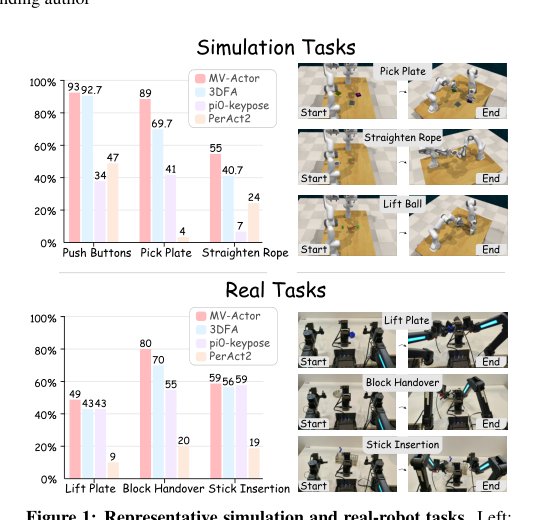
Dataset / Evaluation
评估覆盖了 PerAct2 的 13 个双臂任务和一个真实 ARK-Lift 三任务设置,基本能测试作者关心的遮挡、多视角、双臂协调和 depth degradation。PerAct2 上超过 3DFA 的幅度不大,但在 pick_plate、straighten_rope 这类空间精度任务上的提升与 semantic-spatial claim 对齐;在 lift_ball、push_buttons 等多视角 overlap 高的任务上效果好,也支持 cross-view semantic sharing 的说法。
真实实验是论文更有价值的部分,因为 D405 depth、反光 plate、arm occlusion 更接近 claim 的失败模式。MV-Actor 在这些场景比 raw 3D policy 和 RGB-only VLA 更好,说明 depth repair + geometry prior 的方向是对的。
但 evaluation 的限制也明显。真实世界只有 3 个任务、每任务 10 次测试,统计强度有限;每任务 100 demos 更像小规模 task-specific imitation,不足以证明 generalizable bimanual manipulation。PerAct2 的 baseline 很多结果引用自 3DFA 表,训练设置是否完全可比文中未充分说明。full model 400k、ablation 200k 也让部分归因变脏。benchmark 验证了“这个组合系统有效”,但没有完全验证每个机制的独立必要性。
Limitation
最大前提是高质量 calibration 和足够多视角 overlap。Multi-view Semantic Interaction 依赖重投影一致性;一旦相机外参漂移、手眼标定误差、目标区域只被单 view 看到,核心机制就会退化。论文在长 horizon 和视角变化大的任务上已经出现弱点,这说明它不是一个长期状态建模方法。
第二,方法把 raw depth failure 转移成 depth repair 问题。repair network 在仿真构造退化上训练,真实传感器 artifact 是否覆盖充分没有严格证明。遇到训练退化模式外的透明/反光/极薄结构,metric anchor 仍可能错,而错误 anchor 会系统性污染 cross-view matching。
第三,所谓 spatial awareness 很大程度依赖 Pi3X/MoGe 这类外部模型。若 FFD prior 在机器人近距离、手臂遮挡、动态物体上失效,policy 本身没有显式机制恢复稳定 3D state。这里的几何推理更像 pretrained prior retrieval,不是 online reconstruction 或 belief update。
第四,scalability 上限不清楚。随着 camera 数、token 数、动态遮挡增加,strict correspondence filtering 会带来 coverage 问题;过严会丢信息,过松会引入错误 surface。论文没有讨论如何自适应选择 view、处理 temporal consistency 或维护 persistent scene memory。
第五,增益归因不完全清晰。CLIP frozen feature、Pi3X token、depth repair、3D RoPE、router、训练步数都可能贡献提升。当前实验支持整体设计,但不足以说明核心 gains 主要来自哪一个 mechanism。
Takeaway
- 1. 多视角机器人 perception 不应只做 token concat;显式物理对应是非常强的 sample-efficient inductive bias,尤其适合 demonstration-limited manipulation。
- 2. Feed-forward reconstruction model 可能会成为机器人 policy 的标准 geometry prior。
- 它的角色不是替代 depth sensor,而是修复 depth、补充 spatial token、提升 metric grounding。
- 3. semantic 与 spatial residual 最好不要无脑融合。
一句话总结
MV-Actor 是一类从“多视角 token 堆叠/ raw 3D lifting”走向“几何约束的语义传播 + pretrained reconstruction prior grounding”的双臂操作感知方法,真正贡献在于重新组织多视角语义与空间信息流,而不是提出新的控制策略。