精读笔记
Problem Setting
[World Pilot: Steering Vision-Language-Action Models with World-Action Priors](arXiv preprint / 2026)
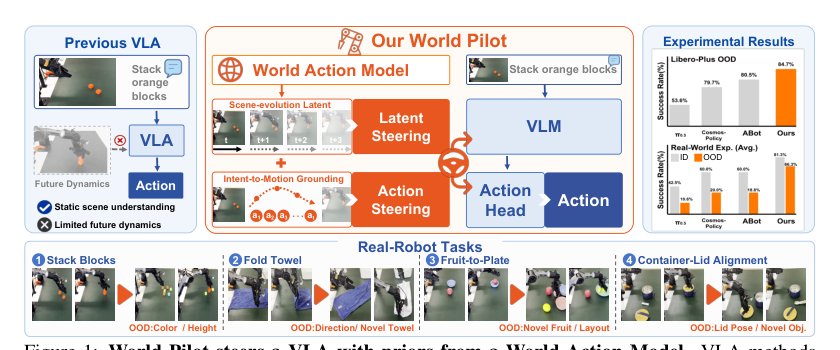
这篇论文不是在重新定义 VLA,也不是在提出一个新的 action head;它实际处理的是 VLA 在 OOD manipulation 中的一个结构性缺口:VLM backbone 提供的是静态语义 grounding,而 manipulation 成功往往取决于动作后场景如何演化、接触会如何发生、物体局部状态会如何改变。
关键矛盾是:VLA 需要动态先验,但直接让 world model 规划或生成 future image 又太脆。WAM 的输出通常是 coarse、distribution-dependent、带生成噪声的;如果把它当作硬目标,会把 world model 的错误放大到执行动作里。因此真正困难点不是“把 WAM 接到 VLA 上”,而是如何让 WAM 的动态信息以可纠错、可忽略、不过度绑定的方式进入 policy。
以前方法卡在两端:纯 VLA 缺少 dynamics;world-model-heavy 方法容易把像素预测、未来图像、逐步动作预测当成 policy supervision,导致控制信号被 appearance artifact 或 noisy plan 污染。World Pilot 试图在这两者之间找一个中间层:WAM 不做最终决策,只 steering VLA。
Motivation
作者的核心观察很直接:image-text pretraining 给 VLA 带来语义和泛视觉能力,但不提供 action-conditioned scene evolution;video/world model 则天然编码时间演化和物理变化,但不一定有足够精确的 closed-loop control ability。两者能力互补,但接口不 obvious。
已有路线的问题在于把 world model 的输出形式选错了。Future image 看起来直观,但像素空间混杂了大量与动作无关的信息:纹理、光照、背景、生成 artifact。Action trajectory 看起来更接近控制,但 WAM trajectory 往往只是 rough hypothesis,不应逐步绑定 policy。论文的动机就是:从 WAM 中提取“动态结构”和“运动形状”,而不是提取“可执行计划”或“可重建图像”。
因此这篇的关键缺口不是缺一个更大的 VLA,而是缺一种信息路由方式:让 dynamics prior 到达 perception/action generator 中真正需要它的位置,同时保持 VLA 自身根据当前语义和 expert supervision 修正 prior 的自由度。
Core Idea
World Pilot 的核心思想是把 WAM 作为 frozen prior provider,而不是 planner、simulator 或 joint policy。它从 WAM 拿两类信息:一个是 future scene latent,代表场景可能如何变化;另一个是 anticipated action trajectory,代表一个粗略 motion shape。前者注入 VLM hidden states,改变 perception representation;后者压缩成单个 token 注入 flow-matching action generator,改变 action generation 的条件分布。
这个设计引入的 inductive bias 是:policy 的视觉表征不只描述“现在看到什么”,还带有“如果按任务意图行动,场景可能怎么变”的隐式预测;action generator 不只从语义 token 生成动作,还收到一个 trajectory-level motion hint。但所有先验都是 soft conditioning,不是 hard constraint。这一点是它和很多 future-image / subgoal / step-wise plan 方法的本质区别。
更重要的是,它重新组织了信息流。传统 VLA 是静态 VLM 表征到动作;World Pilot 是静态语义表征和视频动态先验在不同层级融合,再到动作。它的可扩展性来自模块化:更强 WAM、更强 VLA backbone 都可替换;但这也意味着核心能力上限被 WAM coverage 和 VLA-WAM alignment 限制。
Method
方法上可以压缩成三个机制判断。
第一,Latent Steering 解决的是 perception-side dynamics 缺失。WAM 的 scene-evolution latent 通过 residual cross-attention 注入 VLM hidden states。这里重要的不是 cross-attention 这个模块,而是注入位置:它在 action head 之前改变 token-level representation,使 VLA 的后续 action generator 能读取到局部状态变化、接触后果、未来可见状态等动态线索。Residual 形式也很关键,因为它让原 VLM 语义路径不被 WAM 强行覆盖。
第二,Action Steering 解决的是 action-side trajectory prior 缺失。WAM 的粗轨迹不被当作逐步目标,而是压成一个 prefix token 进入 flow-matching generator。这个选择本质上是在把 trajectory 当作 distributional bias,而不是 deterministic plan。它保留了 motion shape,但避免将 WAM 的 step-level noise 传给每个动作维度。
第三,WAM frozen,只训练 VLA-side fusion/action components。这样做的意义是把 WAM 视为外部动态知识库,而不是和 policy 一起被小规模 robot data 过拟合。缺点是 prior-policy alignment 只能通过最终 action loss 间接学习,文中没有证明这种对齐在更大 domain shift 下仍稳定。
一些实现细节如 5-step denoising、condition dropout、具体 backbone,更多是工程稳定性,不是概念核心;但 condition dropout 可能对防止 policy 过度依赖 WAM 很重要。
Key Insight / Why It Works
这篇最有价值的 insight 是:world model 对 VLA 的最佳用途未必是生成未来图像或直接规划动作,而是提供 latent-level dynamics bias。这个 bias 不需要像素真实,也不需要动作精确,只要在 representation space 中携带稳定的 state-transition structure,就能改善 OOD control。
我认为真正有效的部分大概率是 Latent Steering,而不是完整双路径架构本身。证据是未 action-post-trained 的 Cosmos-Predict latent 也能带来提升,说明视频预训练 latent 已经包含可迁移动态/视觉鲁棒特征。Action Steering 也有效,但它更像 motion-shape regularization,贡献可能依赖 WAM trajectory 与 expert action chunk 的同分布程度。单 token 优于 per-step token 的结果很合理:WAM trajectory 噪声越大,越不应该高频绑定。
这不是 classical planning,也不是显式 reasoning。更准确地说,它是在利用大规模视频模型的 latent structure 和 data coverage 做 test-time prior retrieval / conditioning。所谓“anticipated view of the scene”很可能并不等价于可验证的物理预测,而是一个在视频预训练中学到的动态表征邻域。它为什么能泛化?主要原因可能是:WAM 见过更多 camera pose、appearance、object motion;VLA fine-tuning 学会在 action loss 下读取这些先验。
增益中哪些是核心、哪些是 engineering?核心是 latent prior 的注入形式和 action prior 的 soft conditioning;engineering 包括具体 DiT flow head、condition dropout、denoising step 选择、Qwen3-VL/ABot-M0 基座。论文声称 scene-evolution prior 不依赖 action post-training,这一点很重要,但也意味着收益可能主要来自 WAM 预训练数据覆盖,而非机器人动作理解。
文中未充分说明的是:WAM prior 错误时 policy 如何表现;是否有机制识别 WAM OOD;LIBERO-Plus 中 WAM pretraining 数据和 perturbation distribution 是否存在隐式 overlap。不能排除部分提升来自大型视频模型对 camera/appearance perturbation 的 coverage,而不是学习了更抽象的 manipulation dynamics。
Relation To Prior Work
这篇最接近的谱系是 world-model-augmented VLA / video-predictive policy,包括 future-image guidance、subgoal image conditioning、joint video-action modeling、latent world model steering 等。它不是从零发明“用 world model 帮 policy”,而是在接口设计上做了更干净的选择。
和 future image / subgoal 方法的本质差异:World Pilot 不把未来像素作为中间目标,而直接用 latent。这个差异是实质性的,因为 manipulation control 对 pixel realism 的需求很低,对 state-transition factorization 的需求更高。
和 unified world-action model 的差异:它不追求一个模型同时 reconstruct future 和 act,也不让 reconstruction loss 牵引 action representation。它更像 modular prior injection:WAM 负责提供 broad dynamics prior,VLA 负责 instruction grounding 和 executable action。
和 Being-H0.7 / WoG 等 latent/condition-space 方法相比,World Pilot 的新增点在于双层路由:scene latent 进 perception,trajectory prior 进 action generator。这个分工比“把 world feature 塞进 policy”更有结构性。但从思想谱系看,它仍是已有 latent conditioning、prefix conditioning、residual fusion 的组合;实质创新在于把这些组合成一个对 WAM 噪声更鲁棒的接口,而不是新模型架构本身。
Dataset / Evaluation
评估覆盖了模拟 OOD、长程厨房任务和真实机器人四类任务,整体比只报 LIBERO ID 更有说服力。LIBERO-Plus 对 camera、background、light、noise 等 perturbation 的提升比较支持作者关于 video/WAM prior 增强 OOD robustness 的 claim;真实机器人中的几何、姿态、形变扰动也支持“动态/trajectory prior 对 contact-rich manipulation 有帮助”。
但评估仍有明显边界。LIBERO-Plus 的很多 perturbation 偏视觉分布迁移,未必能区分“动态理解”与“大型视频模型视觉覆盖”。RoboCasa 上 World Pilot 并非最强,说明长程复杂任务里该 steering 机制未必充分。真机实验每格 20 trials,方向一致但统计方差不可忽视;任务数量也不足以证明 open-world generalization。
最关键的是,evaluation 支持“WAM prior improves robustness”,但不足以证明“policy 获得了可泛化物理推理”。它更像证明:在这些 benchmark shift 下,大视频模型的 latent/action prior 是有用的条件信息。
Limitation
核心限制不是论文列出的运行开销这么简单,而是方法把泛化问题转移给了 WAM。若测试场景超出 WAM 视频预训练覆盖,Latent Steering 和 Action Steering 都可能变成错误先验;当前没有 uncertainty-aware gating,也没有机制保证 policy 能自动忽略坏 prior。
第二,WAM 和 VLA 的 alignment 是弱监督的。WAM 输出的 future latent、coarse trajectory 与 expert action 的关系只通过最终 action loss 学到,缺少显式一致性约束或可解释校验。结构上看,这是 soft prior 的优点,也是上限:它避免硬绑定,但也无法保证 prior 真正对应当前可执行动力学。
第三,所谓 dynamics/generalization 可能主要来自 data coverage。Cosmos 系列模型见过大量视频、物理场景、相机变化;在 LIBERO-Plus 的 camera/appearance shift 上提升,很可能是 coverage advantage,而不是模型学会了 manipulation causal structure。文中未充分排除 benchmark overlap 或 implicit memorization。
第四,它不是长期 planner。每个 decision step 生成 chunk-level prior,没有显式长期状态 belief、goal decomposition 或 failure recovery。对于需要多阶段闭环推理、隐藏状态估计、长时程 replanning 的任务,这种 one-step WAM steering 可能不够。
第五,scalability 有成本问题。在线每步 WAM forward 会限制控制频率;如果未来依赖更强视频模型,compute 会更重。真正部署可能需要 distillation、adaptive querying 或 cache/memory 机制。
Takeaway
- 1. World model 对 VLA 最稳妥的作用可能不是 planning,而是 latent prior conditioning;把 noisy prediction 当 soft bias,比当 hard plan 更可扩展。
- 2. Future latent 比 future image 更适合作为 manipulation prior。
- 像素重建在控制中经常是负担,不是优势;representation-level dynamics 才是可迁移信号。
- 3. 对 WAM action trajectory 的正确用法是压缩成低带宽 motion hint,而不是逐步跟踪。
一句话总结
World Pilot 是一类从“端到端 VLA”走向“VLA + frozen world-model latent prior”的模块化演化,真正贡献在于把 WAM 的动态知识以软条件而非硬规划的方式注入 perception 和 action generation。