精读笔记
Problem Setting
【Scale Buys Interpolation, Structure Buys a Horizon: Certified Predictability for Equivariant World Models】(arXiv preprint / 2026)
这篇论文的问题不是传统 world model 的预测精度,而是 predictability certification:给定一个 latent world model 和当前状态,能否判断它的 rollout 在哪些对称变换下仍可信,以及能信到多少步。
真正难点有两个。第一,平均误差不等于局部可信性;一个模型可以 one-step relMSE 很低,但其 Jacobian / Lyapunov spectrum 完全错,从而多步 horizon 失真。第二,equivariance 的单步 guarantee 不自动变成 rollout guarantee;即使模型近似等变,残差也会在扩张通道上按 e^{lambda T} 放大。
以前路线卡在分裂状态:equivariant networks 能给 orbit-level invariance/equivariance,但大多是 T=1 的静态证书;chaos / Lyapunov horizon 理论能给 log(1/epsilon)/lambda 的时间尺度,但没有说明 learned latent world model 什么时候可以信这个谱。本文试图解决的关键矛盾就是:scale 降低平均误差,但 trust horizon 取决于结构残差和局部动力学谱,而不是参数量。
Motivation
已有方法缺的是“per-situation, multi-step, a-priori”的可信性。模型越大,插值越好,但不代表某个状态附近的 tangent dynamics 正确,也不代表 rollout error 的增长率正确。对于 acting agent,真正有用的不是整体 MSE,而是当前 belief 还能 open-loop 几步,什么时候必须 re-observe/replan。
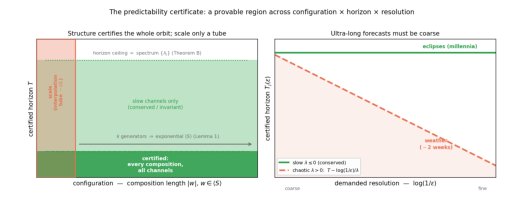
作者的核心观察很干净:equivariance 给 configuration-axis 的可迁移性;Lyapunov spectrum 给 time-axis 的可预测 horizon。单独看都不新,但两者的交点此前基本空缺。关键缺口是:approximate equivariance 到底能保证多久?如果残差非零,能不能靠 scale 把它“近似足够好”?本文的答案是否定的:只要存在扩张指数,残差会指数放大,horizon 只能是 Theta(log(1/epsilon)/lambda)。
Core Idea
论文的核心思想是把 world model certificate 分解为两个轴:对称轨道上的误差一致性,以及时间方向上的误差放大率。若 encoder、predictor、environment dynamics 对同一个群作用等变,且 latent 群表示保范,那么 T-step prediction 和 T-step target 会被同一个 rho(g) 同步搬运,二者差的范数不变,因此 rollout error 在整个 orbit 上常数。这是 configuration generalization 的结构来源,不是数据插值。
时间轴上,真实模型不可能完全等变或无误差,于是作者把 equivariance residual、prediction defect 看成初始/逐步扰动,再通过 latent Jacobian 的 Lyapunov spectrum 放大。由此得到 channel-wise horizon:扩张通道 lambda_j>0 上 T_j(epsilon) ~ log(1/epsilon)/lambda_j;非扩张或守恒通道可以无界。更重要的是 Proposition 6 给了 matching lower bound:即使 predictor 完美,只要 encoder 有 epsilon 级等变残差,也能构造出 orbit-error variation = epsilon e^{lambda T}。这把“近似等变不等于长期证书”变成硬限制。
Method
1)Orbit certificate:通过 A1-A4 把 encoder equivariance、predictor equivariance、dynamical symmetry 和 norm preservation 绑定在一起。它解决的是“同一物理情形的对称变换是否共享同一误差”的问题。必要性很强:如果 dynamics 本身不是该群的对称性,证书就只能近似成立。
2)Generator-to-monoid closure:只检查群生成元上的等变性,然后由组合闭包扩展到所有 word。这解决组合泛化的检查成本问题。其价值不是网络更准,而是有限 structural checks 覆盖指数级 configurations。
3)Spectral horizon:把 residual 的多步传播写成局部线性系统下的扰动增长,由 channel Lyapunov exponent 控制。它解决的是“证书能持续多久”。这里的核心变化是从 error magnitude 转向 error growth rate;one-step error 低但 spectrum 错的模型会被判为不可信。
4)Tightness / lower bound:Proposition 6 说明上界不是松分析,而是 worst-case 可达。这个点很关键,因为它排除了“也许更大模型能靠近似等变获得长期证书”的幻想。
5)Noether hinge:守恒量/不变量所在的 representation block 对应非扩张或线性积累的通道。它解释无界 horizon 的来源,但只证明 conservation => long horizon,不证明 slow channel => conservation。
6)Audit procedure:实际使用时检查等变残差、估计 Jacobian spectrum、输出 horizon / abstain。对于非等变模型,这个 procedure 仍可作为经验 audit,但不再具备结构先验可信性。
Key Insight / Why It Works
最核心的 insight 是:world model 的可信性不应由平均误差定义,而应由“结构残差 × 动力学放大率”定义。equivariance 消掉 configuration 方向的不确定性,Lyapunov spectrum 定价 time 方向的不确定性。这个分解非常有迁移价值,因为它把泛化问题从 data coverage 重新表述为 group orbit coverage + tangent dynamics fidelity。
真正有效的部分大概率是 latent structure,而不是 scaling。论文反复展示一个现象:dense / recurrent 模型可以有很低 one-step error,但 spectrum 错;等变结构通过限制 hypothesis class,使 learned Jacobian 更接近真实动力学的 block / spatial coupling,从而 horizon estimate 更 faithful。换言之,收益不是“模型预测更准”,而是“模型的误差传播机制更对”。
最实质的理论贡献是 Lemma 2 和 Proposition 6。Lemma 2 说明 orbit-constant error 不是大模型可学出的普通现象,而在强量词下刻画 equivariance;Proposition 6 说明 approximate equivariance 的 horizon 极限无法靠工程绕过。这两个结果把 slogan 里的“structure buys horizon”从经验判断变成理论边界。
辅助成分包括 sensing-budget law、public model audit、deployment monitor 等。它们有用,但更多是在说明 certificate 如果 calibrated 可以转化成决策价值。这里的增益依赖 decision 与 certified quantity 对齐;一旦映射到 return、gait quality 或复杂 safety objective,价值明显稀释。论文自己也承认 task-level threshold theta* 不是 dynamics certificate 能给出的。
对 V-JEPA 2-AC 的结果尤其说明问题:foundation-scale latent 有正的 tangent spectrum,但 deployment error 一开始就不在线性化邻域内,因此 raw spectrum 会 over-promise。这里不是 scale 不够,而是 certificate jurisdiction 和 representation operating point 不重合。结论应是:谱证书必须带 cross-check / abstain 机制;非结构模型上的 spectrum-only audit 不可部署。
Relation To Prior Work
这篇论文位于 equivariant learning、certified robustness/conformal prediction、learned world models、Lyapunov predictability horizon 的交叉处。最接近的 prior 各自只覆盖一半:equivariant certification 提供 single-shot orbit guarantee;Lyapunov/NWP 提供误差增长时间尺度;conformal rollout bounds 提供统计覆盖但需要 rollout/calibration;Jacobian regularization 试图压低 rollout error 但通常是 heuristic。
真正不同点是它把 equivariance 从“输出约束/泛化 bias”提升为“多步可信性证书的必要结构”,并且给了 converse:orbit-constant certificate 在强条件下等价于 equivariance。另一个实质新增是 approximate equivariance 的 two-sided horizon law:残差作为误差种子被 Lyapunov 指数放大,而不是传统初始条件误差的简单复述。
看似新的部分中,有些是已有思想的重组:T ~ log(1/epsilon)/lambda 是经典 predictability law;守恒量带来长期稳定也是 Noether/结构动力学里的老思想;generator closure 是群表示的基本性质。论文的新意在于把这些组织成 learned latent world model 的可计算 certificate,并强调哪些部分是先验结构保证,哪些只是对任意 C1 latent loop 的经验 audit。
Dataset / Evaluation
评估覆盖从受控谱、低维 chaotic systems、40D Lorenz-96、PushT/contact、SO(3)、pixels,到 public pretrained TD-MPC2、LeWM、V-JEPA 2-AC。范围很广,但主 claim 的强支持主要来自受控/半受控动力学和 Lorenz-96:这些场景有清晰对称性、可估计 Lyapunov spectrum、可验证残差放大 law。
Lorenz-96 是最有说服力的实验,因为它直接验证“one-step 准不等于 spectrum 准;结构让 spectrum faithful”。PushT / SO(3) / pixel 实验更多验证 orbit-flatness 可跨模态,而不是证明复杂真实任务上的长期预测能力。TD-MPC2 / LeWM / V-JEPA 2-AC 的 audit 有价值,但它们更多证明 taxonomy 和 abstention 机制必要,而不是证明 public large world models 已经可被先验证书化。
真实世界部分是 offline monitoring / audit,而非完整闭环真实部署。V-JEPA 2-AC 反而暴露了一个重要 limitation:大模型的 latent motion 与 tangent linearization neighborhood 不匹配时,spectrum 读数会误导。总体看,evaluation 支持理论机制和 scope taxonomy,但没有充分证明该 certificate 能直接转化成一般 embodied planning 的 safety / return improvement。
Limitation
最大前提是 A3:群必须是 dynamics 的真实对称性,而不只是 observation augmentation。很多真实机器人/交互环境中,对称性会被摩擦、接触、边界、传感器布局、任务目标打破;这时证书只能 approximate,而 Proposition 6 已经说明 approximate residual 在扩张通道上必然 horizon-limited。
第二个前提是 latent Jacobian / Lyapunov spectrum 必须可信。论文承认 learned model 的 C1 closeness 没有被真正验证,只用 one-step L2 error 作 proxy;高维 dense/GRU 失败恰好说明这个 proxy 不可靠。等变结构能缓解,但不保证所有复杂系统里都能恢复正确 tangent dynamics。
第三,certificate 的有效区域可能很窄:必须在局部线性化邻域内,且 lambda_1 明显为正时才有信息;lambda_1 近零时 law 退化,bias-driven divergence 时证书应 abstain。对真实 foundation world model,这类 bias / representation-scale mismatch 可能是常态。
第四,Noether hinge 的现实增益未充分说明。文中证明的是 conservation => unbounded charge horizon,但真实 learned model 是否会学出可用守恒通道、是否能在非构造 dynamics 中稳定出现,仍是开放问题。
第五,下游价值不是自动等于 safety 或 return。certificate 对 re-observation cadence、staleness monitor 这种 aligned decision 很有用;对 planning return、fault avoidance、复杂控制目标则需要额外 task tolerance。这里方法可能只是把问题转移为“如何确定任务相关分辨率 theta*”。
最后,scale claim 的论证方向是合理的,但 public model 部分样本量和 checkpoint coverage 有限制;不能过度解读为“大模型一定无用”。更准确的判断是:parameter count 本身不提供 calibrated horizon,除非同时提供结构或外部 calibration。
Takeaway
- 1)值得记住的不是某个等变 architecture,而是 certificate 的分解:symmetry 负责 configuration transfer,Lyapunov spectrum 负责 horizon pricing。
- 2)approximate equivariance 的长期保证有硬上限。
- 只要 residual 非零且存在扩张通道,horizon 就只能随 log(1/residual) 增长;这对依赖 augmentation 学等变性的路线是一个明确警告。
- 3)world model 评估需要从 one-step error 转向 tangent dynamics fidelity。
一句话总结
这篇论文把等变结构和 Lyapunov predictability law 结合成 learned world model 的多步 horizon certificate,真正贡献是证明结构能给先验可信性而近似等变存在不可突破的谱放大上限。