精读笔记
Problem Setting
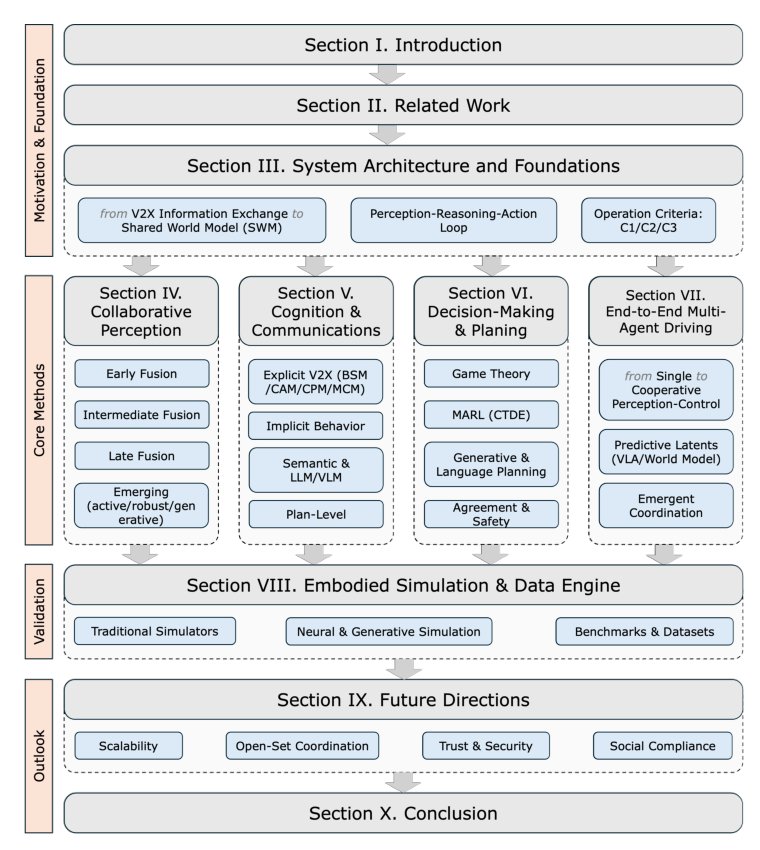
《Multi-Agent Embodied Autonomous Driving: From V2X Information Exchange to Shared World Models》(arXiv preprint / 2026)实际处理的问题不是单一任务,而是多智能体自动驾驶研究范式的重组:如何从 V2X 消息交换、协同感知和局部规划,推进到共享预测状态、意图对齐和联合行动。
真正困难点在于,自动驾驶里的多智能体协作不是简单的信息融合问题。感知层可以通过多视角降低遮挡,但规划层需要知道其他 agent 将如何解释、响应和约束自己的动作。也就是说,系统必须同时解决 partial observability、communication bottleneck、intent ambiguity、non-stationary interaction 和 safety verification。以前大量 V2X/CP 工作卡在“检测指标提升”上,默认只要共享 perception feature/object list,下游自然会变好;但实际 planning gain 经常不稳定,甚至在 dense traffic 下 negotiation 或 perception sharing 可能伤害决策。
关键矛盾是:多传信息可以提高可观测性,但也引入带宽、延迟、攻击面、不一致 belief 和 planner 复杂度;少传信息更可部署,却不足以表达 intent、role、future commitment。论文试图把这个矛盾提升到 SWM 层面:不是问传什么数据,而是问系统是否维护了一个足够一致、足够预测性、足够可被 planner 消费的共享世界状态。
Motivation
作者的核心观察是:V2X-centric view 主要解决 data/communication layer,而不是 embodied coordination。很多系统仍然是 loosely coupled decision-makers:每辆车有自己的 internal world model,通信只作为补充或校正。这种范式在遮挡检测上有效,但在需要 mutual predictability、joint future reasoning、role negotiation 的场景里不够。
缺口主要有三层。第一,shared state 缺口:feature fusion 不等于可维护的跨 agent belief;很多 fused BEV 只服务检测,没有被证明能稳定支持闭环规划。第二,intent/plan 缺口:object boxes、velocity、CAM/BSM 这类消息语义贫乏,难以表达“我准备让行/抢行/并入/等待”的约束结构。第三,verification 缺口:LLM/VLM/world model 可以生成解释、计划和未来,但缺少实时安全保证,也缺少在通信退化和开放交通中的证据。
因此作者想到 SWM 不是因为某个模块突然可行,而是因为领域已经出现一批碎片化技术——协同 BEV、semantic communication、LLM negotiation、generative world models、E2E V2X driving——需要一个共同中介变量来判断它们是否真的推进了 cooperative driving loop。
Core Idea
核心思想是把 multi-agent autonomous driving 从“information exchange problem”改写成“shared predictive representation maintenance problem”。这个改写引入了一个很强的 inductive bias:协作的关键不是消息本身,而是消息是否让多个 agent 在状态、未来意图和动作约束上形成 operational alignment。
论文用 SWM 作为组织概念,并提出 C1/C2/C3 三个证据层级:C1 是 cross-agent state alignment,例如 fused BEV、graph state、latent map、V2X knowledge pool;C2 是 intent and plan alignment,例如显式轨迹、语言协商、role/goal memory、future behavior retrieval;C3 是 coordinated downstream action,即共享状态或意图真的改变了 joint policy、trajectory、waypoint 或 control。这个划分的本质区别在于,它不再把 collaborative perception 的 detection AP 当作最终证据,而要求看到从 representation 到 action 的因果链。
理论/直觉上它可能有效,是因为自动驾驶协作的瓶颈正在从 sensing 转向 belief/action coupling。单车模型缺视角,多车感知补视角;但如果补来的信息不能进入一个可预测、可协商、可验证的状态空间,它只会成为 planner 的噪声或延迟负担。SWM lens 的价值是把“共享什么”从 raw data/object/message 提升到 belief、future 和 constraint。
Method
1. 区分 Information Exchange 与 SWM-driven Coordination。它解决的是概念混淆:传统 V2X 标准、CPM/MCM、feature sharing 都容易被称为 collaboration,但很多只是传输层或感知层增强。这个区分迫使研究者回答消息是否导致 shared state、intent alignment 和 coordinated action。
2. 构造 perception-reasoning-action loop。这个 loop 不是新架构,而是机制约束:local observation 和 V2X communication 先形成 shared-state construction;SWM 支持 intent/plan alignment;planner 输出 coordinated action;执行反馈再更新下一轮 sensing/communication。必要性在于 MAEAD 是闭环系统,离线 perception benchmark 不能代表协作能力。
3. 用 C1/C2/C3 对文献进行 conservative evidence coding。这个机制解决 heterogeneous artifacts 不可比的问题:有的论文输出 BEV feature,有的输出 language plan,有的输出 trajectory,有的只是 simulator。作者用 artifact + downstream use 来判断证据强度。核心变化是从“按模块分类”转向“按协作证据链分类”。
4. 将协同感知、通信、规划、E2E、仿真统一到同一证据框架。协同感知主要支撑 C1;semantic/language/plan communication 支撑 C2;MARL、game-theoretic planning、E2E cooperative driving 支撑 C3;simulation/data engine 决定这些 claim 是否能被闭环验证。这个组织方式比逐模块综述更有研究判断力。
Key Insight / Why It Works
最重要的 insight 是:多智能体自动驾驶的真实进展不能用 perception accuracy 或 message bandwidth 单独衡量,而要看 shared representation 是否进入 planning loop。这个判断非常关键,因为当前很多 CP 工作的增益主要来自更好的 representation alignment 和遮挡补全,但并不自动产生更好的协作行为。
论文最有价值的贡献是 C1/C2/C3 这套证据分层。它把领域中大量“看似都在合作”的方法拆开:BSM/CAM 只是 awareness;CPM/object fusion 是弱 C1;intermediate BEV fusion 是较强 C1;trajectory/language negotiation 是 C2;只有 planner/control 真用这些状态并改变动作才是 C3。这个分层能直接暴露很多论文的 claim inflation:声称 cooperative driving,但证据只到 perception fusion;声称 reasoning,但没有 controller grounding;声称 world model,但只是生成 plausible video,没有验证 multi-agent belief alignment。
协同感知有效的主要原因不是通信本身,而是 BEV/graph/latent feature 提供了较好的 cross-view spatial alignment inductive bias。尤其 intermediate fusion 之所以成为主线,是因为它在 raw data 的信息量和 late fusion 的可部署性之间找到折中:保留足够几何/语义结构,同时允许 sparsity、confidence gating、uncertainty modeling。这里真正的机制是 representation alignment + selective communication,不是 transformer 或某个模块本身。
LLM/VLM 部分的有效性更值得怀疑。它们可能提供 semantic grounding、role/intent verbalization、plan critique,但很多所谓“协商”更像 structured prompting + retrieval + benchmark-specific reasoning。文中也没有充分说明这些语言计划如何在实时、延迟、错误感知和 adversarial message 下保持安全。增益来源不清,可能主要来自 foundation model 的先验知识、场景文本化后的简化、仿真环境的可控性,而不是可靠的多智能体在线推理。
World model/generative simulation 的价值主要在 data coverage 和 counterfactual rollout。它们可以扩展 rare events、生成未来、测试 planners,但距离 shared world model 还有缺口:生成一致视频或轨迹不等于维护可审计的跨车 belief。真正需要的是 uncertainty-calibrated、communication-aware、planner-coupled 的 predictive state,而不是高保真生成本身。
E2E cooperative driving 的核心风险是把接口问题隐藏到 latent 里。它可能通过 shared latent 直接优化 perception-control coupling,但 interpretability、credit assignment、failure attribution 都更难。当前最合理的路线不是纯 E2E,也不是纯 LLM planner,而是 hybrid:learned shared representation + explicit intent/plan channel + verified safety filter。
Relation To Prior Work
这篇论文最接近几条 survey 谱系的交叉:V2X cooperative perception surveys、MARL/cooperative planning surveys、end-to-end AD surveys、LLM/VLM driving surveys、world model surveys。它不是在某一条线上做更细,而是把这些线重新接到一个 MAEAD/SWM 证据链上。
相对 CP/V2X survey,本质差异是它不把 fusion stage、bandwidth、dataset 作为终点,而是追问 fused representation 是否支持 intent 和 action。相对 MARL/planning survey,它把 policy learning 放回 perception/communication 约束下看,而不是只讨论 CTDE、credit assignment、non-stationarity。相对 LLM/VLA survey,它更保守:把 foundation model 定位为 semantic advisory / negotiation interface,而不是安全关键 controller。相对 world model survey,它强调 multi-agent sharedness,而不是单车未来视频/occupancy 生成。
看似新的地方,如 semantic communication、language negotiation、world model rollout,其实很多是已有思想重组:feature sparsification 是 communication-efficient CP 的延伸;LLM negotiation 是 plan-level communication 的自然语言版本;generative world model 是 scenario generation + prediction 的 scaling 版本。实质创新在于作者提出了一个“如何判断这些东西是否真的构成 MAEAD”的框架,而不是某个算法模块。
技术谱系上,它属于 deployment-facing system survey / conceptual framework,而不是 method paper。贡献不在性能,而在重新定义评价单位:从模块 benchmark 转向 cooperative driving evidence chain。
Dataset / Evaluation
评估层面,这篇论文没有自己的实验,而是审视已有数据集、benchmark、simulator 是否支撑 MAEAD claim。其判断基本成立:当前证据最集中在 OPV2V、DAIR-V2X、V2X-Sim、V2V4Real、V2XSet 等协同感知基准,以及 CARLA/SUMO/SMARTS/OpenCDA/V2Xverse 等仿真平台。真实世界多车闭环评估很少,真机部署更少。
任务覆盖上,perception benchmark 较成熟,planning/closed-loop/cooperative E2E 仍薄弱。很多数据集可以验证 C1,即是否对齐跨车对象/BEV/occupancy;但很少验证 C2/C3,即 intent negotiation 是否正确、共享状态是否改善闭环安全、通信退化时是否有 fallback。MDrive 这类闭环 cooperative benchmark 反而重要,因为它开始揭示 perception sharing 不必然带来 planning gain。
benchmark 是否支持核心 claim?对“领域正在从 V2X exchange 走向 SWM”这个 claim,文献趋势支持;但对“SWM 已经可实现 deployment-ready coordination”不支持。评估最大 limitation 是 simulation-centered、curated scenarios、offline protocol、缺少 adversarial/open-set/latency-aware real-world validation。很多 foundation-model coordination 的评估更像 proof-of-concept,不足以证明实时安全协作。
Limitation
第一,SWM 概念过宽。论文把 fused BEV、graph state、latent map、symbolic description、knowledge pool、world model rollout 都纳入 SWM 候选,这有助于整合领域,但也削弱了可操作性。什么程度算 shared?什么程度算 model?什么程度算 world?文中未充分说明 formal boundary。
第二,C1/C2/C3 是有用的人工编码,但不是验证标准。它能帮助读者识别证据层级,却不能证明系统满足一致性、收敛性、实时性或安全性。尤其“partial support”的判断有主观空间。
第三,论文的很多未来方向依赖 foundation models/world models,但这些模块的真实能力可能被高估。LLM 的所谓 social reasoning 很可能是 retrieval/prompt prior;VLM grounding 可能受 benchmark overlap 和视觉语言数据覆盖影响;world model 的未来生成可能在视觉上合理但行为动力学错误。核心能力可能主要来自数据覆盖和 scaling,而非可靠因果推理。
第四,方法把一些问题从 communication/perception 转移到 shared-state maintenance 和 verification。比如 sparse communication 降低带宽,但如何保证遗漏信息不破坏安全?language negotiation 增加可解释性,但如何防止 hallucinated agreement?E2E latent 提高端到端耦合,但如何审计错误?这些都没有被真正解决。
第五,部署前提很强。MAEAD 假设一定程度的通信可用、时钟/坐标可对齐、agent identity 可追踪、消息可验证、planner 可消费共享状态。开放道路中 legacy vehicles、行人、自行车、恶意/故障节点不满足这些前提。泛化是否真实存在,目前证据不足。
第六,scaling 上限未被实证刻画。更多 agent 是否带来更好 observability,还是带来 attention dilution、通信拥塞和 belief conflict?论文提出 scaling behavior 作为未来问题,但没有给出实证规律。
Takeaway
- 1. 这篇最值得记住的是 C1/C2/C3:以后看 cooperative driving 论文,先问它证据停在哪一层,而不是看它用了什么 fusion/LLM/world model。
- 2. 协同感知的下一步不是继续堆 fusion backbone,而是 planner-usable shared state:带 uncertainty、latency compensation、trust/provenance,并能触发安全 fallback。
- 3. LLM/VLM 在 MAEAD 中更合理的位置是 semantic interface 和 plan critique,不应被当作安全关键 planner。
- 真正可部署系统大概率是 hybrid:显式协议 + learned representation + foundation-model advisory + verified controller。
一句话总结
这篇论文的价值不在提出新模型,而在把多智能体自动驾驶从 V2X 信息交换重新定位为可验证共享世界模型驱动的协作问题,并给出一套判断文献是否真正走到 coordinated action 的研究框架。