精读笔记
Problem Setting
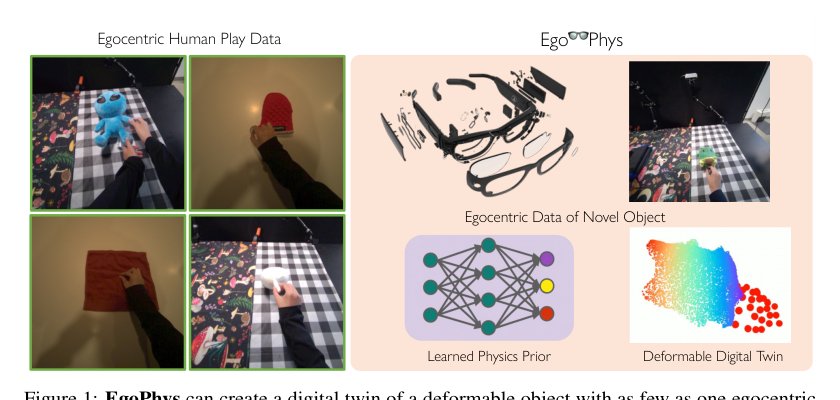
EgoPhys 处理的是 deformable-object real-to-sim 中最不友好的观测设置:单段 egocentric RGB video、非受控人手交互、强遮挡、无深度、无标定多视角。目标不是做视觉上像的视频预测,而是得到一个 spring-mass simulator,可以在新 action 下 rollout,并能作为 robot planner 的 forward model。
真正困难点在于高维物理参数不可辨识。局部 stiffness field、接触模型、几何拓扑、控制点连接关系都从短视频中估计,且 egocentric 视角下可见区域有限。以前的 physics-based twin 方法通常通过强观测和 per-scene optimization 把这个问题硬拟合掉;但这种做法不 scalable,也无法直接从人类日常视频中快速得到可用模拟器。本文的关键矛盾是:数据来源要 scalable,就必须接受弱观测;弱观测下又必须依赖强先验,否则 dense physical parameters 没有足够约束。
Motivation
已有路线的不足很明确。视频生成模型能给出 plausible dynamics,但没有显式物理参数和 action-conditioned controllability;neural dynamics / graph simulator 可以快速 rollout,但通常需要更干净的 state representation 或任务内训练;PhysTwin/PhysWorld 类方法能拟合物理 twin,但更依赖 controlled capture 和测试时密集优化。
作者的核心观察是:per-object inverse physics 虽然昂贵,但它产生的 dense stiffness solution 不一定只能服务于当前对象;这些 solution 可以被看成跨对象物理经验的样本。也就是说,过去方法把 dense refinement 当作 test-time compute,EgoPhys 把它转化为 training-time supervision。缺口就在这里:如何从很多单对象物理拟合结果中抽取一个可复用、低维、能在未见对象上补全 stiffness field 的 prior。
Core Idea
核心思想是 coarse-to-dense amortized system identification。先用传统 inverse optimization 在每个视频上得到粗 simulator:graph topology、global stiffness、contact/damping 等对象级参数;再用一个共享 codebook 预测每根弹簧、每个状态下相对于 global stiffness 的 log-offset。这样,测试时仍保留少量 per-object adaptation,但避免最昂贵、最容易过拟合的 dense per-spring refinement。
这个设计的本质变化是把物理建模从“连续高维参数自由优化”改成“少量材料原型的状态条件组合”。sign-aware codebook 进一步假设 tension 和 compression 的局部响应应使用不同 prototype bank;dynamic conditioning 则允许 stiffness 随 strain、strain rate、contact/height 等状态变化。这不是严格物理材料模型,而是一个很实用的 inductive bias:局部变形响应在小数据下需要离散 bottleneck 和 anchor,否则直接 MLP 会过拟合噪声。
Method
第一层机制是观测对齐:用现成 tracking、segmentation、3D lifting 模型把第一视角 RGB 转成 4D point cloud。它解决的是将 egocentric video 接到 physics optimizer 的接口问题。这个环节很工程化,但在任务里不可或缺,因为后续所有物理拟合都假设已有可跟踪的 object/control state。
第二层机制是 coarse physical anchor:CMA-ES 在低维参数空间里拟合 spring graph 和全局物理参数。它的作用不是提供最终精确模型,而是把对象尺度、拓扑、接触范围和 stiffness order-of-magnitude 定下来。codebook 预测 offset 而非 absolute stiffness,正是为了利用这个 anchor。
第三层机制是 codebook distillation:训练时用 per-object dense inverse-physics stiffness 作为 target,同时用 rollout loss 约束最终动态;测试时 codebook 根据 static graph features 和 dynamic deformation features 生成 dense stiffness。这里最重要的是 prototype bottleneck,而不是 MLP 结构本身。它限制了解空间,使模型更像在选择可复用材料模式,而非任意回归每根弹簧。
第四层机制是把 simulator 接入 MPPI 做 robot planning。这一步验证了 forward model 的可用性,但从方法角度看不是新的 planning 算法;关键在于 real-to-sim 模型是否足够稳定到能支持短程 open-loop control。
Key Insight / Why It Works
最可能真正有效的部分是 anchor-relative codebook。单目 egocentric video 直接识别 dense stiffness 是 ill-posed;但如果先用 CMA-ES 获得一个对象级粗解,再只学习局部 correction,学习问题会稳定很多。log-space offset 也很关键:它把材料差异变成乘性修正,并自然处理 stiffness 的尺度跨度。
prototype bottleneck 是第二个核心。direct MLP 变差说明在这种小数据、噪声 target 下,容量不是瓶颈,正则化和可复用 latent structure 才是瓶颈。codebook 本质上是一种 memory reuse / latent clustering:把训练对象中的 dense refinement 压成少数可复用物理 primitive。所谓 generalization 很可能不是学到了通用连续介质物理,而是在相似对象和相似接触模式中检索/组合已有局部响应模式。
dynamic conditioning 的作用更像 rollout stabilizer,而不是材料识别本身。它让同一根弹簧在不同 strain/strain-rate 状态下选择不同 offset,因此可以补偿 spring-mass 模型过于简单的问题。换句话说,codebook 部分也在吸收 simulator/model mismatch,不完全是材料参数。
上游 reconstruction 大量依赖 foundation model 和工程过滤,增益来源有一部分可能来自更稳的 4D tracks、controller connections、ground/contact heuristics,而非 codebook 本身。论文通过统一输入给 baselines 试图隔离这一点,但 EgoPhys pipeline 与 baseline adaptation 的公平性仍有限,因为 PhysTwin/Spring-Gaus 并非为 monocular egocentric 设置设计。这里的 claim 应该解读为“在这个 egocentric pipeline 下,learned stiffness prior 比直接套用 per-scene methods 更合适”,而不是完全证明方法在所有 real-to-sim 设置中优越。
Relation To Prior Work
最接近的是 PhysTwin / PhysWorld / Spring-Gaus / MatPhys 这条 explicit physics + video reconstruction 的谱系。EgoPhys 没有发明新的 deformable simulator,也没有从根本上解决 differentiable physics;它的实质创新是把 per-scene dense refinement amortize 成跨对象 codebook,并把输入设置推进到 egocentric RGB-only。
相对 PhysTwin,差异不是 spring-mass formulation,而是参数估计范式:PhysTwin 是 test-time dense optimization,EgoPhys 是 coarse optimization + learned prior inference。相对 MatPhys,EgoPhys 更强调 egocentric human interaction 和 spring-level state-conditioned stiffness,而不是从单视角视频预测 part/material prior。相对 graph neural simulator,EgoPhys 保留显式物理参数和可控 simulator,因此更适合 real-to-sim/planning,但表达能力受 spring-mass 简化限制。
看似新的部分里,4D reconstruction pipeline 很大程度是现有 foundation modules 的组合;robot MPPI 也是标准用法。真正新增的信息是:dense inverse-physics solutions 可以作为监督信号,被压缩成一个小 codebook,在未见对象上替代 per-spring test-time optimization。这是本文最值得保留的贡献。
Dataset / Evaluation
数据集覆盖 plush toys、towels、cloth/bags 等,交互包括 lifting、pulling、pushing、folding;从任务形态看比单一 cloth benchmark 更接近日常人类交互。但规模非常小:19 条短视频,codebook 训练只有 8 条序列。这个规模足以做 proof-of-concept,不足以支撑强泛化结论。
评估基本围绕三件事:observed-window resimulation、future prediction、held-out sequence zero-shot codebook inference。它确实验证了本文最核心的工程 claim:在相同 egocentric observations 下,codebook prior 能改善 rollout 并避免 dense refinement。ablation 也比较直接地支持 prototype bottleneck 和 dynamic conditioning 的作用。
但 evaluation 的外推能力有限。held-out set 仍来自同一采集协议、相似桌面环境、相似交互长度和相似对象分布;benchmark overlap 风险存在,尤其是 plush/towel 类对象在视觉和物理模式上重复度较高。真机实验只有三个任务,且 open-loop、短程、无真实物理参数对照;它证明了 simulator 对简单 manipulation 有用,但没有证明复杂 contact-rich planning 或长期闭环任务能力。
Limitation
方法成立依赖几个强前提。第一,upstream 4D reconstruction 必须足够稳定;如果 tracks 漂移、遮挡区域 hallucination 错、hand-object contact 估计错,后续 inverse physics 会在错误 state 上拟合出貌似合理但物理含义偏移的 stiffness。第二,CMA-ES coarse anchor 必须把对象带到正确参数 basin;codebook 只能做局部 correction,不能从完全错误的 topology/contact model 中恢复。
第三,所谓泛化更可能是分布内 material/contact pattern reuse,而不是通用材料推理。训练数据太小,codebook 原型数量也很少,这有助于正则化,但也限制了材料多样性。遇到薄膜、绳索、液体袋、强塑性、不可逆折痕、复杂自接触等,spring-mass + stiffness offset 的上限会很快暴露。
第四,方法并没有完全消除 test-time compute,只是把 dense refinement 换成 coarse CMA-ES + codebook inference。对需要快速在线建模或 closed-loop adaptation 的机器人任务,这仍可能太慢。第五,planner 成功可能主要来自短程几何 rollout,而不是形成可长期预测的 world model;没有闭环 replanning 和大规模 real-robot statistics,sim-to-real claim 应保持克制。
最后,增益归因仍不完全清晰。EgoPhys 同时改变了 reconstruction pipeline、contact construction、stabilizers、stiffness prior 和 baseline adaptation。虽然 ablation 指向 codebook 有效,但有多少收益来自 engineering heuristics、数据覆盖、或 baseline 在 egocentric 设置下不适配,文中未充分说明。
Takeaway
- 1. 对弱观测 real-to-sim,直接估计高维物理参数通常不现实;更可行的路线是 coarse per-instance anchor + learned residual prior。
- 2. Dense inverse-physics optimization 的价值不只在 test-time fitting,也可以作为训练信号,被蒸馏成可复用的 amortized system-identification memory。
- 这个思路可以迁移到 friction、contact compliance、actuator coupling、articulated-object joints 等参数估计问题。
- 3. 小数据下 prototype/codebook bottleneck 比直接 MLP 更可靠;它提供的不是更强表达能力,而是更强的可迁移结构约束。
一句话总结
EgoPhys 是 deformable real-to-sim 从 per-scene dense optimization 走向 egocentric-data-driven amortized physics prior 的早期尝试,其核心贡献是用 coarse-anchor-conditioned material codebook 复用单对象 inverse-physics 解,而不是提出新的物理模拟器。