精读笔记
Problem Setting
论文标题:GeneralVLA-2: Geometry-Aware Reconstruction and Governed Memory for Robot Planning(arXiv preprint / 2026)。
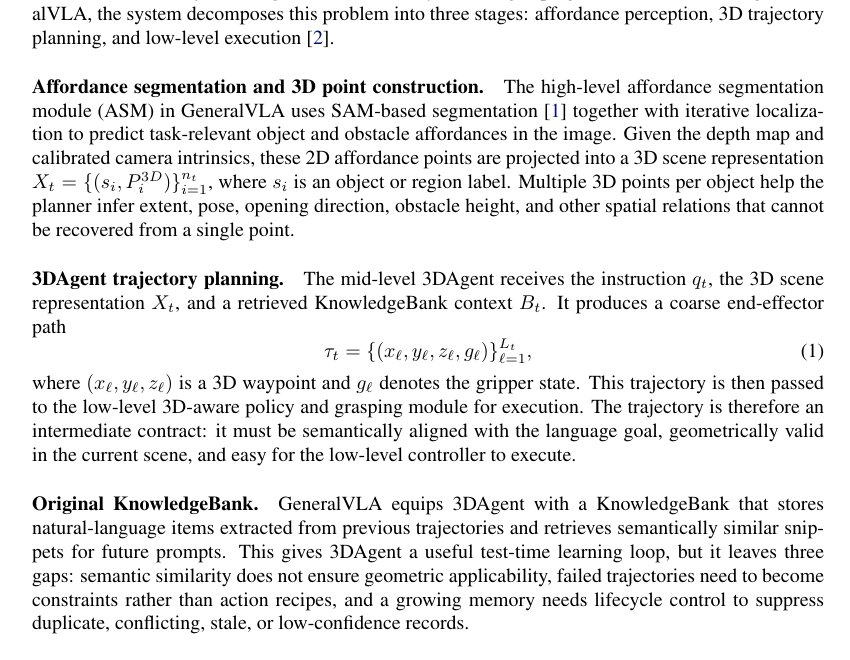
这篇论文实际处理的是 hierarchical VLA 的 planner conditioning 问题,而不是重新定义 VLA policy。GeneralVLA 已经有一个比较清晰的中间接口:ASM / localization 产生 3D scene points,3DAgent 输出 end-effector waypoint trajectory,low-level policy 执行。GeneralVLA-2 盯住的是这个接口中最容易出错的两类输入:object-centric 3D geometry 和 long-term manipulation memory。
真正困难点有两个。第一,生成式/单目 3D 对 manipulation 来说风险很高:看起来 plausible 的背面结构、姿态或尺寸误差,可能直接改变 grasp pose、clearance、collision relation。第二,经验复用不是普通 text retrieval:相似任务的经验可能在当前几何、工具状态、失败模式、环境约束上完全不适用。以前方法卡在“多给 planner 信息”这个层面,但没有解决“信息是否被当前观测支持、是否仍然可信、是否和其他 memory 冲突”的问题。
关键矛盾是:planner 需要更多上下文才能泛化,但 robot planning 又极度厌恶错误上下文。GeneralVLA-2 的问题设定可以概括为:如何把 geometry prior 和 past experience 作为外部证据接入 VLA planner,同时降低 hallucination 和 memory contamination。
Motivation
已有路线不够的原因不是缺少更强的 backbone,而是 planner 输入的 evidence quality 不稳定。单目 SAM3D-style reconstruction 的强项是补全和生成,但 manipulation 需要的是 calibrated scene 下的可靠几何;append-only KnowledgeBank 的强项是快速积累经验,但它无法区分 successful recipe、failure constraint、stale heuristic 和 conflicting memory。
作者的核心观察是:在很多机器人场景中,系统不是完全没有几何证据——它有 RGB-D、多视角、mask、camera pose;也不是完全没有经验——它有历史轨迹、execution feedback、outcome。缺口在于这些信息没有被组织成“可验证、可退让、可治理”的形式。于是论文选择的方向不是 end-to-end retrain,而是 planner-facing evidence refinement。
这也是论文最合理的出发点:hierarchical VLA 的接口既是瓶颈,也是可插拔改进点。只要 trajectory contract 不变,就可以在 perception side 加 conservative geometry evidence,在 memory side 加 governed retrieval,而不需要重训底层控制器。
Core Idea
核心思想可以压缩成一句:不要让 planner 直接相信生成模型和历史记忆,而是让它只消费被当前观测和 verifier 支持的 evidence。
GeoFuse-MV3D 引入的 inductive bias 是 multi-view silhouette / mask support 优先于 monocular plausibility。外部 3D estimator 不是 oracle,而是 proposal;输入视角 mask、pose 和 soft visual hull 才是约束。它改变了重构的建模方式:从“生成一个完整物体”转向“在 baseline reconstruction 上做受观测支持的几何校正”。这在 manipulation 中更合理,因为 downstream 更关心 pose/extent 的稳定性,而不是视觉上最漂亮的 novel-view synthesis。
Governed KnowledgeBank 的 inductive bias 是 precision-oriented memory reuse。它把 memory 从语义相似片段变成带质量分数、置信度、生命周期、冲突链接和 verifier evidence 的 record。和 prior memory work 的本质区别不是“也用了 memory”,而是它承认 memory 本身是 noisy state,需要 admission、promotion、suppression、archival。这个设计更 scalable 的地方在于,随着经验增加,系统不是单纯扩大 retrieval pool,而是维护一个可控 active set。
Method
方法层面最关键的不是模块数量,而是几个约束机制。
1. Geometry prior as proposal, not answer。GeoFuse-MV3D 用 VGGT 这类外部 feed-forward geometry provider,但只把它作为几何先验来源。它解决的是 MV-SAM3D 仍可能存在的 pose / shape ambiguity;必要性在于多视角输入已经提供了约束,不应再完全依赖生成式补全。核心变化是从 generative hallucination 转向 observation-checked correction。
2. Mask support / soft visual hull as conservative regularizer。每个 3D 点投影回输入视角,用 mask consistency 判断其是否被观测支持。低 support 不是直接删除,而是 bounded inward shrink。这解决 hard pruning 容易破坏 geometry completeness 的问题,也符合机器人规划中对 over-shrink / missing parts 的敏感性。这里的核心变化是把 mask 从 segmentation output 变成 geometry confidence signal。
3. Axis-wise low-dimensional correction。它只允许尺度和位移这类低维变换,而不是任意形变。解决的是 baseline object extent / alignment 的系统性偏差;必要性在于低维 correction 更不容易过拟合 mask noise。它的作用更像 robust calibration,不是完整 reconstruction learning。
4. Geometry-only fusion。最终只融合 Gaussian centers,不覆盖 appearance、opacity、scale、rotation、SH features。这解决的是外部 prior 或 mask correction 破坏 rendering attributes 的问题。核心变化是把 geometry fidelity 和 appearance preservation 解耦。
5. Memory governance。KnowledgeBank record 显式区分 procedural hint、failure avoidance、tool usage,并带有 confidence、quality、lifecycle、conflict metadata。retrieval scoring 不只看 text relevance,还惩罚 conflict / stale,奖励 success / recency / usage。它解决的是 semantic retrieval 高召回但低精度的问题。尤其重要的是 failure memory 被渲染为 constraint,而不是被误当作可复制策略。
Key Insight / Why It Works
这篇最有价值的 insight 是:hierarchical VLA 的性能上限很大程度不是 planner 本身,而是 planner 输入 evidence 的 epistemic hygiene。GeneralVLA-2 的两个贡献看似分散,一个是 3D reconstruction,一个是 memory;但它们背后是同一个机制:对外部信息做 support-aware filtering。
GeoFuse-MV3D 有效的原因大概率不是因为它引入了一个更强 3D generator,而是因为它限制了 generator 的自由度。多视角 mask 和 camera pose 提供了 hard-to-fake 的几何约束;axis-wise correction 提供了低维可控调整;geometry-only fusion 避免外观通道被污染。换言之,它的核心贡献是 better inductive bias 和 conservative post-hoc alignment,而不是 scaling。考虑到 GSO-30 上提升幅度只有几个百分点,这更像工程上合理的 refinement,而不是本质突破。
KnowledgeBank 有效的原因更明确:它把 memory reuse 从 recall-oriented retrieval 改为 precision-oriented retrieval。对于 long-horizon agent,错误 memory 的负效应往往比没有 memory 更大;因此 admission、conflict handling、failure-as-constraint 的收益会非常直接。这里所谓“推理增强”很可能主要来自 retrieval quality、experience coverage 和 test-time compute,而不是 LLM planner 获得了新的抽象规划能力。
我认为论文中最可能是真正核心贡献的是 governed memory 的 framing,而不是具体打分公式。公式本身很普通,像是 retrieval reranking + metadata filtering;但把 failure、lifecycle、conflict 和 verifier 作为 persistent metadata 接入 robot planner,是有迁移价值的。相比之下,GeoFuse-MV3D 更像对 MV-SAM3D/VGGT/visual hull 的谨慎组合,技术上合理但新意有限。
需要警惕的是增益归因。RLBench 中 GeneralVLA-2 相比 w/o KnowledgeBank 提升明显,但这可能来自任务探索十次后的经验覆盖,而不是泛化推理。Terminal-Bench / SWE-Bench 证明 governed memory 对 software agents 有用,但不能自动证明其对 embodied geometry-conditioned planning 同样关键。文中未充分说明 reconstruction improvement 到 manipulation success 的因果链。
Relation To Prior Work
这篇位于三条谱系的交叉点:object-centric multi-view reconstruction、hierarchical VLA planning、agent memory governance。
和 SAM3D / MV-SAM3D 的关系:GeoFuse-MV3D 不是替代它们,而是在 MV-SAM3D 输出上叠加 geometry prior + mask-verified correction。真正不同点是外部 geometry estimator 被降级为 prior provider,而不是最终 reconstruction source。这一点是实质设计选择;但 soft visual hull、mask reprojection consistency、axis scaling 本身都不是新概念,更像已有几何约束在 3D Gaussian object reconstruction pipeline 里的重组。
和 VoxPoser / CAP / Manipulate-Anything 这类 foundation-model planning 的关系:GeneralVLA-2 继续站在 intermediate representation 路线,而不是端到端 VLA policy 路线。它的新增信息不是更大模型,而是更干净的 3D evidence 和更受控的 memory context。这和 RT-2/OpenVLA/π0 那类 data-scale policy 是不同演化方向:一个靠参数内化技能,一个靠外部结构化证据提高 test-time planning。
和 Synapse / AWM / ReasoningBank 的关系:KnowledgeBank 的本质新增是 memory governance,而不是 memory 本身。ReasoningBank 已经说明 reasoning memory 可以帮助 agent;GeneralVLA-2 进一步强调 verifier metadata、生命周期、冲突控制和 failure memory 类型化。看似新的是机器人 KnowledgeBank,实质上是把 software-agent memory management 的一些思想迁移到 embodied planner,并补上几何适用性语义。
因此这篇的创新更偏系统架构和 evidence management,而非单一模型算法突破。
Dataset / Evaluation
实验覆盖了三类 evidence,但验证力度不均衡。
GSO-30 用来验证 GeoFuse-MV3D 的 reconstruction claim。协议上比较公平:同样五个输入视角、mask、pose、held-out views。结果一致提升,但幅度很小,说明方法确实能修正一部分 geometry / rendering,但还不足以证明对 manipulation 有决定性影响。更关键的缺口是:没有清晰展示哪些 grasp/collision errors 因 reconstruction branch 被消除。
Terminal-Bench 2.0 和 SWE-Bench Verified 用来验证 KnowledgeBank 的 memory governance。这两个 benchmark 对 long-horizon agent memory 是合理 proxy,但和机器人规划存在 domain gap。它们能证明“governed memory 比 semantic memory 更适合 agent problem solving”,但不能单独证明“机器人操作中的经验复用被解决”。
RLBench 的 14 个任务和真机四个任务更接近核心 claim。这里 GeneralVLA-2 相比 CAP/VoxPoser/Hamster 覆盖更多任务,w/o KnowledgeBank 下降也支持 memory 有帮助。但评估仍偏 training-free after exploration,而非严格 zero-shot;探索十次存经验本身就是一个强条件。真机任务数量少、场景静态、horizon 较短,不能验证长期 memory aging、conflict accumulation 或 heavy occlusion 下的稳定性。
总体看,evaluation 支持“这个系统设计方向有用”,但不足以完全支持“几何感知重构 + governed memory 是机器人泛化规划的关键解”。
Limitation
最核心限制是前提很重。GeoFuse-MV3D 假设有 calibrated multi-view、可靠 masks、准确 camera poses、目标对象一致可见;这些条件一旦破坏,mask support score 就可能从约束变成错误信号。它选择 conservative correction,所以鲁棒但上限也低:不能真正修复严重遮挡、拓扑错误、deformable object 或 texture/lighting artifacts。
KnowledgeBank 的上限取决于 verifier 和经验覆盖。错误 verifier 会把坏 memory 提升为 active knowledge,或者压制少见但有用的经验;长期运行中 conflict graph、stale knowledge 和 task distribution shift 会成为主要问题。文中虽然有 lifecycle,但没有证明它在真实 lifelong robot deployment 中稳定。
更深一层的限制是,planner 可能并没有学会长期状态建模。所谓长期经验更像 retrieval-augmented prompting:当历史任务覆盖当前 case 时有效;当场景组合真正 out-of-distribution,memory 可能失效甚至误导。RLBench 和真机结果中的提升可能主要来自 explored task-specific memory,而不是 open-world generalization。
增益归因也不够清楚。GeoFuse-MV3D 在 reconstruction metric 上的提升很小,却被放进机器人 planning narrative;KnowledgeBank 在 software-agent benchmark 上的提升较强,但 embodied 任务中 memory、reasoning backbone、task exploration、motion planner、segmentation quality 的贡献没有完全拆开。部分结果可能主要来自 engineering / data coverage / test-time retrieval,而不是新的规划能力。
Takeaway
- 1. 对 hierarchical VLA 来说,改 planner 不一定是第一优先级;更高杠杆的方向可能是 planner evidence 的质量控制,尤其是 geometry 和 memory 的可靠接入。
- 2. 生成式 3D 用于机器人时应被当作 proposal,而不是 truth。
- 多视角 mask、pose、depth 这类低级观测约束仍然是防 hallucination 的关键 inductive bias。
- 3. Agent memory 的下一步不是存更多,而是治理:admission、failure typing、conflict suppression、lifecycle 和 verifier metadata 会比单纯 semantic retrieval 更重要。
一句话总结
GeneralVLA-2 是一次 evidence-governed hierarchical VLA 演化:它没有提出新的端到端机器人策略,而是通过保守几何校正和受治理记忆复用,让 planner 消费更可信的外部证据。