精读笔记
Problem Setting
这篇论文的实际问题不是“做一个更大的机器人模拟器”,而是解决 embodied interaction 中最麻烦的系统断裂:同一个任务在 RL benchmark、scripted demonstration collection、VLM/agent interaction、trajectory annotation 和 replay/debug 之间往往不是同一个环境、同一个 action semantics、同一个 episode state。
真正困难点在于长程 embodied episode 的因果链很长:layout 随机化、物体物理、机器人 embodiment、controller、planner、skill phase、任务状态、传感、标注、成功判定和数据落盘必须一致。如果其中任何一层是离线脚本或 magic action,高层看到的“行为”就和低层可训练的 action 不一致;如果 episode 不能 replay,失败恢复、counterfactual、数据过滤和评测都不可控。
以前方法通常卡在三个地方:第一,模拟器有 physics/rendering/RL throughput,但没有把 planning、skill、annotation 和 serving 做成同一 runtime contract;第二,benchmark 有任务语义,但高层动作常常是抽象状态编辑或 task-specific script;第三,数据生成 pipeline 能出图像和标签,但不能保证这些标签来自真实执行成功的交互轨迹。关键矛盾是:研究者想要高层抽象和大规模自动化,但 embodied data 的有效性又要求每个状态变化都由可执行控制闭环产生。
Motivation
作者的核心观察是:现在机器人学习、VLA/world-action model 和 embodied agent 都越来越依赖 simulation,但它们需要的已经不是单一 simulator,而是一个 shared execution substrate。低层需要 RL-ready MDP 和 demonstrations;中层需要 grounded skill;高层需要语言命令、计划、观测和后果在同一世界里闭环发生。已有路线的问题是这些层被不同系统切开了。
缺口不在于资产不够多、任务不够多或渲染不够真实,而在于 episode 没有统一生命周期。一个高层 agent 在 Habitat/household-style 环境里可以发出语义动作,但这些动作未必对应 robot controller;一个 manipulation benchmark 可以训练 policy,但其数据和高层任务 decomposition 未必一致;一个 synthetic-data 系统可以渲染复杂场景,却无法记录“机器人实际在哪里抓、planner 为什么选这个目标、失败后如何 retry”。
所以 MagicSim 的动机是把“可执行性”作为基础设施属性:随机化必须可复现,规划必须在 step loop 内,技能必须落到 robot action,标注必须绑定 execution trace,数据必须由 success gate 过滤。这个方向本质上是把 simulation 从 passive world model 变成 active episode compiler。
Core Idea
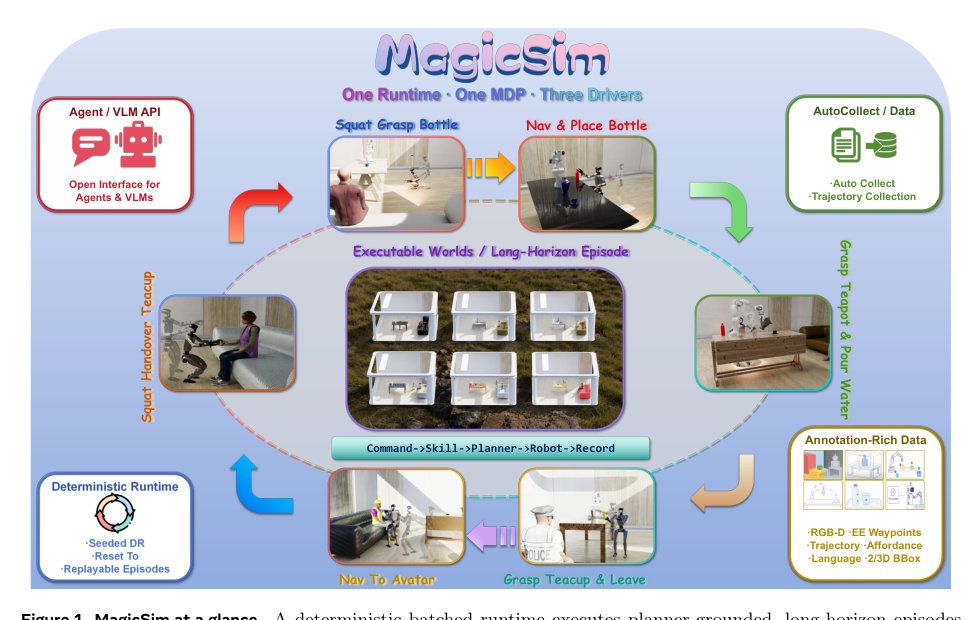
MagicSim 的核心思想是 episode-centric unification:把 world、runtime、action、supervision、exposure 五件事压到同一 deterministic batched MDP 里。一个任务不是分别实现 RL 版本、采集版本和 agent 版本,而是先定义一个共享 MDP;不同 driver 只是在这个 MDP 上选择不同 action path:RL policy 直接 step,AutoCollect 走 Command→Skill→Planner→Robot→Record,Inference/Replay 计划走 RobotManager action space。
这个建模方式改变了 prior 的组织逻辑。prior 常见做法是把高层 agent、planner、controller、data recorder 做成 pipeline;MagicSim 则把它们变成 runtime 内的并行状态机。物理 tick 是同步的,但每个 env 的 command state、skill phase、planner future、retry state、record buffer 是异步的。这样既保留 GPU/batched simulation 的吞吐,又避免一个慢规划调用阻塞整个 batch。
引入的 inductive bias 是:所有监督都围绕“执行过的 episode”而不是“渲染出来的帧”组织。affordance 不是图像上猜出来的区域,而是 planner-selected grasp target;language 不是事后 caption,而是 runtime facts 和 skill phases 的模板化投影;trajectory 不是所有尝试,而是经过任务成功信号过滤的执行记录。这种信息流更 scalable 的原因不是某个算法更强,而是它减少了系统间 semantic mismatch。
Method
1)Deterministic manager runtime:解决随机化、多环境 reset 和 replay 不可控的问题。每个 manager 拥有自己的状态切片和随机流,reset 按 env_ids 和固定顺序发生,snapshot/reset_to 是生命周期的一部分而非日志回放。核心变化是把 reproducibility 从“记录种子”提升为 runtime contract。
2)Parameterized world/entity construction:解决静态 USD prop 难以支持 domain randomization 和异构物理的问题。对象被表示为 logical identity、simulation family、asset/source、pose/scale、visual/physical/solver parameters、observation hooks 的组合。关键变化是 semantic identity 与 physical prim path 分离,使 P1/P2/P3 lifecycle、re-instancing 和 replay 可行。
3)One MDP, three drivers:解决 benchmark、data collection、agent interaction 三套环境分裂的问题。TaskBaseEnv 固定 observation/action/reward/termination/success/status 边界,driver 只改变如何 step。核心变化是 evaluation signal、collection write gate 和 agent feedback 使用同一 status ontology。
4)Asynchronous planner-in-the-loop:解决 batched simulation 中规划调用慢且 ragged 的问题。技能 submit future,simulation 继续 step,planner service microbatch 聚合请求并返回结果。核心变化是 planning 从外部脚本变成 runtime service,并且 test-time compute 不再破坏 batch throughput。
5)AtomicSkill layer:解决高层命令和低层物理之间缺少可靠接口的问题。技能固定为可验证 execution unit,内部可以是 motion generation、RL backend、MPC 或 script,但都必须产生 typed outcome、phase trace、success check 和 retry path。核心变化是把生成性放在上层,把物理可执行性工程化地固定在下层。
6)Runtime annotation + success-gated recording:解决 synthetic labels 与真实执行脱节的问题。系统记录 camera/Omni labels、native eef waypoint/object bbox/affordance、skill/planner trace、language L1/L2/L3,并只在成功后 flush。核心变化是监督和实际 action/state transition 同源。
Key Insight / Why It Works
最核心的 insight 是:embodied learning 的很多困难不是单个 policy/planner 的性能问题,而是 episode information alignment 问题。只要 benchmark、collector、planner、annotation、serving 各自维护一套状态,数据再多也会带来 semantic drift。MagicSim 通过 one runtime + one MDP 把这些状态强制对齐,所以它的主要价值是 representation alignment 和 lifecycle alignment,而不是新算法。
真正可能有效的部分有三点。第一,deterministic manager runtime 是基础贡献:它让 domain randomization、parallel reset、failure replay、counterfactual 和 success-gated collection 变成可组合操作。第二,planner-in-the-loop asynchronous execution 是工程上但非常关键的贡献:它把 test-time compute 融入 batched environment,而不是把规划预先离线化。第三,AtomicSkill + annotation bank 把高层命令的可执行空间限制在经过验证的候选和技能上,大幅提高采集成功率,同时产生结构化监督。
需要直接指出的是,系统能力很大一部分来自 engineering / scaling / data coverage:15 类物理 family、17005 资产、约 10^8 级候选 action annotations、约 33 embodiment、多任务 registry、cuRobo fork、tiled capture、manager lifecycle。这些不是坏事,但论文的“统一性”增益很难和“覆盖面足够大、先验足够多、技能工程足够强”分开归因。
所谓 high-level reasoning 目前也不应过度解读。AutoCollect 中的长程行为主要是命令序列 + AtomicSkill state machine + planner feasibility + retry,而不是 learned long-horizon reasoning。VLM/agent 部分更多是接口和未来方向;外部 high-level command API、closed-loop planner RL、InferenceRunner 都有 planned/integration-point 色彩。当前最扎实的是 executable data infrastructure,不是 autonomous embodied agent intelligence。
另一个隐含机制是 hidden supervision / retrieval-like execution。Asset annotation bank 给出了大量 physics-validated candidates,技能运行时从 bank 中取 goalset 再让 planner 选可行解。这更像 retrieval + feasibility filtering + test-time planning,而不是从 raw observation 中自主发现 affordance。对于数据生成这是优势;对于声称泛化能力则需要谨慎。
Relation To Prior Work
MagicSim 最接近的谱系不是单一 simulator,而是 IsaacLab/ManiSkill/RoboCasa/BEHAVIOR/Habitat/MimicGen/cuRobo/LLM-agent interfaces 的系统级重组。它站在 Isaac Sim/IsaacLab 之上,不是替代 physics engine;使用 cuRobo,不是提出新 motion planner;使用 skill/TAMP 思路,不是发明 skill abstraction;使用 success-gated synthetic data,也和 MimicGen/RoboCasa 一脉相承。
真正不同点在于它把这些东西放进同一个 runtime boundary。IsaacLab/ManiSkill 强在 RL throughput 和 manipulation env,但 planner-grounded skill、annotation-rich collection、agent-facing interaction 未必共用一个 episode lifecycle。RoboCasa/MimicGen 强在数据生成,但多 embodiment、多物理、async planner service 和 reset_to replay 不是核心。Habitat/BEHAVIOR 强在 embodied semantics,但 robot-grounded contact-rich execution 和 low-level action consistency 不同。MagicSim 的新增信息是“执行 substrate 的统一设计”,而不是某个任务族或模块本身。
看似新的部分中,有不少是已有思想的系统化拼接:YAML-first config、domain randomization、seeded reset、skill hierarchy、success-gated demos、language trace、Omni annotations、planner services 都不是新概念。实质创新在于把它们的边界重新画到了 episode/MDP/runtime 上,并处理了很多通常被论文忽略但会决定系统是否可用的问题:per-env asynchronous semantic state、planner future microbatch、logical identity vs prim path、P1/P2/P3 lifecycle、native execution annotations 与 success gate 对齐。
Dataset / Evaluation
论文的 evidence 主要是 coverage 和 capability demonstration,而不是严格 benchmark-driven validation。任务覆盖面很广:tabletop、mobile manipulation、loco-manipulation、dexterous、garment、contact-rich、camera、HRI;embodiment 覆盖固定臂、双臂、灵巧手、移动底盘、移动操作、humanoid、quadruped;物理覆盖 rigid/articulation/deformable/cloth/fluid/granular/rope/effects/avatar;数据侧有 asset annotations 和 runtime annotations。
这能较好支持“MagicSim 是统一基础设施”的主张,尤其是同一 task MDP 被 RL/AutoCollect/serving 复用的系统论点。但它没有充分证明几个更强 claim:例如这种基础设施生成的数据是否显著提升 VLA/world model 泛化;跨 embodiment 泛化是否来自共享接口还是任务/资产 overlap;异构物理是否足够真实到能 sim2real;high-level agent 是否真的能在该环境中闭环学习。
真实世界/真机证据基本缺失或不是重点。对机器人领域而言,这是关键 limitation:系统能产生大量 execution-grounded simulated trajectories,但是否可迁移到真实接触、柔性物、流体、humanoid loco-manipulation,文中未充分说明。
benchmark 是否验证核心 claim?如果核心 claim 是“统一 runtime 可承载多种 driver 和数据产品”,论文的系统展示基本支持;如果 claim 是“更 generalizable embodied intelligence”,证据不足。很多 agent/VLM 相关内容是 downstream potential,而非完成的 evaluation。
Limitation
第一,方法成立依赖大量 engineered priors:AtomicSkill vocabulary、candidate banks、asset annotations、cuRobo planner、controller library、task-specific success predicates。如果这些先验覆盖不到,系统并不会自动产生新行为。换句话说,它把开放世界规划问题转移成 skill/backend/annotation engineering 问题。
第二,success-gated data 有明显选择偏差。保存的是成功轨迹,失败默认被丢弃或可选保存,因此训练集天然偏向 planner 和 skill 已经能解决的状态分布。对于 imitation/VLA 训练,这可能造成 policy 学到“成功分布的表面模式”,而不是 robust recovery。失败恢复数据是否系统保留、如何使用,文中未充分说明。
第三,泛化 claim 需要谨慎。跨任务、跨场景、跨 embodiment 的共享接口不等于策略泛化。共享 MDP/manager/skill 只是让实验可运行;真正 policy 是否能 transfer,仍依赖训练数据覆盖、观察空间设计、reward 和 task overlap。增益来源不清,可能主要来自 scaling / data / candidate retrieval。
第四,物理 fidelity 是硬上限。论文自己承认 deformable、fluid、granular、thin shell、multi-material、dense contact 等仍是近似。对于 autonomous lab、HRI safety、contact-rich manipulation,如果没有真实校准,这些 simulation labels 可能只在 sim 内一致,而不是真实物理有效。
第五,long-horizon reasoning 目前更像可执行脚本链。Command→Skill→Planner 结构能产生长程 episode,但长期记忆、partial observability、symbolic causal reasoning、策略自我修正等能力并没有被验证。planner 实际没有形成长期状态建模,它只是被 skill 调用来解决局部连续可行性。
第六,系统复杂度本身是上限。一个统一 infrastructure 会带来维护成本、版本依赖、CUDA/Isaac/cuRobo/thread/context 问题、资产生命周期差异和 annotation schema 演化问题。论文把这些处理成 runtime contract,但扩展新 solver、新 robot、新 tactile model 或新 high-level agent 时,是否仍能保持确定性和吞吐,仍未充分说明。
Takeaway
- 1)这篇最值得记住的不是“有很多任务/物理/机器人”,而是把 embodied episode 作为第一类对象:执行、评测、标注、采集、replay 和 serving 都围绕同一 episode state 对齐。
- 2)未来 embodied simulator 的竞争点可能不再是单纯 physics/rendering fidelity,而是 execution substrate:能否让 high-level command、low-level control、planner、annotation 和 data product 共享同一 MDP 和 runtime lifecycle。
- 3)AtomicSkill + candidate bank + async planner 是一个实用范式:把开放生成放到上层,把物理可行性和成功率交给经过验证的底层接口。
- 这对大规模数据生成非常有用,但不应被误读为通用 reasoning。
一句话总结
MagicSim 是一篇系统基础设施论文:它把机器人模拟从分散的 physics/rendering/benchmark/data pipeline 推进为 one-runtime-one-MDP 的 executable episode substrate,真正贡献在运行时对齐和可执行数据生成,而非新控制算法或已验证的通用 embodied intelligence。