精读笔记
Problem Setting
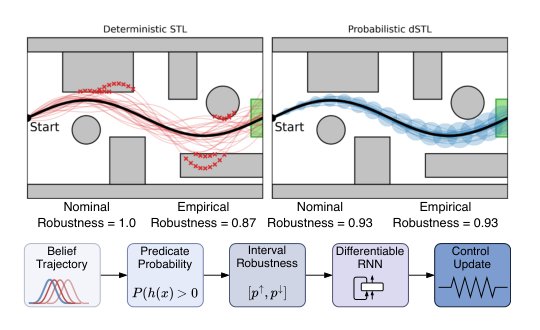
这篇论文处理的是 stochastic robotic planning 中 STL specification 的优化问题,但真正的问题不是“如何写 STL”,而是 deterministic STL robustness 在随机系统里会系统性高估安全性。传统 STL optimizer 看到的是一条 nominal trajectory;真实系统执行的是一族轨迹分布。只要 obstacle clearance 和噪声尺度同量级,nominal robustness 就会变成误导信号。
困难点在于 temporal logic 的 satisfaction 不是逐时刻 chance constraint 的简单拼接。eventually 和 always 对时间上的概率事件有完全不同的结构,predicate 之间还可能相关。以前方法要么能给 probabilistic semantics 但不适合反传,要么能反传但只处理 deterministic traces。关键矛盾是:安全保证需要保守概率推理,而高效 planning 又需要平滑、可微、可组合的目标。
Motivation
已有路线缺的是一个既尊重 uncertainty 又能进入 gradient pipeline 的 STL monitor。chance-constrained STL 可以表达 violation probability,但往往把 temporal formula 拆成局部约束,损失 STL 的组合结构;StoRM / stochastic robustness interval 给了概率区间语义,但没有自然成为 differentiable optimizer 的一部分;STLCG 把 STL 变成 computation graph,但默认输入是确定信号。
作者的核心观察是:STL monitor 本身可以被看作一个时序计算图。如果把节点值从 scalar robustness 换成 probability interval,再用保守概率界组合逻辑,用 smooth reductions 处理 min/max,那么 stochastic STL 的语义可以被嵌入到可微规划中。缺口不是表达能力,而是“概率语义—可微性—线性时间 monitoring”三者没有同时成立。
Core Idea
pdSTL 的真正核心是把 planning object 从 trajectory 改成 belief trajectory。predicate 不再问“当前位置是否在安全集外”,而是问“当前 belief 下满足 predicate 的概率区间是多少”。逻辑公式的输出也不再是 signed distance,而是 satisfaction probability 的 conservative lower bound。这个建模变化引入的 inductive bias 很明确:optimizer 会偏好在不确定性扩散后仍有概率余量的路径,因此自然产生更大的 clearance 和更保守的 timing。
第二个核心是重新组织 temporal operator 的信息流。bounded □/◇/U 被写成 backward recurrent sliding-window reduction,使未来窗口的概率区间以类似 hidden state 的形式复用。这里的“LSTM-style”更像工程上的 recurrent unfolding,而不是学习模型意义上的 LSTM;但它确实把原本离散、递归、非平滑的 STL evaluation 变成可反传的 temporal computation graph。这使 pdSTL 比传统 probabilistic STL 更适合 optimization,也比 deterministic differentiable STL 更贴近 deployment distribution。
Method
1. Belief-space predicate probability:每个 atomic predicate 先在 belief distribution 下转成 satisfaction probability。它解决的是 deterministic predicate 对 uncertainty blind 的问题。对 Gaussian + linear predicates 可闭式计算;复杂区域通过半空间分解和保守组合。
2. Interval-valued semantics:每个 formula node 维护 lower/upper probability bounds,而不是单一概率或单一 robustness。它的必要性在于不假设事件独立时,精确 joint probability 通常不可得;区间语义用保守界保留 soundness。
3. Fréchet composition:conjunction / disjunction 用 Fréchet bounds 传播上下界。核心变化是把未知相关性显式纳入保守性,而不是偷偷用 independence assumption 获得漂亮但脆弱的概率。
4. Smooth min/max relaxation:STL 的 min/max 语义被 log-sum-exp 类平滑近似替代。它解决可微性问题,但也引入 relaxation bias;β 趋大时回到 exact SRI,但优化稳定性和精确性之间存在 trade-off。
5. Recurrent temporal monitoring:bounded temporal windows 用 backward shift-register 维护,使每个公式节点随时间单 pass 更新。它解决的是 temporal operator 的重复计算和不可微递归问题,本质是 memory reuse + differentiable dynamic programming。
Key Insight / Why It Works
最有效的原因不是某个复杂模块,而是优化目标终于和部署风险对齐了。deterministic STL 优化 nominal signed distance,真实系统只要有 dispersion,就会在障碍附近出现 violation。pdSTL 优化 lower-bound satisfaction probability,相当于直接把 uncertainty margin 写进 objective,因此 planner 会主动绕远、延迟 merge、选择概率上更安全的时机。这是 better inductive bias,而不是 scaling。
最可能的核心贡献是“interval probabilistic semantics + differentiable recurrent monitor”的结合。StoRM 已经给了 stochastic robustness interval,STLCG 已经给了 differentiable STL graph;pdSTL 的价值在于把二者接起来,并证明这条路径在 robotics planning 中足够实用。单独看 smooth min/max、sliding window、Fréchet bounds 都不是新东西;组合后形成一个可优化的 belief-space STL objective 才是实质增量。
需要保持怀疑的是 guarantee 的强度。只要 belief model 错了,SRM 就会变成 model-based confidence,而不是真实概率保证。真机实验中 covariance 由离线 residual 预表征,说明核心能力部分来自对 disturbance distribution 的覆盖,而不是 planner 自己在线理解不确定性。所谓“closing realization gap”在当前证据下更准确地说是:在噪声模型较匹配时,belief-aware objective 显著减少 nominal-to-real gap。
LSTM-style RNN 的表述有一定 marketing 成分。这里没有学习长期记忆,也没有 sequence model 泛化;它主要是把 temporal reduction 写成可微、线性时间、可复用状态的计算图。真正机制更接近 differentiable dynamic programming / scan,而不是 neural recurrence。
Relation To Prior Work
最接近的两条线是 stochastic STL / chance-constrained temporal logic 和 differentiable STL / STLCG。前者关心概率 soundness,但常常不适合 gradient-based synthesis;后者关心反传和可扩展优化,但忽略 belief uncertainty。pdSTL 位于二者交叉处:把 StoRM 风格的概率区间语义放进 STLCG 风格的 computation graph。
看似新的部分包括 LSTM-style unfolding 和 interval differentiable monitor,但本质上是已有思想重组:Fréchet bounds 来自概率界,smooth robustness 来自 differentiable STL,sliding-window monitor 来自高效 temporal evaluation。实质创新在于组合后的系统设计:它给 robotics planner 一个保守概率 satisfaction lower bound,并且这个 lower bound 可以直接对 controls 反传。
与 chance-constrained MPC 的区别在于 pdSTL 保留了 STL formula 的 temporal composition,而不是只管每个时刻的 violation probability。与 risk-aware STL 的区别在于它更偏 optimizer-friendly computation graph。与 deterministic STLCG 的区别最本质:STLCG 优化 signal-level robustness,pdSTL 优化 belief-level satisfaction probability。
Dataset / Evaluation
evaluation 覆盖范围还算合理:一个简单 2D planning 场景验证 realization gap,一个 lane-change MPC 场景验证 temporal timing 和 receding-horizon 使用,一个 Crazyflie 真机实验验证物理扰动下的安全裕度。它不是大规模 benchmark,但对 robotics formal methods 论文来说,真机部分足以增加可信度。
实验支持的 claim 是有限但清楚的:在噪声模型相对已知、规格较简单、belief 可传播的情况下,pdSTL 比 deterministic differentiable STL 更能保持 empirical safety margin。它没有充分支持更强的 claim,例如复杂多智能体任务、强非高斯不确定性、在线感知不确定性变化、长公式长 horizon 下的 scalability。
明显 limitation 是 baseline 较少。主要对比 deterministic STLCG,缺少与 chance-constrained MPC、sampling-based stochastic STL planner、CVaR/risk-sensitive MPC 的系统比较。因此增益归因不完全清楚:到底来自概率 STL 语义、来自更保守 clearance、还是来自针对噪声模型的手工 belief inflation,实验没有完全拆开。
Limitation
第一,probabilistic guarantee 依赖 belief model。论文承认 covariance 离线估计,且当前没有 active covariance shaping。换言之,planner 并不会主动获取信息或降低不确定性,只是在给定 uncertainty envelope 下选路径。一旦真实 disturbance 超出 envelope,lower bound 可能过度乐观。
第二,Fréchet bounds 的 soundness 以 conservativeness 为代价。对于高度相关的 predicates 或 temporal events,它可能给出过低 lower bound,使优化过度保守甚至不可行。复杂公式下这个问题会放大,尤其是大量 conjunction 和 always constraints 叠加时。
第三,smooth relaxation 改变了 exact semantics。虽然 β→∞ 有一致性,但实际优化必须用有限 β;过小会偏离逻辑语义,过大会梯度尖锐、优化困难。文中未充分说明 relaxation bias 对 guarantee 数值的影响。
第四,scalability 不是只看 O(T|φ|)。最大窗口 W、公式树大小、predicate probability 计算、belief propagation 都可能成为实际瓶颈。长 horizon dense constraints 下,所谓 linear-time monitor 只是 monitor 层面的结论,不等于整套 planning pipeline 可扩展。
第五,真机泛化能力有限。实验更像验证“预建模扰动下的 conservative planner 更安全”,不是证明系统能在线适应未知 stochastic dynamics。核心能力可能主要来自噪声模型覆盖和保守路径选择,而不是更强的 reasoning。
Takeaway
- 1. 最值得迁移的 insight 是:对安全关键 temporal specs,优化对象应该从 nominal robustness 转向 distribution-aware satisfaction lower bound。
- 很多 sim-to-real gap 不是控制器不够强,而是 objective 本身错配。
- 2. STL monitor 可以被看作 differentiable temporal computation graph;把逻辑语义改写成 recurrent scan / dynamic programming,是让 formal specs 进入现代 optimizer 的有效路径。
- 3. 区间概率语义是一个实用折中:它牺牲 tightness 换 soundness 和 compositionality。
一句话总结
pdSTL 是把 stochastic robustness interval 和 differentiable STL computation graph 接起来的 belief-space STL planner,真正贡献在于让保守概率满足度成为可反传优化目标,属于 formal methods 向 differentiable risk-aware planning 演化的一步。