精读笔记
Problem Setting
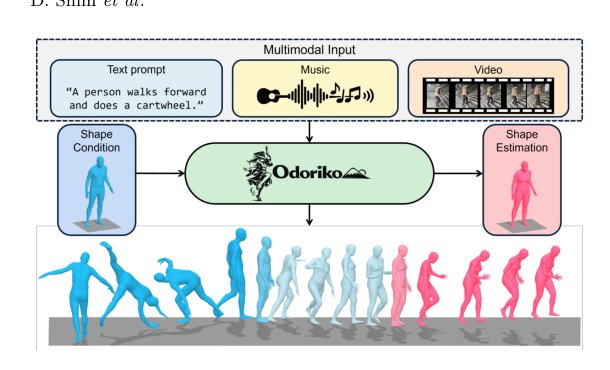
这篇论文真正处理的是“subject-conditioned multimodal motion modeling”:给定文本、音乐、视频或 2D keypoints,不仅要生成或重建合理 motion,还要让 motion 与执行者的身体形态一致。关键矛盾是:motion 既由外部 condition 决定,也由身体结构决定;但现有 unified motion models 通常只统一 condition 侧,把 subject variation 当作噪声。这样会导致模型学习到一个平均化的 motion prior,在语义对齐、节奏对齐和视觉重建上看似合理,但对 limb proportion、gender template、mass distribution 所诱导的 kinematic signature 没有显式控制。以前方法卡在两个方向:generalist 模型缺 shape,shape-aware 模型缺 multimodal unification。Odoriko 的问题设定就是把这两条线合并,并检验 shape 是否能作为跨任务共享的结构变量。
Motivation
已有路线不够的核心原因不是模型不够大,而是条件变量定义不完整。text-to-motion 和 music-to-dance 的 condition 通常只描述动作语义或外部驱动,不能区分同一动作由不同身体执行时的系统性差异;video-to-motion 虽然能从观测中看到身体,但若不估计 shape,pose reconstruction 会把形态误差转嫁给关节姿态。作者的关键观察是:body morphology 不是可忽略的 nuisance,而是 motion distribution 的组织变量。缺口在于,没有一个框架能在 text/music/video/keypoints 这些异质输入下,同时支持 shape-conditioned generation 与 shape estimation。换句话说,之前统一的是 modality,Odoriko 试图进一步统一“condition + subject”。
Core Idea
Odoriko 的核心思想是把运动建模从 p(motion | modality condition) 改成 p(motion | modality condition, morphology)。这不是简单多加一个属性标签,而是改变了 motion prior 的分解方式:语义、节奏、视觉证据负责约束“做什么/看到什么”,SMPL gender 与 beta 负责约束“这个身体如何做”。在这个分解下,模型不必用同一个 latent motion manifold 去吸收跨主体差异,从而有机会学到更干净的 action semantics 与 morphology-conditioned dynamics。
本质区别在于,它把 shape 放进 diffusion denoising 的信息流,而不是后处理、prompt attribute、retargeting 或单独的 pose fitting。gender 与 beta 的 staged injection 也提供了一个有用 inductive bias:模板级差异先影响跨模态 grounding,连续体型差异再影响细粒度 motion refinement。这种组织方式理论上比把所有条件拼成一个 token 更可扩展,因为它把异质条件按作用层级分开,而不是让 transformer 自己从数据里完全学出来。
Method
方法中真正重要的机制有四个。第一,data-domain x0 diffusion:它直接在 motion representation 上去噪,避免引入额外 latent decoder 对形态一致性的干扰;这对关节相关性强、物理约束强的 motion 可能比 v-prediction / flow-style latent generation 更稳定。第二,frozen modality encoders + lightweight adapters:这解决的是多模态训练中的表示对齐和优化稳定性,让 backbone 学 motion synthesis,而不是同时学习 text/audio/video semantics。第三,hybrid conditioning:text token 参与早期 joint attention,music/video/keypoints 以时间对齐方式加到 motion tokens,global feature 与 timestep 结合提供序列级控制;这相当于把局部同步和全局语义分开建模。第四,shape conditioning / estimation 双模式:生成任务中显式输入 gender/beta,估计任务中用 estimation token 预测 gender/beta。这个设计把 generation 和 reconstruction 统一到同一个 denoising backbone 下,但也引入了生成随机性与估计确定性之间的优化冲突。
Key Insight / Why It Works
最可能真正有效的部分是显式 disentanglement:把 subject morphology 从 motion variation 中拿出来作为条件变量。HumanML3D/AMASS 这类数据天然包含不同主体的形态差异,如果不显式建模,模型只能把 shape-induced kinematics 混进 action prior;一旦给出 gender/beta,模型可以把“动作内容”和“执行方式”拆开,FID、R-Precision 以及 shape predictor 指标都可能受益。
第二个有效点是 representation alignment,而不是单纯 scaling。Odoriko 参数量不大,性能提升不像主要来自模型规模;更像来自把 T5/CLIP/EDGE/TRAM 的外部表征接入一个相对高效的 motion transformer,再用 shape token 给 motion manifold 加结构约束。CLIP 对 R-Precision 有帮助但可能牺牲 FID,这说明一部分指标增益来自 evaluator-aligned semantic embedding,而非真实 motion quality。
第三,shape-aware 评估证明的是“generated motion contains recognizable shape cues”,不是严格证明“motion obeys biomechanics”。gender classifier、beta regressor 和 HEA/HSA/MCD 都是 proxy,且 evaluator 与 generator 共享数据分布,存在 evaluation bias。特别是非 shape-aware baselines 在 canonical HumanML3D representation 上被评估 shape reflection,本身并不是完全对等的比较。
我会把贡献拆成:核心贡献是 morphology-conditioned multimodal motion prior;辅助贡献是统一 architecture 和 shape estimation;工程成分包括 frozen encoders、CFG、UniPC、adapter、padding/masking、sampler steps。增益来源中有一部分清楚来自 inductive bias,但具体多少来自数据覆盖、representation conversion、额外 shape supervision,文中未充分说明。
Relation To Prior Work
Odoriko 最接近两条线的交叉点:一条是 GENMO / MotionCraft / MCM / MotionLab 这类 multimodal motion generalist,另一条是 ShapeMove / AttrMoGen / HUMOS 这类 shape-aware 或 attribute-aware motion modeling。相对 GENMO,它真正新增的信息是 subject morphology;相对 ShapeMove,它真正新增的是把 shape-aware generation 从 text-only 扩展到 text/music/video/keypoints,并把 estimation 也纳入同一框架。
看似新的部分有不少是已有思想重组:MM-DiT 式 token fusion、frozen pretrained encoders、global conditioning token、CFG、x0 diffusion、UniPC sampler 都不是本质创新。实质创新在于信息因子化方式:把 gender/beta 作为跨任务共享的 structural condition,并按照 SMPL 层级注入到不同阶段。它属于 motion diffusion generalist 从“modality unification”向“actor-conditioned generation”演化的一步。
Dataset / Evaluation
评估覆盖了 text-to-motion、music-to-dance、video-to-motion 三类任务,能说明框架不是单一 benchmark overfit 的专用模型。HumanML3D/AMASS 提供 shape annotation,FineDance/AIST++提供舞蹈与部分 gender 信息,EMDB/3DPW/Human3.6M 支撑视频估计;任务覆盖面足够广,但都仍是 offline benchmark,没有真实交互、机器人执行、物理仿真闭环或 production animation pipeline 验证。
标准指标支持“性能不掉队”的 claim,但不完全支持“形态一致的真实运动”这一更强 claim。shape-aware 指标是论文最有价值的评估补充,不过它们依赖训练出来的预测器和生物运动 proxy,容易测到 dataset-specific gender/morphology correlations。FineDance 没有 ground-truth shape,使用 learnable placeholder 时还能报告 music-to-dance 性能,但这并不能证明该数据集上的 shape-conditioned generation。总体看,evaluation 支持 Odoriko 在已有 benchmark 上可行,但对 OOD body shape、非 SMPL 角色、真实物理可执行性支撑不足。
Limitation
最大的隐含前提是 SMPL beta 足以表达任务相关 morphology。这个前提在真实人体 motion 上大致成立,但对 stylized characters、非人形角色、极端比例、服装/装备改变质量分布等场景会失效。方法本质上没有建模动力学约束、接触力或 torque limits,shape 只是统计条件,不是物理模型。
第二,泛化可能主要依赖数据覆盖。模型能否对训练集中少见的 beta 组合、跨性别模板边界、极端身高体重比例产生合理 motion,文中未充分说明。shape token 很可能学习的是数据集中的相关性,而不是可组合的 biomechanics rule。
第三,多任务统一有上限。generation 需要一对多采样,estimation 需要一对一回归;作者自己也承认 dual-mode training 会影响 FID。这说明统一 backbone 并非免费,可能在任务间共享 representation 的同时引入优化折中。
第四,增益归因不清。Odoriko 同时改变了数据使用方式、motion representation、shape supervision、多模态 encoder、conditioning 结构和 sampler,很难判断 shape-aware token 本身贡献多少。non-causal ablation 有帮助,但仍不足以排除 data / representation alignment 的影响。
Takeaway
- 第一,motion generalist 的下一步不只是支持更多 modality,而是把 actor / body / embodiment 作为一等条件变量;否则统一模型学到的只是平均人体运动。
- 第二,shape-aware motion 的关键不是给 prompt 加属性,而是重写 motion distribution 的条件分解,让 morphology 进入 denoising 或生成过程。
- 第三,这篇最可迁移的 insight 是 staged conditioning:不同结构变量应按其物理或语义层级进入网络,而不是粗暴拼接。
- 第四,未来真正值得做的是从 SMPL beta 的统计 shape conditioning 走向 mesh/physics/contact-aware 的可泛化 embodied motion model。
一句话总结
Odoriko 是把 multimodal motion diffusion 从“条件统一”推进到“主体形态条件化”的一篇工作,核心贡献不是更大的生成器,而是把 SMPL morphology 显式纳入跨模态 motion prior 的建模分解。