精读笔记
Problem Setting
这篇论文的真实问题不是训练一个更好的机器人策略,而是在 assistive manipulation 中让一个 off-the-shelf VLA 可用。VLA 已经能从语言和视觉中生成看起来合理的长程动作,但零样本执行可靠性远低于辅助机器人部署要求;失败主要发生在接触、释放、插入、抓取等短时间窗口。以前路线有三种卡点:手工 shared-control controller 太窄;纯 VLA 太不可靠;fine-tune/retrain VLA 数据成本高且容易丢掉 foundation prior。关键矛盾是 generality、precision、human workload 三者不可兼得:越通用越不精确,越可靠越依赖人,越专门越不可扩展。
Motivation
作者不是从“VLA 可以完全自治”出发,而是从一个更保守也更现实的判断出发:VLA 的 semantic/macro-motion prior 已经足够有用,但 contact-level control 还不可信。已有 shared autonomy 往往假设一个明确的任务模型或低维目标分布;已有 VLA deployment 往往把模型当闭环 policy 直接执行;扩散/flow 辅助方法则常把用户命令作为初始化或线性混合,容易破坏生成模型内部结构。缺口在于:如何在不训练 VLA 的情况下,把人的局部修正以生成模型原生可接受的形式注入进去,并且只在必要时注入。
Core Idea
核心思想可以概括为:不要修 VLA,本体冻结;也不要让人全程接管;而是在 VLA 最容易失败的 contact-rich bottleneck,把用户命令作为后验观测来 guide VLA 的 flow-matching action generation。这样系统不是在两个 controller 输出之间做外部仲裁,而是在 VLA 的动作生成过程中改变采样分布。
这引入的 inductive bias 很明确:VLA 负责语义、目标选择和粗轨迹,人类负责局部几何/接触精度;二者不是平均,而是 prior + measurement 的 Bayesian fusion。相比传统 shared control,它不需要为每个任务设计 assistance function;相比 fine-tuned VLA,它避免把开放行为先验压缩到小任务集;相比线性 blending,它承认 VLA action distribution 是多模态的,用户信号应约束 posterior,而不是直接在动作空间插值。
Method
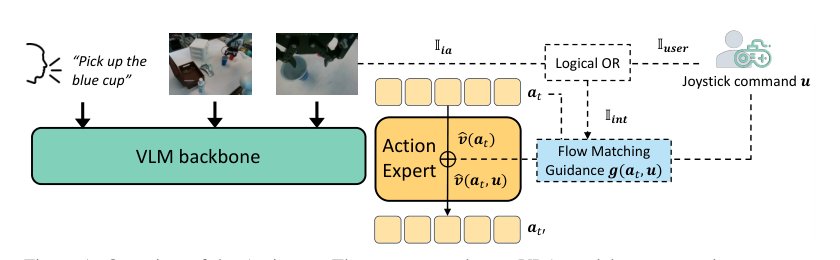
第一,系统策略在 autonomous VLA 与 shared policy 之间切换,解决的是人类低带宽输入不适合全程控制的问题。VLA 执行 macro movement,用户只在高风险阶段介入,核心变化是把 shared autonomy 从 continuous arbitration 改成 sparse bottleneck correction。
第二,intervention detection 不是单纯看视觉接近,而是要求 wrist-view interaction confidence 与 VLA gripper-change intent 同时满足。它解决的是过早/过频繁打断 VLA 的问题,也避免把普通 approach 阶段误判成接触阶段。更重要的是,它把“何时需要人”绑定到 VLA 自己即将改变接触状态的意图上。
第三,policy blending 被写成 p(a|u) ∝ p(u|a)p(a)。VLA 的 flow model 是动作先验,joystick 经 IK 转成 action-horizon measurement。guidance term 在 denoising/flow 过程中把样本推向用户命令,而不是执行后再混合。这解决的是高维机器人中低维用户输入无法直接稳定控制所有 DOF 的问题。
第四,VLA gripper action 被缓存但不直接执行,实际 gripper 改变交给用户或 shared phase。这个设计非常关键:它承认 VLA 的 gripper timing 是高风险源,把最危险的离散接触动作从 VLA 权限中拿掉。
Key Insight / Why It Works
最核心贡献不是 ResNet interaction detector,也不是使用 Whisper/VLA 的系统集成,而是把人类修正写成 flow-matching posterior guidance。它有效的原因在于:用户输入通常只提供局部方向/意图,不能完整指定高维 action chunk;VLA 先验补全未指定 DOF,并保持动作在训练分布附近。相比 linear blending,posterior guidance 更像在 latent/action manifold 上做条件采样,减少多模态分布中不同 mode 被平均后的无效动作。
另一个真正有价值的 insight 是 failure localization:如果 VLA 的错误不是全局语义错误,而是局部接触误差,那么 sparse human correction 的性价比极高。系统的成功并不要求 VLA 可靠完成全任务,只要求它大多数时间能把机器人带到“差不多正确的地方”。这也是为什么它对 novice 用户收益更大:人不需要掌握全程高维控制,只需要在 VLA 已经缩小搜索空间后做局部修正。
哪些可能只是 engineering:interaction detector 是轻量监督分类器,标签来自 gripper transition 前窗口,本质是一个实用 trigger,不是通用 contact reasoning;voice interface 与 scene recovery task design 也是系统工程。哪些是实质机制:flow posterior guidance、gripper authority restriction、phase-aware sparse intervention。
增益来源有一部分归因仍不清。成功率提升既来自 posterior blending,也来自简单但强的安全策略:不让 VLA 直接开合 gripper。若没有这个 restriction,纯 VLA 失败可能更严重;若有这个 restriction 但用更简单的 teleop assist,差距有多大文中未充分说明。所谓 generalization 也主要来自 π0.5 的数据覆盖和语义 prior,不是 Assistron 学到了新泛化能力。
Relation To Prior Work
它最接近三条谱系:经典 probabilistic shared control、diffusion/flow guidance for inverse problems、VLA-based robot manipulation。和传统 shared control 的差异在于 prior 不再是手工目标模型或任务特定 trajectory predictor,而是 frozen foundation VLA 的 action distribution。和 diffusion assistance 的差异在于它不把用户命令作为 noisy initialization,而是在 flow vector field 中加 posterior guidance;这对 π0.5 这种 action chunk 有 latent/discarded dimensions 的架构尤其重要。
看似新的部分中,Bayesian shared autonomy、posterior inference、Tweedie/flow guidance 都不是全新思想;新意在于把这些机制接到 off-the-shelf VLA 的 action generation 上,并服务于 assistive manipulation 的局部 intervention。真正新增的信息是:VLA 可以作为 shared autonomy 的 semantic/action prior,而不是 endpoint controller;人类可以作为 test-time measurement,而不是训练数据提供者或全程 teleoperator。
Dataset / Evaluation
evaluation 是真机、真实用户、桌面多子任务 scene recovery,覆盖 opening、placing、insertion、pulling 等基本 manipulation primitive。它足以验证论文的核心应用 claim:Assistron 在一个受控但非平凡的日常 manipulation 场景中,比纯 VLA 可靠,比纯 joystick 省力。
但它没有充分验证更强的 claim:开放世界泛化、跨家庭环境、长时状态推理、复杂语义纠错。任务仍是桌面、物体集合有限、场景结构固定、用户知道目标图像。VLA 不知道 goal image 这一设定让语言交互更真实,但也使 evaluation 混合了 instruction quality、用户策略、VLA prior 和 shared-control 机制多个因素,增益归因不完全干净。
ablation 聚焦单个 drawer-grape 任务,能说明 posterior blending 优于 linear/direct,但不能证明所有 contact-rich 类任务都受益同等明显。interaction detector 的 12k wrist-frame 数据来自相关 tabletop tasks,泛化到新视觉域和新接触模式仍是未充分说明。
Limitation
第一,上限被 frozen VLA 明确限制。Assistron 不是 semantic failure repair system;如果 VLA 选错对象、误解语言、卡在错误子目标,局部 joystick guidance 只能临时 override,不能提供稳定 long-horizon replanning。文中案例里已经出现 VLA fixate drawer、找不到 cup 等语义/注意失败。
第二,posterior blending 假设用户意图与 VLA prior 大体一致。这个假设很强:当用户想做 prior 外动作,guidance 会产生人机冲突,甚至把命令投回 VLA 偏好的错误 mode。文中承认需要 OOD detection,但没有解决。
第三,interaction detector 的监督信号是 gripper-state transition 前 2 秒,这把“交互阶段”定义成与 gripper event 强绑定的模式。对 pushing、tool use、continuous contact、force-controlled insertion 等没有明显 gripper transition 的任务,这个 inductive bias 可能失效。
第四,scalability 不是免费的。虽然不 fine-tune VLA,但需要为平台训练/校准 interaction detectors、IK 映射、joystick-to-action horizon、gripper authority logic。它减少了 policy training 成本,但把一部分复杂度转移到了 runtime arbitration 和安全机制。
第五,用户研究规模和任务分布不足以支撑强泛化结论。核心能力可能主要来自 π0.5 的数据覆盖;Assistron 的贡献是把这个 prior 包装成可部署 shared autonomy,而不是产生新的 reasoning/planning 能力。
Takeaway
- 1. 对 assistive robotics,更现实的路线可能不是追求 fully autonomous VLA,而是把 VLA 当作 semantic/macro-action prior,把人类放在 contact bottleneck 上。
- 2. shared autonomy 与 foundation policy 的结合,关键不应是 output blending,而应是 test-time posterior conditioning;这类思想可以迁移到 diffusion policy、trajectory generative model、甚至 language-conditioned planning。
- 3. 冻结 foundation model 并不意味着系统不能适配用户;适配可以发生在 inference-time guidance、authority gating 和 safety wrapper 中。
- 4. 未来真正值得做的是可靠检测“VLA prior 不可信”的状态:不仅是 contact phase,还包括 semantic OOD、mode conflict、user-policy disagreement,并在这些情况下切到更强的人类控制或重规划。
一句话总结
Assistron 是一类把 frozen VLA 从 autonomous policy 改造成 shared-autonomy prior 的方法演化,其真正贡献在于用局部交互检测和 flow posterior guidance,把人类低带宽修正嵌入 VLA 动作生成过程,而不是微调模型或线性混合控制器。