精读笔记
Problem Setting
这篇论文不是在解决一般 textile simulation,而是在找 woven architected materials 的中间尺度力学表示:既要保留单根 weaver 之间的拓扑/几何相互作用,又要足够便宜以支持参数扫描和设计。真正困难点在于 weave 的宏观性质不是简单材料本构,而是低能几何模态的组合:crimp interchange、shear locking、slip、pullout 都来自离散 interlacing。continuum model 的问题是把这些模态平均掉;high-fidelity FE/contact 的问题是把所有细节都算进去,导致设计不可用。关键矛盾是 expressive enough vs cheap enough,而不是精度本身。
Motivation
作者看到的缺口是:origami/kirigami 已有 bar-and-hinge 这类物理透明的 ROM,但 weaving 仍主要在 continuum homogenization 和 yarn-scale FE 两端摇摆。已有 lumped models 更偏 folding/contact kinematics,缺少针对 weaver-scale in-plane coupling 和 crimp interaction 的有效元素。核心动机是把 weaving 中少数主导变形机制显式编码成模型结构,而不是指望 homogenized constitutive law 在大变形、slip、局部损伤附近仍然有效。换句话说,缺的不是另一个更细的仿真器,而是一个带正确 inductive bias 的可校准低阶力学语言。
Core Idea
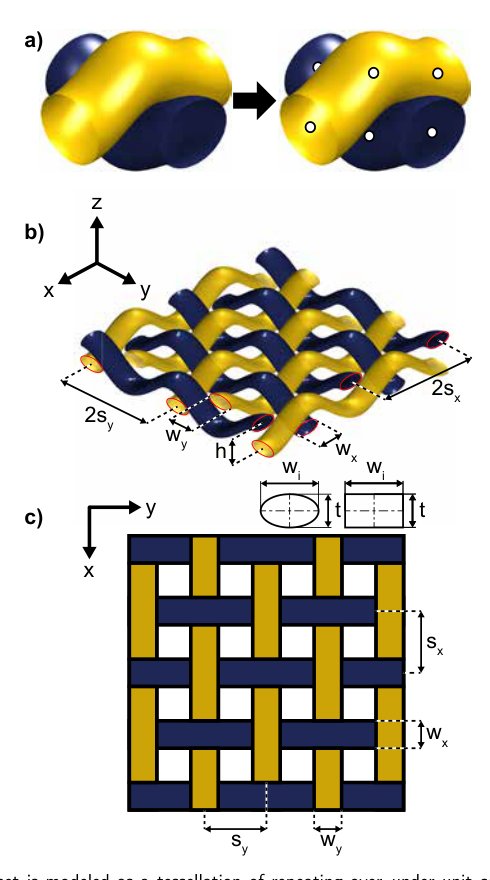
核心思想是把 woven sheet 表示成一个物理语义明确的 interaction graph:节点沿 weaver centerline,边/弹簧不追求通用性,而是分别对应 axial stretch、in-plane uncrimping、inter-weaver shear 和 pseudo-frictional slip。这样模型的低能模态被预先限制在 weave mechanics 真正关心的几个自由度里。
它理论上可行,是因为许多 woven phenomena 的一阶决定因素不是局部三维应力分布,而是 weaver centerline 的相对几何、角度变化与拓扑约束。它和 continuum 的差别是保留离散 topology;和 FE 的差别是主动丢弃接触/截面细节;和传统 bar-and-hinge 的差别是 stiffness 不完全由材料几何解析给出,而是作为 effective interaction parameters 通过实验校准。这是一个强 inductive-bias + empirical closure 的 ROM。
Method
方法上最关键的不是四个元素本身,而是每个元素对应一个被认为不可压缩的 weave interaction mode。bar element 解决 weaver centerline 轴向承载,是唯一相对直接来自材料参数的部分;three-node spring 解决 crimp interchange,把单根 weaver 的角度展开和横向收缩耦合起来;four-node spring 解决交叉 weaver 之间的 dihedral/shear 变形,使 shear locking 一类响应可在 cell 级出现;Cartesian connector 解决层间相对 slip/伪摩擦,但它本质是 conservative spring,不是真 friction。
unit-cell eigenanalysis 的作用是验证这些元素不是任意拼装:最低能模态确实落在 shear、crimp、x/y slip 上,移除任一元素会产生 zero-energy mode。这一步是全文方法论上最有说服力的部分,因为它把“元素设计”连接到“weave-specific low-energy subspace”。calibration 则承担 quantitative closure:用 bending 和 shear 的实验趋势反推有效 stiffness,而不是声称模型可从 first principles 预测。
Key Insight / Why It Works
这篇真正有效的原因是 better inductive bias,而不是 scaling。作者把 woven mechanics 的复杂性压缩成少数可解释的 latent deformation modes,并让全局响应通过这些 mode 的能量竞争自然出现。crimp-to-bar energy handoff、Poisson-like contraction、graded anisotropy 这些现象并不是额外规则,而是几何约束下能量最小化的结果。
最核心贡献是 mode-aligned ROM:元素不是为了数值方便随便选,而是和物理低能模态一一对应。eigenmode analysis 和 stiffness scaling 说明模型内部坐标系大致对齐了真实机制,这比单纯拟合曲线更重要。calibration 是必要但也是弱点:它让模型能贴近实验,但也把一部分 predictive burden 转移给数据。distributed calibration 的高精度基本就是 per-condition fitting;lumped calibration 的中等 R2 更接近真实泛化能力。pullout 和 tearing 的展示不能过度解读:pullout 不模拟滑移过程,tearing 不模拟裂纹扩展,它们主要展示了离散结构表示的便利性,而不是 validated failure model。
Relation To Prior Work
它最接近 bar-and-hinge / node-and-spring / lumped structural models,尤其是 origami 的低自由度能量模型和近期 ribbon/woven lumped formulations。它也和 textile continuum homogenization、yarn-scale FE/contact simulation 构成明显三角关系:continuum 快但失去 topology,FE 准但太重,本工作在中间选取 mechanism-level DOF。
看似新的部分中,node-spring、quadratic energy、direct stiffness assembly、Newton/arc-length 等都不是新思想;实质新增在于把 woven-specific phenomena 映射为一组 calibrated effective elements,并用 eigenmode 必要性论证该元素集的完整性。它不是一个 first-principles textile mechanics model,而是一个结构化 surrogate mechanics model。相比黑箱 surrogate,它的新增信息是物理可解释的 mode decomposition;相比传统 homogenization,它保留了 weaver-level heterogeneity 和局部拓扑事件。
Dataset / Evaluation
evaluation 覆盖了三类层次:element/unit-cell 验证、真实 Mylar woven samples 的 bending/shear calibration、以及若干应用 demonstration。真实实验是有的,但材料、weave pattern、尺度和加载模式都很受控,主要验证 plain weave + linearly elastic strips + quasi-static loading 下的趋势拟合。
实验确实支持“校准后可复现 bending/shear stiffness trends”这个 claim,也部分支持“元素语义可分离”。但它没有充分验证跨材料、跨 weave topology、真实摩擦滑移、损伤演化或复杂边界条件下的预测。distributed calibration 的结果更多是拟合能力;lumped calibration 才是泛化证据,但表现只是中等且受 objective weighting 影响。应用部分更像模型表达能力展示,不是严谨 benchmark。
Limitation
最大隐含前提是 dominant mechanics 可由 centerline kinematics + 四类有效 stiffness 捕获;一旦截面变形、局部 buckling、接触压力分布、材料非线性或真实 friction 成为主导,模型就会失效或需要重新加 closure。第二个前提是 calibration domain 代表 deployment domain;否则 stiffness 参数没有可迁移保证。
scalability 上限不在 DOF,而在 calibration 和 physics coverage。模型可以很快地扩展到大 woven sheets,但每换材料/截面/制造/加载机制都可能要重新标定。frictional hysteresis 被切成四个 monotonic branch 是工程折中,不是物理解决;pseudo-frictional connector 不能产生耗散。tearing 没有 failure criterion,pullout 没有 contact/sliding history,因此这些结果不能当作真实破坏过程预测。文中未充分说明 irregular weave、defect-rich topology 和大转角下四节点 spring approximate tangent 对稳定性的影响。
Takeaway
- 第一,woven systems 的可设计力学可以被看成少数低能几何模态的组合;把模型坐标系对齐这些模态,比提高网格精度更有价值。
- 第二,effective-parameter ROM 是设计工具的合理路线,但它必须诚实面对 calibration dependency,不能伪装成 first-principles prediction。
- 第三,未来真正值得做的是 closure:从材料、截面、接触/friction law 推导或半解析估计 k_cart、k_3spr、k_4spr。
- 第四,这个思路可迁移到其他 architected materials:先找 mechanism-level latent modes,再建可解释低阶能量模型,而不是直接 homogenize 或全量 FE。
一句话总结
这篇论文把 woven mechanics 从 continuum/FE 两端拉到一个 mode-aligned、可校准的 reduced-order interaction model,中等牺牲物理完整性来换取 weaver-level 可解释性和设计可用性。