精读笔记
Problem Setting
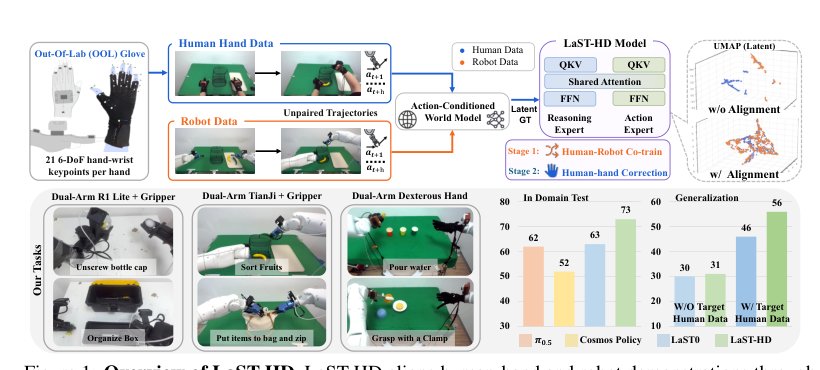
[LaST-HD: Learning Latent Physical Reasoning from Scalable Human Data for Robot Manipulation](arXiv preprint / 2026)。这篇论文实际处理的是 human-hand data 到 robot policy learning 的中间表示问题,而不是简单的人手模仿。真正困难点在于:人手示范天然包含丰富接触和物体交互先验,但其动作空间、执行动力学、视觉外观和可执行约束都与机器人不同。以前方法要么做 kinematic retargeting,把迁移压成几何映射;要么从人类视频提取 affordance / trajectory prior,离可执行 action 仍有 gap;要么直接 cross-embodiment co-training,依赖大规模数据把 mismatch 平均掉。关键矛盾是:最便宜、最丰富的数据不是机器人数据;最可控、最可执行的数据又最难 scale。LaST-HD 的问题设定就是寻找一个可监督、可训练、可跨 embodiment 的中间接口。
Motivation
已有路线不够的根本原因是对齐层级选错了。动作层太具体,会被 morphology 绑死;视觉层太表面,容易学到 appearance evolution 而不是 contact dynamics;语言/任务层又太抽象,无法指导低层控制。作者的核心观察是,reason-before-act VLA 已经在 action 前插入 latent reasoning token,这些 token 可以被改造成 cross-embodiment transfer 的“物理接口”。缺口在于:现有 VLA 的 latent reasoning 通常由 future visual feature 或自监督目标驱动,并不显式要求人手和机器人在物理后果上对齐。因此,作者想用 world model 的 action-conditioned forward dynamics feature 来定义什么叫“同一个 manipulation dynamics”。
Core Idea
论文真正的核心不是 OOL Glove,也不是 MoT VLA,而是把 human-to-robot transfer 从 action imitation 改成 latent physical consequence alignment。它让模型先学一个跨 embodiment 的、动作条件下的未来物理表征,再由这个表征去约束 VLA 的 latent reasoning,最后再生成具体机器人动作。
直觉上这可能成立,因为 manipulation 中很多可迁移信息不在手的姿态本身,而在动作导致的物体状态变化、接触关系、相对运动和任务阶段推进。人手推苹果和机器人夹爪推苹果的外观与关节轨迹不同,但如果动作后果相似,world model 的深层预测特征可能形成相近结构。与 prior 的本质区别在于:prior 多数在“输入表示”或“动作标签”上混合 human/robot;LaST-HD 则在“动作生成之前的 latent reasoning 目标”上强行引入 forward-dynamics inductive bias,重新组织了从 human data 到 robot action 的信息流。
Method
关键机制可以压缩为三件事。第一,用 action-conditioned world model 作为 alignment bridge:它解决 unpaired human/robot trajectory 无法直接监督的问题,通过预测未来后果产生共享 latent target。这里 world model 不是 policy,也不是 planner,而是一个 latent target synthesizer。
第二,把这些 target 注入 reason-before-act VLA:reasoning expert 预测 latent physical tokens,action expert 通过 shared attention 使用这些 tokens 生成具体 embodiment action。这样 latent alignment 会直接影响控制,而不是停留在辅助 representation learning。
第三,用 OOL Glove 把人手数据从“视频示范”提升为“可 retarget 的 action-proximal trajectory”。这解决的是人手数据质量和可监督性问题。它不是纯算法贡献,但对方法成立很关键,因为如果人手 action 噪声大,action-conditioned world model 的 anchor 会变弱。
mixed co-training 和 online correction 更像 progressive curriculum:先让机器人和人手数据在共享 latent 中共存,再用少量 failure-state human correction 增补部署分布。它提高实用性,但核心创新仍是 latent target 的定义。
Key Insight / Why It Works
最可能真正有效的是 action-conditioned forward-dynamics latent,而不是“latent reasoning”这个词本身。没有 action conditioning 的 world-model feature、SigLIP future feature、无 latent reasoning 都变差,说明关键在于把监督目标从 appearance feature 推向 physical consequence feature。这是 better inductive bias + representation alignment,而不是单纯 VLA scaling。
但也要警惕:所谓 reasoning 更像 compact dynamics retrieval / predictive feature conditioning,不一定形成可组合的长期物理模型。模型并没有显式维护 object state、contact graph 或 causal dynamics;latent token 是 world model 深层特征经 pooling 得到的监督信号,解释性有限。它可能在训练分布附近提供很好的 dynamics prior,但遇到真正 OOD 物理属性、复杂非刚体或长时序闭环失败时,上限会暴露。
OOL Glove 的贡献也不能低估。论文把算法增益和数据采集质量绑在一起:更稳定的人手 keypoint、更快采集、更强 action-proximal supervision 本身就会显著改善学习。部分提升可能主要来自 data coverage / collection efficiency,而不完全来自 latent alignment。在线 correction 的提升尤其可能是 targeted data coverage,而不是模型突然获得更强推理。
如果要迁移这个 insight,重点不是复制 glove,而是:不要直接把异构数据混到 action space;应先找一个由任务后果定义的中间表征,并让 policy 的 action decoder 必须依赖这个表征。
Relation To Prior Work
它最接近三条线:human-to-robot imitation / retargeting,cross-embodiment VLA co-training,以及 world-model / latent-CoT VLA。和 kinematic retargeting 相比,LaST-HD 不把人手姿态映射本身当作核心解,而是把 retargeting 后的人手轨迹用来学习 shared dynamics。和 EgoMimic、DexWild、H-RDT、EgoScale 这类 human-as-embodiment 路线相比,它不是仅靠联合训练让 backbone 自己发现对齐,而是显式构造一个 action-conditioned physical latent target。和 LaST0 / latent-CoT VLA 相比,它把 latent CoT 的监督从 future visual / multimodal prediction 改成跨 embodiment 的 forward-dynamics alignment。
看似新的部分中,MoT、flow action head、world model、DAgger-style correction 都不是全新思想;真正新增的信息是:用 action-conditioned world-model feature 作为 human/robot shared reasoning target,并把这个 target 放在 VLA action generation 的前置 latent channel 里。这是已有组件的有效重组,但重组点有实质价值。
Dataset / Evaluation
评估覆盖了真实机器人、双臂夹爪、灵巧手、多任务和三类泛化场景,这比纯仿真或单平台实验更有说服力。它确实验证了一个重要 claim:额外人手数据在 LaST-HD 下比在 LaST0 下更能转化为机器人泛化,尤其在 unseen scenario adaptation 中。
但 evaluation 仍不足以完全证明“morphology-agnostic physical reasoning”。任务数只有六个,且都在作者硬件、相机、采集和 retargeting pipeline 内闭环;每个设置的 rollout 数不大;泛化主要是 position/object/background 层面的有限扰动,不等价于开放世界物理泛化。在线 correction 的 20 分钟高成功率很实用,但本质上是 failure-state targeted data injection,不能直接推出大规模零样本泛化能力。
消融比较合理,尤其 latent target 和数据源消融支持核心机制。但增益归因仍不干净:world model 预训练、人手数据质量、相机视角、retargeting、VLA backbone、训练 recipe 都可能贡献性能。文中未充分说明这些因素的独立贡献。
Limitation
最大的隐含前提是:action-conditioned world model 的深层特征在 human 和 robot 之间天然可对齐。这个假设在刚体 tabletop manipulation 中合理,但在高度接触敏感、力控主导、流体、布料、工具使用等场景中未必成立。world model 可能学到的是数据分布中的相关性,而非稳定的物理因果结构。
第二,方法仍 heavily rely on data。论文强调 scalable human data,但这也意味着能力上限可能主要来自覆盖率:见过足够多类似人手交互后,latent space 更容易把相似任务聚在一起。所谓泛化可能是 dense data + targeted correction 下的局部插值,而不是强 OOD extrapolation。
第三,retargeting 没有消失,只是被弱化和后移。OOL Glove 数据仍需要映射到 gripper / dexterous hand action,且 appendix 承认新手型需要新的 heuristic pipeline。若 retargeting 质量差,latent alignment 和 action supervision 都会受损。
第四,reasoning 成本和实时性是硬限制。latent token 自回归生成带来延迟,说明该方法更像 slow reasoning prior,而不是即插即用的高速控制器。未来必须走 fast-slow、latent compression 或 distillation。
第五,物理推理的解释仍偏弱。UMAP 和 attention map 只能说明 representation 看起来更对齐、更关注交互区域,不能证明模型学到了可组合 dynamics。planner 实际没有显式长期状态建模,复杂长程任务中可能仍靠局部模式匹配。
Takeaway
- 1. 最值得记住的 insight 是:跨 embodiment 学习不要优先对齐动作,而要对齐动作导致的物理后果;forward-dynamics latent 可能是比 pose / image / language 更合适的接口。
- 2. reason-before-act VLA 的 latent token 可以成为外部监督的“插槽”。
- 这比把 human data 直接混进 policy loss 更可控,也更容易注入 inductive bias。
- 3. 人手数据要真正服务 robot learning,必须从 passive video 走向 action-proximal capture。
一句话总结
LaST-HD 是 human-data-scaled VLA 向“物理后果对齐”演化的一步:它的实质贡献不是让机器人模仿人手,而是用 action-conditioned world-model latent 把人手经验转写成机器人可用的前置 dynamics reasoning signal。