精读笔记
Problem Setting
论文标题:KRVF: A Source-Aware Semantic Voxel World Representation for Edge Mobile Manipulation(arXiv preprint / 2026-06-26)。
这篇论文实际处理的是移动操作中的“任务可用世界状态”问题,而不是传统意义上的 mapping/reconstruction。机器人需要回答的是:某个对象现在是否存在、证据来自哪里、是否新鲜、能否抓、能否等待或查询;这些问题并不等价于得到一个几何上最完整的点云/TSDF/occupancy map。
真正困难点在证据不一致:RGB-D 对透明、反光、暗色、薄物体会失败;2D detector 可能给出正确语义但没有可靠 depth;旧的 occupied voxel 可能是动态物体残留;free-space carving 又可能把真实但 depth-failed 的对象清掉。以前方法卡在把这些 evidence collapse 到单一几何状态:要么过度相信深度,要么过度相信语义,要么把 transient frame-level detection 直接变成 action input。
关键矛盾是:操作系统需要低延迟、可查询、可行动的状态,但高保真 reconstruction 往往优化的是全局几何一致性;语义先验对 manipulation 很有用,但如果直接写进地图,会破坏 measured geometry 的 epistemic integrity。
Motivation
已有路线缺的不是更多 reconstruction capacity,而是 evidence provenance。OctoMap/TSDF/RTAB-Map 可以给几何,semantic mapping 可以给标签,YOLO-depth pipeline 可以给单帧抓取目标,但它们通常没有把“证据来源、置信度、时间有效性、是否只是 hypothesis”作为一等公民暴露给任务层。
作者的核心观察是:在 mobile manipulation 里,地图首先是 robot memory,其次才是 reconstruction artifact。任务系统需要知道 belief 为什么成立,而不是只知道某处 occupied。尤其在 depth failure 场景下,正确做法不是 hallucinate persistent geometry,也不是把缺失 depth 当 free space,而是保留一个显式、可过期、可查询的 semantic hypothesis。
因此缺口是一个位于 SLAM/感知与行为树/抓取之间的表示层:它不试图替代 SLAM,也不试图成为最强重建器,而是把在线 RGB-D、语义检测、深度修复和任务查询组织成一个 source-aware state server。
Core Idea
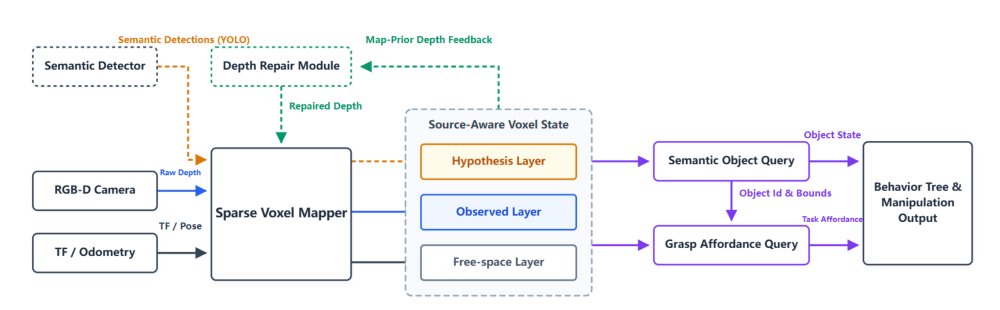
KRVF 的真正核心不是“用 voxel 做语义地图”,而是改变 voxel 的语义:voxel 不再只是空间占据单元,而是一个 evidence-bearing task state。每个 voxel 记录 occupancy log-odds、appearance、semantic evidence、source confidence、freshness 和 evidence type。这个 inductive bias 强制系统保留 belief provenance:raw depth、repaired depth、semantic hypothesis、uncertain surface 不被压成同一种 occupied/free 结论。
更重要的是 observed-hypothesis separation。KRVF 把测得几何和语义先验假设分开:语义可以生成 bounded hypothesis,用于 query、visualization、候选 grasp,但默认不能进入 persistent observed map。这个设计本质上是在表示层引入 epistemic boundary,使系统既能利用语义先验,又避免 detector hallucination 污染长期地图。
和 prior 的本质区别在信息流:传统 pipeline 多是 sensor → geometry map → downstream parser,或 detector → depth crop → grasp;KRVF 改成 sensor/detector/depth-repair → source-aware voxel memory → task query。它的 scalable/generalizable 之处不在算法复杂度,而在接口抽象:更换 detector、robot、planner 时,世界状态的证据结构仍然稳定。
Method
1. Source-aware voxel state:解决单一 occupancy 无法表达证据质量的问题。它需要记录 q、τ、η 等字段,因为操作决策依赖“这个 voxel 为什么可信、是否过期、是不是修复/假设”。核心变化是从 geometry cell 变成 task evidence cell。
2. Observed / hypothesis / free-space 分层:解决语义先验与测量几何互相污染的问题。observed layer 只承载测量或显式确认的几何;hypothesis layer 承载 depth failure 下由语义触发的 bounded belief;free-space layer 用于保守清理。核心变化是把 epistemic status 变成地图结构,而不是隐藏在后处理逻辑里。
3. Source-weighted fusion 与 temporal freshness:解决 raw depth、repaired depth、低置信观测、旧观测不能同权的问题。它并没有提出复杂 probabilistic inference,而是用 log-odds 权重、miss counter、TTL、stability 等机制实现工程上可控的 evidence integration。这里的价值在于可解释和低延迟,不在理论新颖性。
4. Detection-to-voxel grounding:解决 2D detector 不能直接成为 3D action evidence 的问题。检测框内 depth samples 只在已有 occupied voxel 附近更新语义,避免“检测即物体”。核心变化是语义标签依附于 3D 支撑,而不是替代几何。
5. Map-prior depth feedback:解决当前帧 depth failure 时完全依赖瞬时观测的问题。历史 voxel map 可渲染成 camera-view depth prior,再参与 repair,并带 source/confidence 回写。这个机制的 insight 是 memory reuse:地图不只是输出,也是感知输入。但文中未充分说明它在真实噪声下相对普通 temporal filtering 的增益。
6. Object / grasp query:解决下游每个模块都要重新解释点云的问题。KRVF 把 semantic object 和 heuristic grasp candidate 作为一等接口输出。核心变化是 representation alignment:地图直接对齐行为树和 manipulation API,而不是只发布 raw cloud。
Key Insight / Why It Works
最核心的有效性来自 representation alignment,而不是更强的几何建模。KRVF 把移动操作真正需要的变量——source、freshness、semantic identity、actionability——放进地图状态,使下游 query 不必从 raw point cloud 重新推断这些东西。这是比“更密的地图”更符合任务的 inductive bias。
observed-hypothesis separation 是最实质的贡献。它解决了 robotics 系统里常见但很少被显式建模的问题:semantic prior 有用,但不能被当成 measured fact。这个边界使系统能在 depth failure 下仍然产生任务候选,同时保留“这里没有可靠几何”的事实。对真实机器人而言,这比单纯提高重建质量更重要,因为错误的确定性比显式的不确定性更危险。
map-prior depth feedback 的想法也值得迁移:把世界模型作为 test-time memory 反哺当前感知,类似一种低成本的 temporal retrieval / memory reuse。但当前论文没有证明这比已有 temporal fusion、TSDF prior、tracking-based completion 更强;它更像合理系统设计,而不是已验证的算法突破。
抓取候选生成、shadow-shell guard、color stabilization、candidate promotion 等大多是 engineering robustness。它们可能提升 demo 稳定性,但不构成核心科学贡献。尤其 grasp query 是 heuristic affordance layer,不应解读为 grasp planning 的进展。
如果系统表现良好,主要归因应是:better inductive bias + explicit memory/state interface + conservative evidence handling,而不是 scaling、learning、planner reasoning 或数据覆盖。这里没有强化学习的核心方法,也没有 evidence 表明存在 learned generalization;标签中的“强化学习”与正文贡献基本不匹配。
需要警惕的点是:qualitative demos 很容易被接口设计本身支持,但不等于真实部署收益。没有 baseline 和量化 ablation 时,无法判断 source-aware voxel、hypothesis layer、map-prior repair、dynamic clearing 各自贡献多少;增益来源不清。
Relation To Prior Work
KRVF 最近的谱系不是 neural scene representation,而是 occupancy mapping / semantic mapping / robot memory interface 的系统化重组。它继承 OctoMap 的 occupancy/log-odds 思路,继承 semantic mapping 的 label attachment,继承 RGB-D SLAM/TSDF 的几何输入,继承 practical manipulation pipeline 的 query/action interface,但把这些组合成一个 source-aware task representation。
相对 OctoMap,真正差异不是 voxel,而是 voxel state 的语义扩展:source、freshness、semantic evidence、hypothesis status 成为一等字段。相对 TSDF/Voxblox,KRVF 主动放弃高保真 surface objective,换取低延迟和任务可查询性。相对 RTAB-Map,它不做 pose/global SLAM,而是假设 pose 已给定,专注局部可行动状态。
相对 SemanticFusion/Kimera 等 semantic mapping,KRVF 的新增信息是 hypothesis separation 和 task query interface。很多 semantic mapping 把 label 融进 map,但并不强调“这个 label 是否有几何支撑、是否只是语义假设”。KRVF 的实质创新就在这个 epistemic distinction。
相对 direct YOLO-depth grasping,KRVF 的差异是从 frame-level perception 变成 temporally maintained memory。它不是每帧检测后直接抓,而是把检测 grounding 到 voxel support,再通过 stability/freshness/object query 输出 action target。
看似新的部分里,source-weighted log-odds、TTL、dynamic clearing、color stabilization 都是已有思想的工程重组;真正有迁移价值的是把这些机制统一到 task-facing map 的表示规范里。
Dataset / Evaluation
评价非常有限,主要是 simulation 或 replay-style ROS 2 demos,没有真实机器人实验。覆盖的现象包括实时 RGB-D voxel mapping、semantic grounding、depth failure hypothesis overlay、grasp candidate query、KRVF-to-manipulation bridge。这些 demo 足以说明系统接口和表示行为是可运行的,但不足以验证完整 mobile manipulation claim。
它没有证明跨场景泛化,也没有证明多任务鲁棒性;没有闭环抓取成功率,没有 edge hardware 上的 latency / CPU / memory 数据,没有与 PointCloud2、OctoMap、RTAB-Map cloud、YOLO-depth direct grasp 等 baseline 的定量对比。文中自己也承认第一版是 technical documentation 和 qualitative demonstration。
因此 evaluation 支持的是弱 claim:KRVF 是一个合理的 ROS 2 表示层设计,能在受控 depth-failure 场景下保持 observed/hypothesis 区分。它不支持强 claim:KRVF 已经在真实边缘移动操作中显著提高成功率或鲁棒性。
benchmark/evaluation bias 风险主要来自 demo selection:所有场景都围绕其表示优势设计,如 missing depth、semantic overlay、query visualization;这些是合理 sanity check,但不是压力测试。增益来源不清,尤其无法判断 hypothesis overlay 是否真正改善 action outcome,还是只改善 visualization/query availability。
Limitation
方法成立依赖几个强前提:外部 pose/TF 足够准,RGB-D calibration 稳定,detector label 可靠,语义框与物体空间范围近似匹配,voxel resolution 足够支撑 grasp query,动态清理不会误删或误保留关键结构。任何一个前提出问题,source-aware 表示只能暴露不确定性,不能自动解决物理错误。
scalability 上限主要来自 voxel memory、query latency 和局部窗口设计。KRVF 适合 tabletop/near-field/local manipulation,不适合大规模长期语义地图,除非引入更强的 memory management、loop consistency 和 object-level abstraction。它不是 SLAM backend,因此全局一致性外包给上游。
泛化能力没有被证明。由于没有 learned model,所谓泛化更多来自工程接口的可移植性,而不是算法对新物体/新场景的感知泛化。对透明/反光物体的处理也不是物理 reconstruction,而是 bounded semantic hypothesis;这本质上是把“缺几何”的问题转移为“是否愿意基于显式假设行动”的风险策略问题。
reasoning/planning 也不能高估。KRVF 提供 query 和 heuristic grasp candidate,但没有长期状态推理、belief planning 或 closed-loop manipulation policy。planner 实际没有形成长期状态建模;长期性主要是 voxel memory + TTL + stability。
核心能力可能主要来自表示约束和系统解耦,而非新算法。文中未充分说明 source confidence 如何学习/校准,hypothesis promotion/demotion 如何安全执行,depth repair 错误如何避免被 map prior 放大。增益归因不清。
Takeaway
- 1. 对移动操作,world model 的关键不是 reconstruction fidelity,而是 evidence-aware actionability:每个 task-relevant belief 都应带来源、置信度、新鲜度和可查询接口。
- 2. observed-hypothesis separation 是值得迁移的设计原则。
- 任何把 semantic prior、language prior、memory prior 写进机器人状态的系统,都应该显式区分 measured fact 与 actionable hypothesis。
- 3. 地图可以作为 perception 的 test-time memory,而不只是输出。
一句话总结
KRVF 是一类把语义、几何、时间和证据来源重新对齐到操作查询接口的 task-facing voxel memory 方法,其主要贡献是显式区分 measured geometry 与 semantic hypothesis,而不是提出新的重建或抓取算法。