精读笔记
Problem Setting
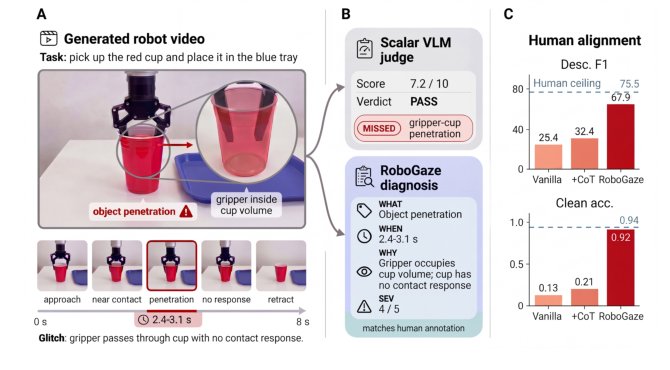
论文标题:RoboGaze: Evaluating Robot World Models via Structured Vision-Language Analysis(arXiv preprint / 2026-06-30)。这篇论文实际在解决 robot world model 生成 rollout 的 event-level failure diagnosis,而不是一般意义上的视频质量评分。关键矛盾是:机器人视频可以视觉上很真实,但在 task completion、object identity、contact/physics、robot body continuity 上完全不可用;下游需要知道具体哪里错、何时错、错得多严重,而不是一个 overall score。以前方法卡在两端:传统指标对 embodied correctness 近乎失明,monolithic VLM judge 虽能描述异常但缺少任务/场景 grounding,容易把不确定性当 failure,也无法稳定给出 temporally localized diagnosis。
Motivation
作者看到的缺口很明确:robot video evaluation 需要的是 diagnostician,而不是 aesthetic judge。已有 VBench、VideoScore、GRADEO、RBench/RoboWM-Bench 等路线大多仍围绕 global score、dimension score 或 benchmark ranking;它们能比较模型,但不能可靠解释单个 rollout 的 failure mechanism。机器人场景中,错误判断必须同时绑定 instruction、initial scene、subtask phase 和可见证据;缺任何一项,VLM 都会在正常遮挡、视角变化、物体短暂不可见时 cry wolf。因此 RoboGaze 的方向是引入结构化诊断协议,把 VLM 的自由判断限制在机器人错误本体和证据验证流程内。
Core Idea
核心思想是把“让 VLM 评价视频”改成“让 VLM 在约束空间内生成并审判 failure hypotheses”。RoboGaze 不期待一次 prompt 就完成复杂 embodied reasoning,而是把信息流重排为:先建立 task/scene memory,再把视频按执行进度局部化,再在少数相关 failure dimensions 上生成候选异常,最后由 critic 以视觉证据、时序一致性和任务语义为条件做拒绝或合并。
这个建模方式的本质区别在于它引入了 robotics-specific latent structure:任务进度、场景状态、对象/机器人一致性、物理可行性、视觉可解释性。相比 prior 的 global VLM scoring,它不是让模型直接学习一个隐式评价函数,而是在 test time 用 ontology、routing 和 verification 约束推理路径。这种 inductive bias 可能更 scalable,因为新增任务或 embodiment 时,不必重新训练 evaluator,只要 failure taxonomy 和 prompt contract 仍覆盖主要错误模式。
Method
方法中真正必要的机制有三点。第一,task-scene grounding 解决的是 reference frame 缺失问题:没有预期 subtask、目标状态、初始 support/occlusion 信息,VLM 很难区分 failure 与合法但少见的执行轨迹;grounding 把评价从绝对视觉判断变成相对任务判断。第二,candidate routing + specialist analysis 解决的是诊断搜索空间过大问题:不是每个片段都需要检查全部 30 类错误,稀疏路由减少无关维度带来的 hallucinated findings,也让每类错误有更强的 checklist prior。第三,critic verifier 解决的是 VLM evaluator 的主要病灶:过度报告。它把 specialist 输出视为 hypothesis 而非 final answer,要求可见证据、时间一致性、语义一致性都成立才进入报告。这个 verifier 是系统从“高召回评论员”转为“可用诊断器”的关键。
Key Insight / Why It Works
最重要的 insight 是:robot video evaluation 的难点不是生成更多 reasoning token,而是控制假设空间和 false positive。CoT 只能让 monolithic judge 更会解释自己的猜测,但不能保证它少猜;RoboGaze 有效,是因为它把异常检测拆成可 contestable 的中间假设,并用 verifier 明确拒绝弱证据。这更接近 structured test-time compute,而不是模型能力本身的突破。
增益最可能来自三部分:更好的 inductive bias、memory reuse、以及 verification-driven precision control。task/scene memory 提供 reference;taxonomy/routing 提供 closed-world search space;verifier 提供 conservatism。taxonomy-only 实验说明错误本体有帮助但不是全部;self-consistency 说明多采样不是主要原因。因此“multi-agent”这个表述有一定 marketing 成分,实质贡献是把 VLM judge 从 end-to-end scalar predictor 改成 staged diagnostic protocol。
需要保持怀疑的是,所谓 physical reasoning 可能仍然很浅。PP/VQ 维度明显落后,说明系统对接触、穿透、支撑、刚体连续性等依然依赖 VLM 的视觉直觉和文字化描述,缺少 3D geometry、optical flow、pose/contact tracking。也就是说,RoboGaze 更擅长组织已有 VLM 感知能力,而不是创造新的物理理解能力。
Relation To Prior Work
它最接近三条线:general video evaluation 的 multi-dimensional scoring,VLM-based hallucination/glitch diagnosis,以及 robotics-specific world model benchmarks。和 VBench/VideoScore 的差异不是“维度更多”,而是从 video-level quality score 转向 event-level temporally grounded report。和 GLiDE/GlitchBench 的差异在于 RoboGaze 有 task instruction、robot execution semantics 和闭集 robotics taxonomy;它不是开放场景找 glitch,而是相对于任务执行找 failure。和 RBench/RoboWM-Bench 的差异在于后者更像模型排名或 execution score,RoboGaze 强调 per-video diagnostic evidence。
看似新的部分里,multi-agent prompting、CoT、critic verification 都不是新概念;真正新增的信息是把这些已有思想组合到 robot world model evaluation 的结构上,并定义了一个可评分的 event-level taxonomy/benchmark。实质创新在 protocol 和 evaluation target,而不是模型架构。
Dataset / Evaluation
RoboGazeBench 覆盖 simulated GR1、real-initialized GR1 和 DROID multi-view manipulation,任务包括 pick/place、pour、push、articulated objects,且有人类 event-level 标注、severity、temporal span 和 free-text description。这个 benchmark 比普通视频质量评价更贴近论文 claim,因为它确实能测 temporally localized diagnostic agreement 和 clean-clip false positive。
但评价仍有明显边界。第一,主要视频来自 Cosmos/GR00T family,cross-generator 只做了小规模 pilot,因此泛化到更广 world model 架构仍未充分验证。第二,评价依赖 LLM description judge,虽然做了 robustness check,但输出格式、taxonomy vocabulary 与 judge rubric 之间可能存在 alignment bias。第三,benchmark 验证的是“和人类诊断标注一致”,不是“用这个 evaluator 选择/训练 world model 后下游机器人性能提升”。因此它支持离线诊断工具的 claim,但不直接证明 closed-loop robot learning utility。
Limitation
最大限制是方法的上限由 VLM 可观察/可表述的 evidence 决定。对于几何穿透、微小接触、支撑关系、短暂抓取失败、多视角冲突,语言 prompt 很容易不够;文中也承认 PP/VQ gap 需要 3D 或 pixel-level signal。第二,闭集 taxonomy 是优势也是瓶颈:它让评估稳定,但会压制 open-world failure,复杂任务中的 cascading failure 可能被硬塞进 primary dimension。第三,scalability 成本不低,约 9 次 VLM 调用/视频,本质是用 test-time compute 换可靠性;在大规模 model selection 或在线 deployment 中成本会成为真实问题。
更深的限制是增益归因仍不完全干净。虽然消融排除了 taxonomy-only 和 self-consistency 的大部分解释,但 task/scene memory、routing、specialist prompt、verifier threshold 之间仍有强耦合;哪些 prompt contract 是普适机制,哪些是 benchmark-specific engineering,文中未充分说明。泛化可能依赖 benchmark failure distribution 与 taxonomy overlap,而非真正的 embodied reasoning 泛化。
Takeaway
- 第一,robot world model evaluation 未来不应只追求 scalar preference,而应输出可定位、可审计、可用于数据清洗/模型调试的 structured failure report。
- 第二,VLM judge 的主要问题不是不会说,而是太容易说;verification 和 evidence gating 可能比更长 CoT 更重要。
- 第三,把任务、场景、时间片段和 failure ontology 显式放进 test-time information flow,是一个可迁移 insight,可用于 VLA rollout critique、simulation data filtering、policy failure attribution。
- 第四,下一步真正值得做的是把 RoboGaze 这类 symbolic/linguistic diagnostic protocol 与几何、光流、pose、contact estimation 结合,否则 physical plausibility 的上限不会靠 prompt 解决。
一句话总结
RoboGaze 是 robot world model 评价从通用视频打分走向结构化、证据约束、test-time 诊断协议的一步,真正贡献在于用 taxonomy-grounded hypothesis generation 和 critic verification 重塑 VLM judge,而不是提出新的视觉或物理理解模型。