精读笔记
Problem Setting
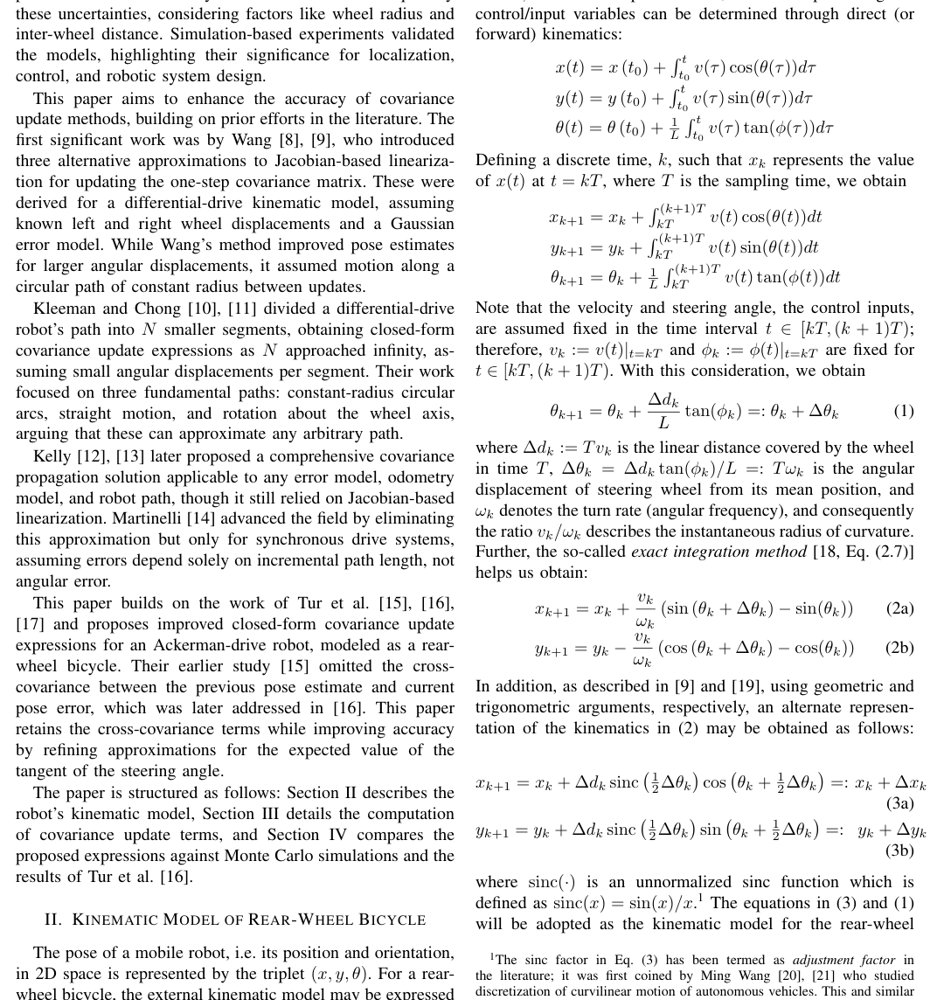
这篇论文解决的不是通用定位,而是 Ackermann / rear-wheel bicycle odometry 中,给定 noisy wheel displacement 和 noisy steering angle 时,离散 pose increment 的 covariance matrix 如何更准确地闭式计算。真正困难点在于随机量以乘性方式进入 Delta d * tan(phi)、Delta d * cos(theta + Delta theta/2)、Delta d * sin(theta + Delta theta/2),所以协方差不是简单的一阶误差传播;尤其 steering noise 经过 tan 后会产生非忽略的偶数高阶矩。以前方法卡在两个地方:一是 Jacobian 线性化只在小扰动下可靠;二是 Tur 等 closed-form 对 steering angle uncertainty 的 expectation 处理不准确,并且早期版本缺 cross-covariance。关键矛盾是:工程上需要实时 closed-form covariance,但数学上非线性随机传播会迅速变得不可控。
Motivation
已有路线不够的原因不是缺一个更复杂的运动模型,而是已有 covariance update 对非线性随机项的统计处理太粗。作者看到的关键缺口是:Ackermann bicycle 模型里,orientation increment 的随机性由 Delta d 和 tan(phi) 共同决定,而 tan(phi + noise) 的期望不能用 tan(phi) 或 tan(phi + worst-case noise) 替代。进一步,x/y increment 的方差还被历史 heading uncertainty 调制,这部分如果被省略或一阶化,会导致 covariance 分量方向性错误。论文动机本质上是修正一个长期被工程近似掩盖的 moment propagation 问题。
Core Idea
核心思想是直接对 pose increment 的随机变量做 moment accounting,而不是对整个非线性递推做一次 Jacobian 化。作者把 Delta x、Delta y、Delta theta 写成 noisy Delta d、noisy phi 和累积 heading error 的函数,然后显式计算一阶矩、二阶矩和交叉矩,最后组成 covariance。
它理论上可能有效,是因为在小采样间隔和小 steering noise 下,主导 covariance 偏差的并不是任意高阶动态,而是 tan 非线性和 heading-error 三角函数的低阶偶数矩。与 prior 的本质区别是:prior 多数把非线性压进局部导数或确定性 worst-case steering;本文承认 steering noise 经过 tan 后的分布变形,并用 Gaussian moment closure 把它保留下来。它引入的 inductive bias 很明确:局部小噪声 regime 下,高阶矩截断比一阶 Jacobian 更能解释 covariance。
Method
方法只需抓住几个机制。第一,采用 rear-wheel bicycle 的离散 midpoint update,但忽略 sinc adjustment factor;这解决的是闭式推导可行性问题,代价是牺牲大曲率/大 Delta theta 下的准确性。第二,对 E[tan(phi_hat)] 和 E[tan^2(phi_hat)] 做 Taylor 展开,并用 Gaussian 偶数矩得到可计算表达;这解决 steering 非线性进入 orientation variance 的核心误差源。第三,对 heading error 的 sin/cos 期望使用 Gaussian 特征函数结果,例如 exp(-var/2)、exp(-2var),把累积 heading uncertainty 转化成 x/y covariance 中的衰减因子;这使位置不确定性不再只依赖当前输入噪声。第四,显式推导 Delta x、Delta y、Delta theta 的二阶矩和 cross-moments;这解决的是 covariance matrix constituent 不完整的问题,而不是引入新滤波框架。
Key Insight / Why It Works
最重要的 insight 是:bicycle odometry covariance 的主要误差不一定来自运动学模型本身,而来自把 nonlinear measurement noise 当作 linear perturbation。特别是 steering angle 的 tan 非线性会让即使零均值 Gaussian noise 也改变 E[tan(phi_hat)] 和 E[tan^2(phi_hat)];这些项直接控制 orientation variance,并通过 midpoint heading 继续污染 x/y covariance。
这篇最可能的核心贡献是对这些 moment terms 的显式整理,而不是仿真、路径设计或工程实现。它不是 scaling,不是 retrieval,不是 data coverage,也不是 test-time compute;它更像是 better inductive bias:在已知 kinematic structure 和 noise family 下,把应保留的二阶/四阶统计量保留下来。辅助部分是 cycloid 仿真和与 Tur 公式对比,它们证明旧近似确实会偏,但没有建立普适性。需要直说的是,论文的“near-accurate”主要来自匹配了自己假设下的 stochastic model;一旦 steering noise 大、存在滑移相关性或 sinc 不能忽略,闭式公式的优势可能迅速消失。
Relation To Prior Work
这篇最接近的是经典 odometry uncertainty propagation:Smith/Cheeseman 的 covariance 表示与 Jacobian 传播、Wang 的 differential-drive closed-form approximation、Kleeman/Chong 的分段极限分析、Kelly 的 general linearized propagation,以及 Tur et al. 针对 Ackermann odometry 的 closed-form 表达。真正不同点不是提出新 vehicle model,而是对 Ackermann bicycle 模型中 steering-noise moments 和 cross-covariance 做更完整的闭式推导。
看似新的地方,有一部分其实是已有思想重组:Taylor expansion、Gaussian moments、sin/cos random argument 的期望都不是新技术。实质创新在于把这些工具系统地用于 rear-wheel bicycle covariance constituent,并指出 prior 中 E[tan(phi_hat)]、E[tan^2(phi_hat)] 的处理不成立。它属于 analytical uncertainty propagation 谱系,不属于 learning-based localization,也不是新的滤波器或 planner。
Dataset / Evaluation
评估是 simulation-only,核心是 cycloid 轨迹下把本文 closed-form covariance 与 Monte Carlo 平均、以及 Tur et al. 旧表达比较。任务覆盖范围较窄:单一运动学模型、合成轨迹、人工设定 Gaussian input noise,噪声方差按输入幅值缩放。没有真实车辆、没有真实轮滑/侧偏、没有传感器融合,也没有跨场景 benchmark。
这个 evaluation 能验证的 claim 是有限的:在作者假设完全成立时,推导公式能复现 MC covariance,并优于旧公式。它不能验证真实 deployment 下的鲁棒性,也不能说明该方法对任意 Ackermann 车辆或复杂地面条件 generalize。实验没有系统 sweep steering variance、curvature、time step、sinc omission error,因此对适用边界支撑不足。
Limitation
核心限制是所有准确性都建立在强假设上。Delta d noise 与 steering noise 独立、跨时间独立、零均值 Gaussian、heading error Gaussian、系统误差已校准、小 Delta theta、小 steering noise、sinc factor 可忽略——这些在真实 odometry 中很容易同时不成立。尤其轮胎侧偏和地面滑移通常是状态相关且时间相关的,不是简单 additive Gaussian。
另一个上限是 tan 的 Taylor 截断没有给出误差界;当 phi 接近较大 steering angle 或 noise variance 增大时,tan 的 heavy nonlinear behavior 会让低阶矩近似变脆。文中未充分说明 covariance matrix 是否始终保持 PSD,也没有讨论数值稳定性。增益来源也不清:可能主要来自修正 Tur 公式中明显错误的 steering expectation,而非提出了更 general 的 covariance propagation theory。某种意义上,它只是把问题从“求 covariance”转移到“已知且可信的 noise model + 小扰动 regime”。
Takeaway
- 第一,Ackermann/bicycle odometry 的 covariance update 不能随意把 steering uncertainty 塞进 tan(phi) 的确定性替代;nonlinear moment correction 是实质性的。
- 第二,在结构化动力学问题里,比起更复杂的滤波框架,先把随机变量的二阶/四阶矩算对,往往能带来更直接的收益。
- 第三,这篇推动的是 closed-form uncertainty bookkeeping 的精度,而不是 localization 系统能力的边界。
- 第四,未来更值得做的是给出适用域、误差界、PSD 保证,并扩展到相关噪声、bias、slip 和真实 Ackermann platform。
一句话总结
这篇论文是对 Ackermann rear-wheel bicycle odometry covariance 传播的一次 analytical correction:真正贡献在于补全并修正 steering 非线性和 heading uncertainty 的闭式矩传播,属于经典模型驱动 uncertainty propagation 的精细化演进,而不是新的定位框架。