精读笔记
Problem Setting
这篇论文不是在做一般意义上的 robotic memory,也不是单纯给 VLA 加长期上下文,而是在解决长时程 manipulation 中“记忆如何保持可执行性”的问题。对于 embodied manipulation,记住一段历史并不等价于能复用它:agent 需要知道同一个物体现在在哪里、哪个部件仍然可操作、状态是否已经变化、过去的动作效果是否仍适用于当前几何和场景关系。真正困难点是 memory 的语义相关性和物理适用性之间存在断裂。embedding retrieval 可以找相似画面或相似任务,但不能保证对应的 handle、joint、pose、state precondition 和 robot skill 都匹配。VLA 的隐式 memory 可能学到统计关联,但很难显式维护 persistent object identity 和 state transition。因此关键矛盾是:长时程任务需要稳定、可更新、可复用的物理结构记忆,而现有 agent memory 多数仍是文本/视觉经验的平面索引。
Motivation
已有路线不够的核心原因是 memory granularity 错了。episode-level memory 记录“发生过什么”,scene memory 记录“环境中有什么”,embedding memory 记录“什么看起来相似”,但 manipulation 需要的是“什么部件以什么参数支持什么动作,并会造成什么状态变化”。作者的关键观察是,机器人操作的可迁移知识往往不在 object category 层,也不在 raw trajectory 层,而在 part-template-affordance-action-effect 这一层。比如 microwave、cabinet、safe 之间的相似性不是语义类别相似,而是都有可拉/可旋转的 articulated part、handle、joint axis、open/closed state 和相似操作函数。论文因此试图补上一个缺口:让 memory 同时成为 language-addressable 的查询接口、object-structured 的状态容器,以及 execution-grounded 的技能索引。
Core Idea
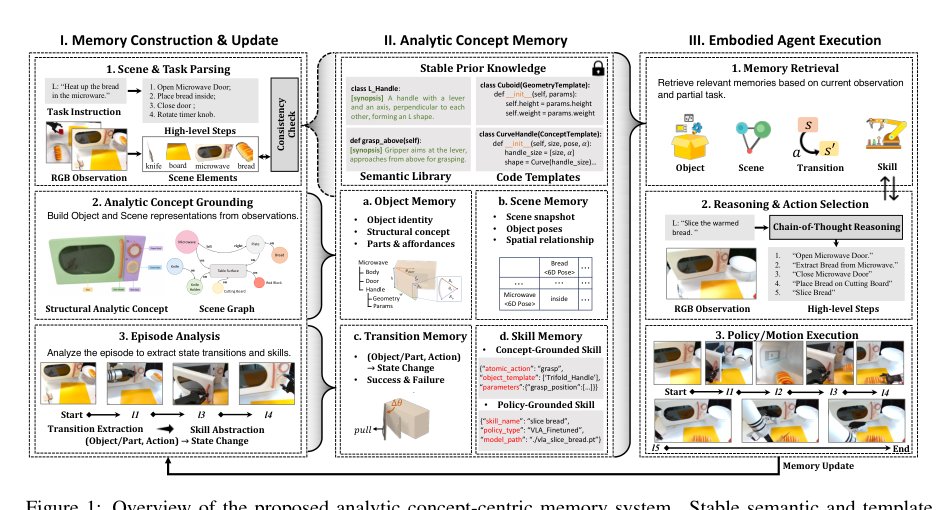
核心思想是把 agent memory 的中心从“历史经验”换成“analytic concept”。每个对象不再被存成 caption、embedding 或 keyframe,而被表示为由 semantic parts、parametric templates、grounded poses、affordances、states 和 manipulation functions 组成的结构化概念。这样,记忆的基本单元天然对应机器人操作中的可控变量:部件、几何、状态、动作前提和动作效果。
这个建模方式引入了很强的 inductive bias:相似性不是由视觉 embedding 决定,而是由可操作结构决定;泛化不是从整段 trajectory 迁移,而是从 part-level template 和 transition 迁移;检索不是找“过去类似场景”,而是找“当前 subtask 下可执行的 object-part-skill”。它和 prior 的本质区别在于信息流被重新组织了:perception 输出不直接喂给 planner 或 memory,而是先被投影到 analytic concept;memory retrieval 不直接返回经验片段,而是返回带 precondition/effect/statistics 的执行候选;execution feedback 不只是更新日志,而是更新 object state、transition 和 skill reliability。
Method
方法中真正必要的机制有四个。第一,stable template library 提供跨 episode 的结构先验,解决同类或异类 articulated object 之间如何共享操作知识的问题;没有这一层,memory 只能记住具体实例,难以跨对象迁移。第二,dynamic object/scene memory 维护 grounded instance 和 scene graph,解决长期任务中对象身份、位置、关系和状态变化的问题;这部分把瞬时 perception 变成可持续更新的 world state。第三,transition memory 把 skill 或 primitive 的 pre-state/post-state 绑定到具体 object-part,解决“动作是否应该执行”和“执行后应该发生什么”的问题;这让 agent 能避免重复打开已经打开的门这类状态不一致行为。第四,skill memory 把 template-grounded routines 和 learned policy skills 统一索引,解决结构化 symbolic prior 与 black-box execution backend 如何共存的问题。
粗到细检索是把这些机制串起来的关键:先用语言和任务语义缩小 category/template/context,再用 category、part、affordance、geometry、pose、state 和 skill statistics 做适用性筛选。这里的本质变化是 retrieval 从 similarity search 变成 applicability search。LLM 在其中更多是 query formulation 和 high-level selection,而不是核心记忆机制本身。
Key Insight / Why It Works
这篇论文最重要的 insight 是:在 manipulation memory 中,表示对了比存得多更重要。ACM 有效主要不是因为更大的 memory,也不是因为更强的 LLM,而是因为它把 retrieval space 约束到 object-part-action-state 结构上,显著降低了错误检索和物理不适用检索的概率。它把许多原本需要 planner 推理的问题提前编码进 memory schema:部件能做什么、技能需要什么前提、动作改变什么状态、哪个对象是同一个对象。
最可能的核心贡献是 analytic concept 作为 memory schema,而不是具体的六类 memory 表。object memory、scene memory、transition memory、skill memory 的划分本身并不新,真正有价值的是这些 memory 都通过同一套 part-template-grounding 对齐。这个 alignment 让 perception、retrieval 和 execution 共享索引空间,减少了典型 embodied agent 中语义层、几何层和控制层脱节的问题。
哪些部分可能只是辅助:LLM model choice、coarse-to-fine retrieval pipeline、skill statistics 更新、甚至一部分 scene graph 维护,更多是工程上让系统闭环可用。真正提供泛化的 likely source 是 template-level structural prior 和 benchmark 中 articulated structures 的 overlap。换句话说,这不是纯粹 learned generalization,而是强先验 + retrieval + execution grounding 的组合。所谓 reasoning 很大程度上是 structured retrieval 后的 precondition checking,并不是形成了复杂的长期 causal planning。
需要警惕的是增益归因不完全清晰。Ours(CS) 和 Ours(DP) 的差异说明 executor backend 仍影响很大;LLM sensitivity 说明 high-level decomposition/query 也贡献了一部分;而 template library 和 perception tools 的质量可能是隐藏的主要变量。若 template 覆盖充分,ACM 会显得很强;若遇到 template 外对象、非刚体、复杂接触或错误 part grounding,优势可能快速下降。
Relation To Prior Work
这篇工作位于 agent memory、object-centric manipulation、skill library / hierarchical robotics、以及 articulated object affordance learning 的交叉处。和 MemER / keyframe retrieval / embedding memory 相比,本质差异不是“也有长期记忆”,而是 memory key 从 visual-temporal similarity 变成 part-structured manipulation applicability。和 VLA memory 系列相比,它不试图把记忆压进 latent recurrent state 或 context token,而是显式外置为可查询、可更新、可审计的结构化 memory。和 SayCan / Code as Policies / agentic robot systems 相比,它补的是 skill selection 前的 object-state-action grounding,而不是 planner 或 API orchestration。
看似新的部分中,scene graph、transition memory、skill memory、precondition checking 都有明显传统 robotics / symbolic planning / hierarchical control 的影子;新意主要在于把这些老思想重新绑定到 analytic concept representation,并面向 LLM/VLA-era embodied agent 做统一接口。实质创新是 memory schema 的选择:用 parametric part templates 作为跨 perception、retrieval、skill execution 的对齐层。它更像是把 classical structured world model 重新包装并接入现代 foundation-model perception 与 agentic execution,而不是提出全新的 planning 算法。
Dataset / Evaluation
评估覆盖面相对完整:有 RMBench 这种 memory-dependent simulation,有 PartNet-Mobility articulated generalization,有真机 tabletop memory tasks,还有 LLM sensitivity ablation。整体上能支撑“结构化 memory 对对象持久性、状态追踪、技能复用有帮助”这一核心 claim。尤其是真机任务中 retrieval accuracy 和 retrieval effort 的改善,比单纯 success rate 更能说明该方法确实改善了 memory access,而不只是 executor 更强。
但 evaluation 也有明显上限。PartNet-Mobility 的跨对象泛化主要发生在 articulated object 和已知 part-template 空间内,因此更像验证 template abstraction 的有效性,而不是开放世界泛化。RMBench 的结果受具体 baseline 实现、skill executor、任务设计和 memory demand 定义影响较大;文中未充分说明各 baseline 是否拥有同等 perception、skill 和 tool access。真机任务数量有限,偏 tabletop、结构相对可控,不能证明 household-scale deployment 的长期 memory stability。整体实验支持方向正确,但还不足以证明 ACM 在开放场景中可持续扩展。
Limitation
最大限制是方法严重依赖 analytic concept grounding 的可用性。只要 part segmentation、pose estimation、template matching 或 state estimation 出错,后续 structured retrieval 和 precondition checking 都会建立在错误符号上。论文说 partial observation 不会覆盖 memory,但没有充分说明长期冲突、误识别和 state drift 如何系统性恢复。
第二个限制是 template library 的 scaling。ACM 的泛化边界基本由 template 覆盖决定:有 handle、drawer、lid、door 这类模板时效果好;遇到 deformable objects、工具使用、流体、复杂接触、多物体装配或非标准 affordance 时,系统需要新增模板、参数估计器和 manipulation functions。这意味着问题可能从 learning 转移到 template engineering。
第三,transition memory 的因果能力有限。当前形式更像记录局部 action-state delta,而不是学习可组合的 dynamics model。对于长链因果、多步依赖、失败后的异常状态,pre/post tuple 未必足够。所谓 planning 很可能只是 retrieval + rule-based consistency check,不应高估为真正的长期推理。
第四,增益来源不清。性能提升可能同时来自更强 perception tools、更结构化 prompts、更完整 skill library、更强 executor 和人工设计模板。文中 ablation 主要看 LLM sensitivity,没有充分拆分 template prior、transition memory、skill memory、identity resolution 各自贡献。若没有这些拆分,很难判断 ACM 的核心收益到底来自 representation alignment,还是来自 engineered system completeness。
Takeaway
- 最值得记住的不是 ACM 的具体 memory taxonomy,而是一个方向判断:embodied memory 应该围绕可操作结构组织,而不是围绕观察历史组织。
- 对于机器人,好的 memory key 应该是 object-part-state-skill,而不是 frame、caption 或 embedding。
- 第二个可迁移 insight 是:泛化可以通过显式中间结构发生。
- 与其让 VLA 在 latent space 中隐式学会 handle/joint/affordance,不如把这些结构显式化,让 retrieval 和 execution 都共享这套索引。
一句话总结
这篇论文把机器人长期记忆从“经验检索”推进到“以可操作对象概念为中心的结构化执行记忆”,本质上是用强 part-template-state-skill 先验重组 agent memory,而不是单纯扩大 VLA 或 embedding memory。