精读笔记
Problem Setting
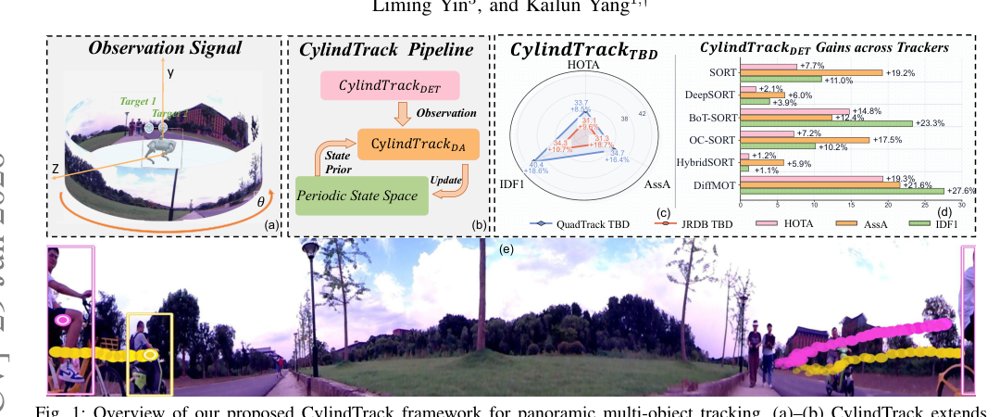
[论文标题] CylindTrack: Depth-Aware Cylindrical Motion Modeling for Panoramic Multi-Object Tracking(arXiv preprint / 2026-06-30)。这篇论文实际处理的是 ERP 全景 MOT 中 identity preservation 失效的问题,尤其是 seam crossing、遮挡、近距离交互导致的 association failure。真正困难点在于观测空间不是普通平面图像:左右边界在像素上远、物理上近;同时大 FoV 带来更多目标和更复杂遮挡,使单帧 box、appearance、depth 都更不稳定。以前方法卡在两个层面:传统 SORT/ByteTrack/DeepSORT 类方法仍用 Cartesian image-plane motion;depth-aware MOT 多把 depth 当 detection-level pairwise cue,而不是 trajectory state。这个任务的关键矛盾是:TBD 需要轻量、在线、模块化,但全景几何要求状态空间和关联代价具备非欧几里得拓扑一致性。
Motivation
作者的动机不是简单“全景图有畸变,所以加几何”,而是指出已有 TBD 的状态表示和 cost function 与 ERP 观测拓扑不匹配。seam crossing 时 x 坐标会发生近似 W 量级跳变,Kalman velocity、IoU、中心距离都会把连续运动解释成异常运动;这会直接制造 track fragmentation。另一个缺口是 depth cue 的使用方式过浅:monocular depth 对遮挡和前后关系有价值,但 frame-wise depth 的 scale fluctuation 会让相邻帧 depth matching 很脆。于是作者想到的方向是:不是只改 detector 或加一个 depth loss,而是把 depth 和 horizontal coordinate 都变成随 trajectory 演化的状态变量。
Core Idea
核心思想可以概括为:把全景 MOT 从 UV 平面上的 box matching,改写为带周期拓扑的 cylindrical state association。水平位置不再是 bounded pixel coordinate,而是可 unwrap 的 longitude;depth 不再是当前检测的附加属性,而是经过时间滤波的 trajectory-level latent state。这样做引入了两个 inductive bias:motion continuity 应该在 angular manifold 上成立,geometric identity cue 应该在 trajectory time scale 上稳定,而不是在 frame-to-frame observation 上稳定。
与 prior 的本质区别在于它没有试图用更强 appearance 或更复杂 detector 去“学会”seam continuity,而是显式改变 tracking 的状态空间和距离度量。这类方法通常更 scalable,因为它把一个需要数据覆盖的模式识别问题转成了结构先验:只要输入确实是 ERP/panoramic,左右边界相邻这个约束不需要从数据中学习。depth 部分也是类似逻辑:不是相信单帧 depth,而是复用历史状态,把 noisy cue 转成低频几何记忆。
Method
关键机制只有三层。第一,DTM 解决 depth cue 时间不稳定的问题:每条轨迹维护 depth 和 depth velocity,用一维 constant-velocity Kalman filter 预测当前 depth,再与 detection depth 做 cost。核心变化是 depth association 从 frame-to-frame comparison 变成 trajectory-to-detection comparison,降低 monocular depth jitter 对 ID 的影响。
第二,SSTC 解决 depth observation 本身质量不足的问题:Temporal Mixer 在 query space 做短时尺度对齐,SGA 用 spherical geometry prior 调整 depth-aware queries。它的必要性在于 DTM 只能滤波,不能修复系统性 depth observation noise;但从机制上看,SSTC 更像 detector-side representation alignment,而不是 tracking 层面的根本创新。
第三,TCMM 解决 ERP seam topology mismatch:水平状态用 unwrapped angle 预测和更新,观测角通过 nearest equivalent angle 对齐;overlap 用 horizontal-periodic pixel-vertical IoU,关联 cost 再融合 depth consistency、angular consistency 和 confidence。核心变化是 motion prediction、overlap computation、association gating 共享同一个周期拓扑,而不是各自仍在 UV 平面里做局部修补。
Key Insight / Why It Works
最重要的 insight 是:全景 MOT 的很多 ID switch 不是 association model 不够强,而是 coordinate system 错了。只要 seam 两侧在 cost space 里仍然很远,appearance/depth 再强也只能事后补救;TCMM 直接把 seam discontinuity 从状态空间里拿掉,因此对 boundary-crossing identity consistency 的增益最可信。
第二个有效点是 trajectory-level depth memory。depth 本身不是新 cue,但把 depth 变成 latent state 后,它从 noisy observation 变成一种低频几何约束,特别适合遮挡和近距离重叠。这里本质上是 memory reuse + better inductive bias,而不是更强 reasoning。DTM 的贡献比 SSTC 更干净,因为它直接改变 association 的信息流。
SSTC 的作用要谨慎看。它可能确实改善 depth representation 的 temporal coherence 和 panoramic alignment,但这部分也可能主要来自 engineering:query-space temporal projection、detector retraining、depth supervision、SAM2 mask、Video Depth Anything 伪标签等因素混在一起,增益来源不清。尤其论文说计算量还下降,说明 architecture redesign 本身也可能贡献了性能-效率 trade-off,不应把所有 detector-side gain 都归因于 spherical spatio-temporal consistency。
最像实质创新的是 TCMM + DTM 的组合:一个修正 topology,一个稳定 depth trajectory。最可能只是辅助的是 SGA/T-Mixer 这类 representation refinement。整篇文章不是 scaling paper,也不是端到端 learned tracker,而是把 explicit geometry prior 重新放回 online TBD pipeline。
Relation To Prior Work
它最接近三条线:SORT/ByteTrack/OC-SORT 类 Kalman-filter TBD,DepTR-MOT/PD-SORT/SparseTrack/DepthSort 类 depth-informed MOT,以及 OmniTrack/S3KF/panoramic tracking 类全景几何建模。与普通 TBD 的差异是 motion state 不再假设 image-plane Euclidean;与 depth-aware MOT 的差异是 depth 不再只是 detection pair cost,而是 trajectory state;与 OmniTrack 的差异是更强调 boundary topology 下的 cylindrical association,并把 depth temporal filtering 纳入同一个在线框架。
看似新的部分里,Kalman depth filtering、angular wrapping、periodic IoU 都不是概念上全新;它们更像已有思想在 panoramic MOT 里的正确组合。实质新增的信息是:在 ERP MOT 中,motion prediction 和 overlap measurement 必须在同一周期拓扑下联合建模,单独改 KF 或单独改 IoU 都不够。这一点 ablation 支持得比较好。SSTC 则属于 detector-side representation alignment 谱系,和 panoramic depth / spherical attention 工作关系更近,创新性弱于 TCMM。
Dataset / Evaluation
评估覆盖 QuadTrack 和 JRDB,都是机器人/全景场景,任务设置与 claim 高度相关:seam crossing、遮挡、移动平台、crowded human-centric scenes 都能测试 identity continuity。它确实验证了方法在 embodied panoramic MOT 里的有效性,尤其 BCIC 直接针对 boundary-crossing claim,比只看 HOTA/IDF1 更有解释力。
但 evaluation 也有明显边界。首先,两个 benchmark 都偏 ground robot / human tracking,不能证明方法泛化到强 vertical motion、无人机、车载多层立体空间、非人类目标。其次,BCIC 是作者定义的 seam-local metric,适合证明 TCMM,但也可能让评估更偏向该方法设计点。再次,detector-side comparison 涉及 depth pseudo-label、mask source、query architecture、training recipe,虽然作者声称控制配置,但增益归因仍不完全干净。最后,online FPS 是有价值的,但 deployment 中 depth model、segmentation supervision、相机标定变化和 ego-motion-induced depth drift 的真实成本没有完全展开。
Limitation
最大前提是 ERP 的主要拓扑问题集中在水平周期边界,因此 HPV-IoU 保留 pixel vertical coordinate 就足够。如果场景存在强 pitch/roll、垂直方向大视角变化、上下边界球面畸变显著,当前 cylindrical/HPV 近似可能不够,spherical 或 full 3D state 才更合理。
第二个前提是 monocular relative depth 在 trajectory 内可滤波。如果相机强烈自运动、场景尺度快速变化、depth estimator 出现系统性漂移,DTM 可能只是平滑错误,把错误 depth 变成更稳定的错误。文中也承认不是 metric world depth,没有 pose-aware filtering,因此几何推理能力上限明确。
第三,方法没有真正解决 detection failure,只是在低置信度检测和拓扑一致 association 中提高恢复概率。若 seam 附近 annotation/detection 长时间缺失,TCMM 只能延缓断轨,不能凭空维持身份。所谓 3D/cylindrical lifting也主要是 association geometry,不是完整 3D tracking。
第四,SSTC 的因果贡献不够清晰。它可能部分是 better depth supervision、better query architecture、better compute allocation 带来的工程收益,而不是 spherical spatio-temporal learning 的不可替代性。文中未充分说明这些 detector-side 改动在更强 detector 或不同 depth backbone 下是否仍有同等收益。
Takeaway
- 1. 对全景 MOT,先改状态空间再堆 association cue;seam continuity 是结构先验,不应该交给数据学习。
- 2. Depth 在 MOT 中更适合作为 trajectory-level memory,而不是 frame-level matching feature;这条 insight 可迁移到遮挡密集的普通 MOT、BEV-free tracking、移动机器人感知。
- 3. 显式几何先验和轻量在线 TBD 并不冲突。
- CylindTrack 的价值在于说明非欧几里得 topology 可以以很低成本插入现有 tracker,而不必转向重型端到端 3D tracker。
一句话总结
CylindTrack 是一篇把 panoramic MOT 从平面 UV association 推向 topology-aware geometric state modeling 的工作,真正贡献在于用周期角度状态和轨迹级深度记忆修正 TBD 的错误归纳偏置,而不是提出一个更大的检测器。