精读笔记
Problem Setting
这篇论文解决的是 agentic multi-robot execution 中的 mission-state governance,而不是传统意义上的 task allocation 或 plan generation。问题的关键矛盾是:上层 agent/LLM/optimizer 可以持续产生看似合理的 assignment、repair、deferral 或 constraint update,但工业多机器人系统真正需要的是一个一致、可审计、可回滚边界清晰的 committed mission state。
困难点不在于单次分配是否最优,而在于长时程执行中多种状态同时变化:任务结构会因 delayed grounding 展开,机器人会占用资源并留下 committed traces,场景会产生临时约束,任务分支之间会出现资源、空间、同步、前置依赖耦合。以前方法卡在不同层面:静态 task graph 会因新观测无法刷新 frontier;flat blackboard 能记录事件但缺少状态治理;global replanning 能恢复可行性但可能重写不该动的已保护工作;LLM/agentic planner 更是天然缺少 committed-state discipline。
Motivation
作者的核心动机是:agentic AI 在工业机器人里更适合做 proposal generator,而不是 execution authority。已有路线往往假设计划模块输出的结构、执行状态、约束记录和修复边界天然一致,但这正是部署时最容易坏的部分。
关键缺口不是“缺一个更聪明的 planner”,而是“缺一个把生成式 proposal 转换为 verified committed transition 的中间层”。这也是论文和大多数 LLM-for-robotics 工作的分水岭:它不试图证明 LLM 会规划,而是承认 proposal 会错,并把系统设计重点放在错 proposal 不能污染任务状态。
Core Idea
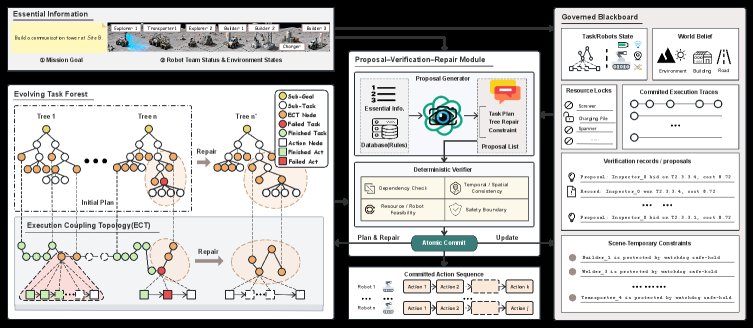
核心思想可以概括为:把长期任务执行建模为受控状态转移,而不是持续重规划。系统维护两个 canonical state objects:task forest 负责 persistent hierarchy、delayed grounding 和 repairable substructure;governed blackboard 负责 robot traces、resource locks、world beliefs、temporary constraints、proposal records 和 verification records。所有 proposal 只有通过 deterministic verifier 后才能 atomic commit。
它引入的 inductive bias 是显式状态治理:任务结构、执行事实、约束生命周期和修复边界必须被分离表示、同步提交、派生耦合,而不能混在 planner 的隐式上下文或黑板日志里。ECT 的作用不是再造一个 planner,而是从当前 forest-blackboard snapshot 派生跨分支耦合面,使 verifier 能看见哪些分支因 precedence、resource、spatial、sync 或 protective relation 不能独立更新。这比 prior 更 generalizable 的地方在于 proposal source 可替换:LLM、启发式、优化器都只是候选生成器,系统一致性不依赖它们可靠。
Method
1. Task forest / governed blackboard 分离:forest 解决任务层级、未完全 grounding、子结构修复的问题;blackboard 解决在线事实、资源锁、机器人轨迹、临时约束和验证记录的问题。核心变化是把“任务是什么”和“当前执行承诺是什么”拆开维护,避免 flat memory 把结构语义和运行时事实混在一起。
2. Derived ECT:ECT 解决跨分支依赖不可见的问题。它不是持久状态,而是从当前 forest 和 blackboard 快照派生的 coupling topology。这样做的必要性在于 repair/parallel commit 需要知道哪些分支硬耦合,但如果把这些耦合作为第三个 canonical state,又会引入同步一致性问题。
3. Verification-gated commit:assignment、repair、constraint update、diagnostic insertion 都被统一为 typed proposal。proposal 可以来自任何模块,但 committed state 只能由 verifier 通过后 atomic update。这个机制解决的是 authority boundary:生成模块不再拥有写入 mission state 的权力。
4. Bounded repair via hard-edge closure:disturbance 发生后,系统通过 hard ECT edge closure 找到 affected units,只允许在 affected subforest 及其 projected blackboard context 内修复。它解决 global replanning 的过度破坏问题,也避免 local patch 忽略硬耦合边界。
Key Insight / Why It Works
真正有效的原因不是某个 allocator 更强,而是状态写入路径被收紧了。所有危险事件——duplicate assignment、stale lock、resource conflict、invalid dependency、repair crossing protected boundary——本质上都是 committed-state corruption。论文的 verifier gate 把这些错误从“执行后诊断”前移到“提交前拒绝”。所以性能提升主要来自 better inductive bias + runtime state discipline,而不是 reasoning 能力增强。
最核心贡献是 forest-blackboard-ECT 这组三层角色划分:forest 提供长期层级结构,blackboard 提供当前执行事实,ECT 提供临时耦合视图。这个结构让系统既不会像静态图那样 frontier starvation,也不会像 flat blackboard 那样无法判定哪些更新一致,还能避免 global repair 把 protected work 一起重写。
辅助成分包括 risk-aware assignment cost、具体 benchmark 中的 candidate generation、各种 proposal 类型枚举。这些更像 engineering scaffolding,不是方法本质。实验中 full method 的零 violation 很大程度来自 verifier 拒绝非法 proposal;这当然是有效系统设计,但不能解读为 planner 变聪明了。
它不是 scaling、retrieval、data coverage 或 hidden model capacity 的故事;更接近 representation alignment 和 test-time governance。论文把 agentic module 的不确定性投影到 typed proposal 接口,再用 deterministic predicates 对齐到 mission-state representation。这一点值得迁移。
Relation To Prior Work
最接近的谱系有四条:MRTA/调度、HTN/PDDL/ROSPlan、LLM-assisted robot planning、blackboard/runtime assurance。论文的新意不是单独发明 task hierarchy、blackboard、verification 或 repair closure;这些思想都已有先例。真正不同的是把它们组合成一个 mission-state write barrier,并明确规定 agentic reasoning 只能产生 proposal,不能直接更新执行状态。
相对 MRTA,它关心的不是 assignment optimality,而是 assignment 是否能进入 governed state。相对 PDDL/HTN,它不假设 domain model、current state 和 execution record 已经一致,而是把一致性维护本身作为问题。相对 LLM planning,它不把语言模型规划能力作为核心卖点,而是把 LLM hallucination/不完备推理视为正常输入噪声。相对 runtime assurance,它更具体地给出了长时程多机器人任务层级、资源锁、临时约束和修复边界的状态组织方式。
因此,这篇更像 systems paper / architecture paper,而不是算法 paper。实质创新在于 mission-state governance abstraction;形式化命题本身较弱,主要是把 verifier 检查的约束在 atomic commit 下保持不变,属于合理但不深的 invariant argument。
Dataset / Evaluation
评估覆盖了 factory scenario、remote-construction stress benchmark、ablation 和 scalability probe,能验证论文最核心的 claim:在 modeled mission predicates 下,governed state + verification gate 能减少无效提交和破坏性修复。ablation 的设计相对有信息量,因为它把 flat-BB、global repair、no verifier、no structural repair 的失败模式分别暴露出来。
但 evaluation 的边界也很明显:这是高层 mission-state simulator,不是真机系统;物理执行、感知误差、通信延迟、localization drift、motion planning failure 和连续碰撞规避都没有真正进入验证闭环。benchmark 是否足以证明 general deployment robustness,文中未充分说明。结果更强地支持“状态治理架构在作者定义的模拟谓词下有效”,而不是“工业多机器人安全执行问题已解决”。
另外,和 DART-DAG、LiP-LP 等 baseline 的比较要谨慎。很多 baseline 并不是为 governed temporary ledger / atomic commit / bounded repair 设计的,因此 violation 数很高并不意外。实验更像证明缺少治理层会坏,而不是证明某个具体 planner 被全面超越。
Limitation
最大限制是 verifier 的 soundness 完全依赖 blackboard projection 的保守性。Assumption 1 很强:机器人能力标签、残余能量、资源锁、世界状态、临时约束都不能乐观。如果 lower-level 模块给出 stale 或 optimistic 信息,verification gate 会在错误状态上做正确推理,保证随即失效。
第二,verification 只覆盖 represented predicates。论文明确不保证 physical safety、global optimality、eventual completion,也不替代 motion planning / control safety。因此它更像 mission-level consistency layer,而不是完整 autonomy safety solution。
第三,scalability 上限不清。验证成本随 candidate/frontier/constraint coupling 增长而显著上升,Large/XL 已经显示 verification 是主要成本。真实工业系统中如果约束更密、机器人更多、commit 频率更高,centralized atomic governance 可能成为瓶颈。文中未充分说明分布式一致性和实时性。
第四,增益归因有一部分是“更严格地拒绝非法更新”。这不是问题,但需要避免过度解读为 agentic reasoning 更好。方法可能把困难从 planning 转移到 constraint modeling 和 verifier engineering:只要约束漏建、边界定义错、hard/soft 分类错,系统仍可能提交危险状态或过度保守停滞。
Takeaway
- 1. 对 agentic robotics,最值得迁移的 insight 是 proposal/commit separation:生成式模块不应拥有状态写权限,尤其是在多机器人长时程任务里。
- 2. 长期任务执行的核心 representation 不应只是 task graph 或 shared memory,而应区分 persistent hierarchy、online commitment 和 derived coupling view。
- 3. 局部修复的关键不是“局部重规划”四个字,而是必须有可验证的 hard-coupled affected scope,否则 local repair 会漏掉耦合,global repair 会破坏保护区。
- 4. 未来真正值得做的是把这种 mission-state verifier 接到真实低层证书:motion feasibility、perception uncertainty、resource sensors、digital twin consistency 和 distributed commit protocol。
一句话总结
这篇论文的价值在于把 LLM/agentic 多机器人规划从“生成计划”推进到“验证门控的 mission-state 治理”,本质上是用显式状态表示和 atomic commit 约束生成式 proposal 的系统架构演化。