精读笔记
Problem Setting
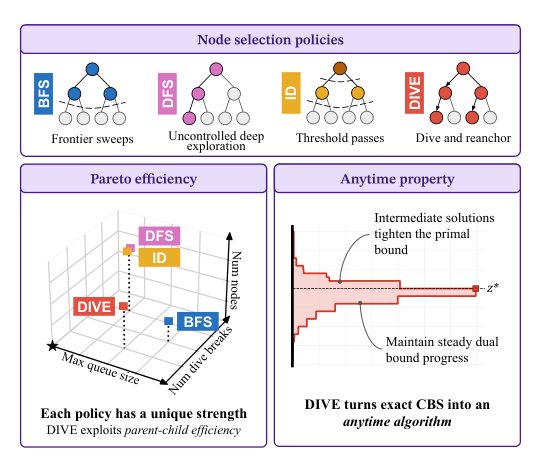
Dual-Informed Vertical Expansion for Multi-Objective Node Selection in Anytime Conflict-Based Search(arXiv preprint / 2026)。这篇论文实际处理的是 exact CBS 的高层搜索调度问题:给定同一个 CT、同一个 branching、同一个 lower-bound key 和 pruning rule,应该以什么顺序扩展 OPEN 中的节点。困难点不在 MAPF 定义,而在 exact CBS 的目标并不单一:少扩展节点、快推进 dual certificate、小内存、保持 parent-child continuity、早产出可行解,这些目标互相冲突。传统 BFS 卡在 frontier 大、跳跃多、通常直到终止才有 feasible solution;IDCBS 卡在重复工作和仍缺乏 early incumbent;DFS 类方法卡在 certificate 进展不可控。论文的关键矛盾是:能否牺牲少量 best-first node efficiency,换来显著更好的 dive continuity、内存和 anytime 行为,同时不破坏 exactness。
Motivation
作者真正抓住的缺口是:CBS 社区长期把 best-first node selection 当成 optimal CBS 的组成部分,而不是一个可替换策略。多数已有工作在改 lower-bound key、conflict selection、bypassing 或 heuristic,本质仍在 best-bound 框架内优化;它们没有改变“搜索如何穿过 CT”这个维度。因此已有路线对 expanded nodes 很敏感,但对 deployment 中同样关键的 memory pressure、interruptibility、parent-child locality 和 early incumbent 不够敏感。作者的核心观察是 B&B 中 correctness 来自 admissible lower bound、branch coverage 和 incumbent pruning,不来自 best-first 顺序;一旦这个分离成立,就可以把 node selection 当成多目标设计空间,而不是实现细节。
Core Idea
核心思想是把 exact CBS 从“best-first 扫 frontier”改成“best-bound reanchored diving”。DIVE 每次从当前全局 best-bound node 开始一个 dive,随后优先沿着刚扩展节点的 child 继续往下走;这样搜索在局部上像 DFS,能利用 parent-child 只差一个 constraint 的结构,也更可能较早进入 feasible/primal region 找 incumbent。但每个 dive 结束后又回到全局 best-bound frontier,因此不会像普通 DFS 那样长期困在一个低价值分支。
本质区别不是多了一个 tie-breaker,而是重新组织了 CBS 中 primal 与 dual 信息流:BFS 几乎只推进 dual certificate,DFS 过度追逐局部深度,ID 用 threshold 重复恢复 best-first discovery;DIVE 则允许短暂离开 dual frontier 去寻找 primal incumbent,再通过 best-bound restart 重新校准 certificate。这个 inductive bias 很明确:局部连续性有价值,但必须被全局 lower bound 周期性约束。
Method
方法上真正必要的机制很少。第一,B&B 抽象用于证明 traversal order 与 exactness 可分离:只要 policy 每次从 OPEN 中选节点,且 lower bound、branch coverage、incumbent pruning 合法,节点顺序不影响最优性。这一步是论文最重要的建模动作,因为它把 CBS node selection 从 correctness 叙事中解放出来。
第二,DIVE 的 child-following 机制解决 parent-child discontinuity:CBS child 只比 parent 多一个约束,连续处理可能复用低层搜索状态、减少工程上的切换成本,也在结构指标上减少 dive breaks。第三,incumbent cutoff 解决 depth-oriented search 的失控风险:一旦 child lower bound 不可能优于当前 incumbent,当前 dive 立即停止。第四,best-bound diversified restart 解决 DFS 的局部执着问题:每次新 dive 都从全局最小 lower-bound node 重启,使 primal-zone excursion 被限制在单个 dive 内。warm start 和 MC-DIVE 是自然扩展:前者提前激活 pruning,后者在队列过大时把策略推向 DFS 端。
Key Insight / Why It Works
这篇真正有效的地方不是某个复杂算法模块,而是识别了 CBS 的一个被低估自由度:exactness 约束的是 coverage/pruning invariant,不约束 traversal order。DIVE 的收益来自 better test-time compute allocation 和 memory/locality inductive bias,而不是新的 lower bound 或更强 MAPF reasoning。它主动花一些额外节点去探索 primal/optimal zone,换取早期 incumbent;同时用 best-bound reanchoring 保持 dual side 不至于停滞。
最核心贡献大概率是“diversified diving + incumbent cutoff”的组合。单独 DFS 加 pruning 不够,因为没有全局 restart 会在 primal zone 里过度扩展;单独 best-first 也不够,因为它不进入足够深的区域产生 incumbent。DIVE 的机制相当于在 exact CBS 中引入 MIP-style plunging,但用 CBS 的 parent-child locality 和 MAPF incumbent gap 赋予它具体意义。
哪些可能只是辅助:tie-breaking、具体 MC-DIVE 阈值、PIBT warm start 都不是核心思想。warm start 对 dense regime 很重要,但这也暴露了 DIVE 的上限:如果早期 incumbent 不容易获得,深潜可能变成额外成本。文中所谓 anytime CBS 不是 magically better planning,而是用 controlled primal-zone exploration 提前买到 feasible solution;这是一种 test-time compute trade-off,不是 lower-bound quality 的提升。wall-clock 增益来源仍不完全清楚,因为论文主要报告结构指标,parent-child locality 是否在不同实现中稳定转化为运行时间,文中未充分说明。
Relation To Prior Work
最接近的技术谱系不是传统 CBS heuristic 改进,而是 branch-and-bound / MIP 中的 node selection、plunging、best-bound/depth hybrid。相对于 CBS best-first heuristic work,DIVE 没有提供更强 admissible key,而是改变 key 的使用方式;相对于 IDCBS,它不靠 threshold pass 和 root restart 省内存,而是保留 frontier 并周期性 best-bound reanchor,避免重复扩展;相对于 suboptimal/focal CBS,它没有放弃 exactness,也不依赖 non-admissible ordering 来换速度。
看似新但其实是已有思想重组的部分:diving、incumbent pruning、warm start、memory-responsive switching 在 B&B/MIP 里并不新。实质创新在于把这些思想精确嵌入 CBS,并给出 CBS-specific trade-off 分析:dive breaks、queue size、primal-dual progress 与 parent-child efficiency 被放在同一框架下讨论。论文真正新增的信息是:CBS 的 node selection 可以被当成 Pareto design space,而不是 best-first 的小修小补。
Dataset / Evaluation
实验覆盖了标准 MAPF benchmark 的几类 grid/warehouse/room 场景,并包含不同密度、complete-solve、anytime incumbent、warm start、DFS ablation 和 memory-responsive variant。它基本验证了论文的核心 claim:DIVE 不是全面优于 BFS/ID,而是稳定落在不同 Pareto 点上,尤其是减少 dive breaks、降低相对 BFS 的队列、提供早期 incumbent/gap。
但 evaluation 仍有明显边界。第一,没有真实机器人或在线 replanning loop,所谓 deployment benefit 主要由离线指标间接支持。第二,wall-clock 只作为截断或 first incumbent 时间,未系统证明 dive continuity 在不同 CBS 工程实现中确实带来稳定 runtime gain。第三,benchmark 仍是标准 MAPF grid 分布,跨任务泛化、非标准 objective、复杂动态环境没有验证。第四,dense regime 依赖 warm start 才稳定,说明 DIVE 的 anytime 优势在可行解稀疏时并不自足。
Limitation
核心前提是 lower bound 沿 parent-child 单调、induced search tree 有限、incumbent pruning 合法,并且 parent-child 连续扩展在实现层有实际收益。如果这些条件弱化,理论和经验收益都会变窄。DIVE 的扩展节点开销不是偶然,而是机制内生的:它故意进入 primal zone;当 first incumbent 难找或 incumbent 很松时,这部分探索可能只是额外搜索。
scalability 上限主要在高密度、可行解稀疏、低层重规划昂贵且不可复用的场景。warm start 能缓解,但也把部分能力外包给 suboptimal planner;因此 dense case 中增益归因不完全属于 DIVE。文中未充分说明在 state-of-the-art CBS 组合大量高级 heuristic、并行化、复杂 bypassing 后,DIVE 的边际收益是否仍显著。另一个限制是理论分析大量依赖 stylized tree / singleton optimal-zone / perfect tree 来解释结构,虽有启发性,但不能直接预测真实 CBS tree 上的最优 policy。
Takeaway
- 1. exact search 的 node selection 不应只用 expanded nodes 评估;memory、incumbent discovery、certificate progress 和 locality 是独立目标。
- 2. 对 CBS 而言,best-first 不是 correctness 的同义词;只要 B&B invariant 保持,traversal policy 是一个可学习、可响应、可调度的自由度。
- 3. DIVE 最可迁移的 insight 是“周期性回到 dual frontier 的 controlled primal probing”:这可用于其他 B&B-style planners,而不只是 MAPF。
- 4. 未来更值得做的是 adaptive/learned node selection:根据 queue growth、incumbent gap、branch productivity 动态决定何时 dive、何时 reanchor,而不是固定策略。
一句话总结
这篇论文把 exact CBS 的高层节点选择从 best-first 实现细节提升为 B&B 式多目标调度问题,DIVE 的贡献是在不破坏最优性证明的前提下引入受 lower-bound 锚定的 depth-oriented primal probing,属于 exact search policy 从静态 best-bound 向 anytime/responsive hybrid traversal 演化的一步。