精读笔记
Problem Setting
这篇论文实际处理的是 LTV 近似驱动的 robust nonlinear MPC / SLS 中的 guarantee gap:控制器是在 LTV tracking-error dynamics 上设计的,但真实系统是 nonlinear dynamics;如果 linearization error 没有被 soundly bounded,所谓 robust constraint satisfaction 只对 surrogate model 成立。真正困难点在于,LEB 必须局部紧、在线快、可微、可传播,并且不能破坏 SLS 原本的快速求解结构。以前方法卡在两端:全局 Lipschitz / Hessian bound 有 guarantee 但太保守;sampling / 忽略误差有性能但没有 formal guarantee;传统 interval reachability sound 但慢、不可微、难以嵌入 optimizer。关键矛盾是:越紧的 nonlinear remainder bound 往往越贵、越不可微,而实时 robust control 恰恰需要它在每次迭代中被快速重算并参与优化。
Motivation
作者的动机不是再提出一个 tube MPC,而是修补 nonlinear SLS 中最薄弱的一环:linearization error oracle。已有路线把 LEB 当成外部常数、离线 bound 或保守 margin,导致 trajectory optimization 本身不知道哪些 nominal states 会产生更小 remainder。作者的核心观察是,linearization error 不是只需要被包住,它还应该被优化;因此 bound 必须 differentiable。另一个观察是,很多 conservativeness 不是来自 SLS,而是来自误差集合表示和传播方式:把 off-centered interval 强行 zero-center、把 zonotope 过度转成 ellipsoid,都会放大 tube。关键缺口是一个能把 local LEB、zonotope propagation 和 GPU-SLS 联在一起的 formulation。
Core Idea
论文的核心思想是:把 nonlinear dynamics 相对 LTV approximation 的 residual 当作额外 disturbance,并为它构造 tight local disturbance set,然后让 SLS 像处理 exogenous disturbance 一样处理它。这样 formal guarantee 的对象从 LTV surrogate 回到原 nonlinear system。这个转化本身不新,关键在于 residual bound 被做成 trajectory-dependent、differentiable、GPU-parallel,并且保留 off-centered structure。
本质区别在于建模信息流被反过来了:prior 通常先求 nominal/controller,再用一个固定或粗糙 bound tighten constraints;这里 LEB 依赖当前 tube、nominal、feedback response,并反过来影响下一轮 nominal optimization。这个闭环让 optimizer 有能力主动选择低曲率、低 remainder 的轨迹。引入的 inductive bias 是“安全轨迹不只要远离约束,还要处在局部线性化可信的动力学区域”。这比单纯加大 tube 更有结构,也更适合高维 GPU-parallel SLS。
Method
方法上最重要的不是模块数量,而是三个机制如何分别消除 bottleneck。
第一,analytic dynamics 的 path-based Hessian bound 解决 classic interval Hessian 在 full box 上评价导致的 dependency / wrapping。它沿 coordinate-wise path 展开 remainder,让混合二阶项和对角二阶项在 prefix set 上取 interval enclosure。核心变化是二阶曲率信息不再被全局 box 一次性抹平,而是按路径局部化;理论上保证不比 expanded / classic IH 更松。
第二,NN dynamics 的 CROWN-based LEB 解决神经网络 Hessian bound 难算的问题。CROWN 给网络输出的 affine upper/lower relaxation,但这些 affine slope 不等于 nominal Jacobian;论文显式减去 local Jacobian term,把 output bound 转成 Taylor remainder bound。核心变化是把 NN verification 产物从“输出可达集 bound”重解释为“线性化误差 bound”。
第三,SLS formulation 被改成能处理 nonzero-centered zonotopic disturbances 和 right-invertible disturbance matrices。LEB 的 interval 通常天然 off-centered;如果强行 zero-center 会无谓增大 tube。论文保留 offset,并把 exogenous disturbance 与 LEB generator 拼接传播。right-invertible 改写的作用是让这种更一般的 disturbance representation 仍能使用快速 Riccati/GPU-SLS 求解器。这个部分更多是 formulation engineering,但对实际 tightness 很关键。
Key Insight / Why It Works
最核心的有效性来自两个地方。第一,LEB tightness 来自减少 interval overapproximation 的作用域,而不是更复杂的控制理论。PBH 的优势本质上是 better inductive bias:Taylor remainder 的二阶项并不需要在整个 local box 上同时取 worst-case Hessian;沿路径分解后,每个 Hessian entry 只在更小集合上取 bound,减少 dependency loss。这个 insight 可迁移到其他需要二阶 interval remainder 的 verified planning / learning 问题。
第二,控制性能提升来自把 LEB 放进 optimization loop,而不是只做 post-hoc certificate。可微 LEB 让 nominal trajectory 避开高曲率区域;nonzero-centered zonotope 避免人为对称化误差;SLS feedback response 又会优化 disturbance amplification。因此最终 tube 变小是三者叠加:local tighter bound + structured propagation + controller shaping。论文没有完全分清各自贡献比例,尤其是 zonotope vs PBH vs GPU-SLS baseline 的增益归因仍有混合。
最可能的实质贡献是 PBH LEB 与 nonlinear SLS 的可微闭环耦合。CROWN-to-LEB 是聪明且有用的改写,但更像把 verifier affine relaxation 接到控制里的自然 extension。right-invertible disturbance matrix 与 nonzero-centered zonotope 是高价值 formulation engineering,不是新的控制范式。GPU parallelism 是 enabling factor,部分结果可能主要来自 scaling / implementation,而非理论上更优的 control objective。
这不是 retrieval、memory reuse 或 data coverage 型方法;它是 better local certificate + test-time compute + structured uncertainty propagation。对 NN dynamics,能力边界则强依赖 verifier tightness 和 training data 覆盖;所谓 neural dynamics safety 并不等于真实系统 safety,模型误差未被覆盖时 guarantee 只停留在 learned model 内。
Relation To Prior Work
它最接近 robust nonlinear SLS / tube MPC、interval-based conservative linearization、NN verification for dynamics 三条路线的交叉点。和 nonlinear SLS prior 的本质差异是:prior 要么假设 LEB oracle,要么用 global / offline bound,要么忽略 linearization error;本文把 LEB 做成在线、可微、局部的 solver component。和传统 interval Hessian / CORA 类方法相比,区别不是 soundness,而是把 interval remainder 做得足够快且可微,并通过 path-based decomposition 降低 conservativeness。和 CCM / global certificate 相比,它选择 trajectory-specific certificate,因此更不保守,但也牺牲了全局性。
看似新的部分中,Taylor remainder bounding、CROWN affine relaxation、SLS disturbance response 都是已有思想;真正新增的信息在于如何把它们组织成一个实时 RNOCP pipeline,并解决 off-centered LEB 与 SLS 快速求解器之间的表示不匹配。它属于“certified local planning / robust MPC 的工程化可扩展化”谱系,而不是完全新的 safety theory。
Dataset / Evaluation
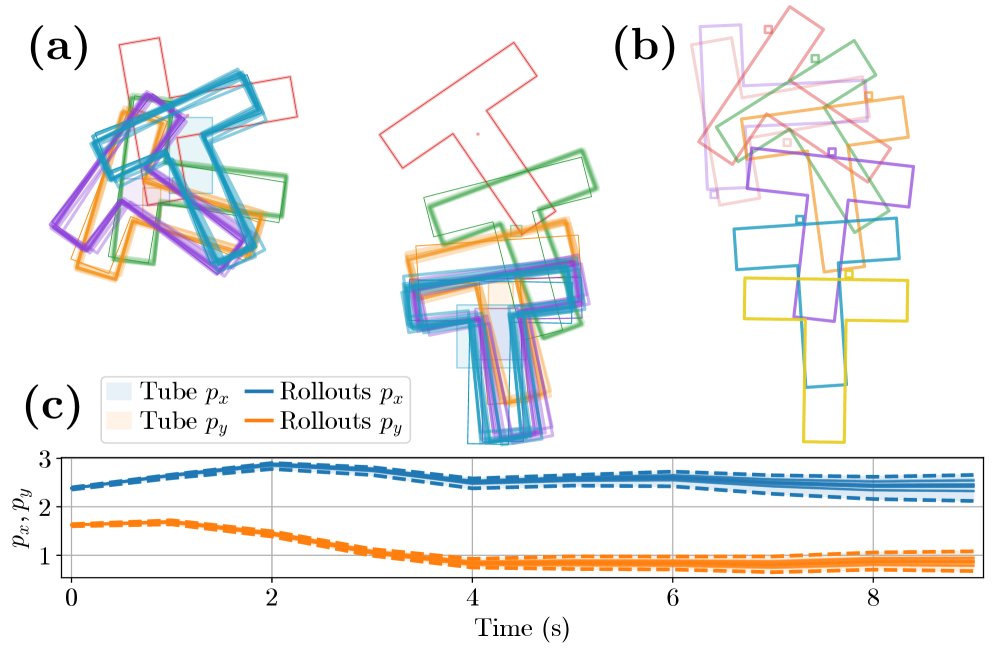
评估覆盖了低维 analytic、较长 horizon、耦合高维系统和 NN dynamics,任务范围对论文 claim 是基本对齐的:既测 LEB tightness,也测 controller tube,也测 runtime。真实世界层面没有真机实验,T-pusher 是 learned/simulated dynamics;因此不能说明真实 contact-rich deployment 已被解决。高维 quadrotor 主要验证 SLS/GPU scaling 和 tube propagation 在结构化系统上可跑,并不代表任意高维 nonlinear dynamics 的 PBH 都可扩展。
实验支持“在这些系统上可以实时产生更紧且 sound 的 tubes”这一 claim,但对“general nonlinear / neural dynamics”支持有限。NN 结果尤其需要谨慎:它证明 verifier-based LEB 能让 rollouts 留在 learned-model tube 中,但没有覆盖 learning error;如果 model mismatch 主导,formal guarantee 会断裂。消融显示 nonzero-centered zonotope 和 LEB gradient 有收益,但增益来源不完全干净,部分可能来自 representation choice 和 solver engineering。
Limitation
最大限制是 guarantee 的对象依赖 dynamics model 的正确性。analytic systems 中这还可接受;NN dynamics 中,如果训练误差、OOD 行为或 contact discontinuity 没被额外 bound,论文的 certificate 只覆盖网络模型的 linearization remainder,而不是真实物理系统。文中也承认 learning error 未 formal 考虑。
第二个限制是 scalability 的真正瓶颈被转移到 bound computation。GPUSLS 主体可以在高维下扩展,但 PBH 需要 Hessian / interval evaluation,维度升高后成本和 conservativeness 都可能快速恶化。图中也显示 PBH 高维 scaling 不如 SLS 主求解器。对 NN,CROWN relaxation 在更大网络、更宽 input set 上可能变松或变慢,文中未充分说明其上限。
第三,local certificate 本质上依赖 tube 不要太大、nominal 不要进入强非线性区域。一旦 disturbance 大、horizon 长、约束迫使系统穿过高曲率区域,LEB 可能膨胀并使 optimization infeasible。此时方法不是解决非线性 reachability 的根本困难,而是把问题限制在“局部线性化仍可被 tight certified”的区域。
第四,coordinate-wise path 的 ordering 可能影响 bound tightness,但论文没有深入讨论;right-invertible padding 对数值和 conservativeness 的影响也未充分说明。整体上,方法很实用,但不是对 arbitrary nonlinear robust control 的通用解。
Takeaway
- 最值得记住的不是某个 runtime 数字,而是:linearization error bound 应该是可微、局部、在线优化对象,而不是离线安全 margin。
- PBH 的 insight 可迁移:对 Taylor remainder 做 path-wise / structured interval decomposition,往往比在 full box 上做 Hessian interval 更紧,而且仍保持 soundness。
- 对 verified control 来说,集合表示很关键;保留 off-centered zonotope structure 可以直接减少 conservativeness,很多所谓 controller improvement 其实来自 uncertainty representation 改得更合适。
- 未来真正值得做的是把 model error、contact discontinuity、output feedback 和 LEB 一起纳入同一个可优化 certificate;否则 NN dynamics 上的 formal guarantee 仍然停在 model-internal 层面。
一句话总结
这篇论文是 nonlinear SLS / robust MPC 从“快速但常忽略线性化误差”走向“实时可微局部 certificate”的一次重要工程化推进,真正贡献在于把 tight LEB 变成可优化、可传播的 disturbance structure,而不是提出全新的控制理论。