精读笔记
Problem Setting
[Finite-Sample Closed-Loop Stability of Model Predictive Path Integral Control for Linear Time-Invariant Systems](arXiv preprint / 2026)
这篇论文实际处理的不是“MPPI 能不能优化一个 horizon cost”,而是更闭环的问题:有限样本 MPPI 在每个时刻重新采样、执行第一步、再 shift nominal sequence 后,状态是否仍能被一个稳定反馈的 Lyapunov margin 控住。真正困难点在于 MPPI 误差不是一次性的 optimizer error,而是每一步都会重新出现,并且和高斯过程噪声叠加进入状态递推。已有 open-loop sampling complexity 或 optimizer convergence 只能说明某个固定状态下的更新质量,不能说明 receding-horizon execution 下误差不会累积成闭环不稳定。本文的关键矛盾是:MPPI 的控制是有限样本、带温度 bias 的随机估计;稳定性证明需要可比较的、具有明确 Lyapunov decrease 的 deterministic reference。作者选择的 reference 是 LQR,而不是一般 MPPI optimal policy。
Motivation
已有路线不够的原因很直接:MPPI 的信息论推导、free-energy bound、importance-weighted update 收敛性,都没有把“反复执行后的状态分布”纳入证明闭环稳定性的 Lyapunov 框架。换句话说,它们证明的是 planner 在某一步像 optimizer,而不是 controller 在闭环中像 stabilizer。
作者的核心观察是一个非常特殊但有用的 LQ 结构:对 unconstrained LTI/quadratic problem,只要 terminal cost 取 DARE solution,任意有限 horizon 的 exact MPC 第一控制量都等于 infinite-horizon LQR。这消除了 horizon truncation error,使 MPPI 和 LQR 的差距只剩两类:finite-sample Monte Carlo error 和 finite-temperature smoothing bias。这个观察把问题从“证明 MPPI 本身稳定”改写成“证明 MPPI 对 LQR 的扰动足够小”。
Core Idea
论文真正的核心思想是 baseline reduction:不直接分析 MPPI 闭环,而是把 finite-sample MPPI 嵌入到一个已知稳定的 LQR 闭环附近。DARE terminal cost 的作用不是普通 MPC terminal trick,而是把 finite-horizon optimizer 的第一步固定为 LQR,从而给 MPPI 提供一个无 horizon bias 的 target。这样一来,MPPI 的复杂性被压缩成一个输入扰动 d_k = u_k^MPPI - u_k^LQR。
理论上这可能有效,是因为 LQR 的 Lyapunov decrease 有明确 margin α_P;只要 d_k 的 state-dependent gain 部分小于 small-gain threshold,剩下的常数项就只形成 practical stability floor。和 prior 的本质区别在于:prior 多分析 MPPI update 是否接近某个 open-loop optimum;本文分析的是这个 update 作为 feedback perturbation 是否能被 closed-loop Lyapunov margin 吸收。新的 inductive bias 是“用 LQR 稳定性结构解释 MPPI”,而不是从 path-integral objective 内生地产生稳定性。
Method
1. DARE terminal cost / LQR equivalence:解决 reference controller 不清的问题。因为 exact finite-horizon LQ MPC 的第一步等于 LQR,所以 MPPI 的目标不再是任意 open-loop optimum,而是可稳定化的 LQR feedback。这一步是整个证明成立的锚点。
2. Infinite-sample bias decomposition:解决即使 M→∞,MPPI 也未必等于 LQR 的问题。由于权重是 exp(-J/λ),infinite-sample MPPI 是 Gibbs-smoothed update;通过二次型 cost 和 Gaussian completing-the-square,可显式写出 bias gain κ_λ。核心变化是把温度 λ 的影响从经验参数变成稳定性常数。
3. Finite-sample concentration:解决有限 M 下 weighted ratio estimator 偏离 infinite-sample update 的问题。作者把误差写成 O(sqrt(log(m/η)/M)),并依赖 compact state/warm-start set 给出统一 lower bound on normalization。这里本质是 standard concentration,不是 MPPI 特有的新机制。
4. Lyapunov perturbation / small-gain:解决误差进入闭环后是否破坏稳定的问题。MPPI error 被写成 β∞||x|| + e_M(η),其中 β∞ 必须被 LQR Lyapunov margin 吸收,e_M 和过程噪声形成 residual floor。这是从 approximation guarantee 到 stability guarantee 的关键桥。
5. Stopped process localization:解决高斯噪声下 compact-set concentration 与状态有界性的循环依赖。作者用 Lyapunov sublevel set Ω_R 和 exit time τ_R,在有限 horizon 上给出高概率不逃逸事件。这个处理是必要的,因为 unbounded Gaussian noise 下无限时域留在任意 bounded set 的概率为零。
Key Insight / Why It Works
最核心贡献不是 concentration bound,而是把 MPPI 稳定性问题降维成 LQR perturbation problem。只要 DARE terminal cost 消掉 deterministic finite-horizon bias,MPPI 与 LQR 的差距就能被清楚拆成两块:Monte Carlo error 随 M 增大下降,temperature bias 随 λ→0 下降。这个 decomposition 很干净,也解释了为什么“增加样本数”不是万能的:M 只能消掉采样噪声,不能消掉 finite-temperature Gibbs smoothing。
真正有效的原因是 Lyapunov margin accounting。LQR 给出 V(A_cl x)-V(x)≤-α_P||x||²;MPPI perturbation 产生 cross term 和 quadratic term。若 β∞ 足够小,这些 state-dependent perturbation terms 被 α_P 吃掉;剩余的 β0、ε_M、Σ_w、η 只进入 practical floor。这是标准 robust stability 思路,但在 MPPI 场景中第一次被组织成 finite-sample certificate。
最可能是核心贡献的是:temperature bias 的 closed-form characterization 和 small-gain connection。有限样本 O(M^{-1/2}) bound 本身比较常规,实验中的 M* 保守也说明这部分主要是 worst-case certification engineering。ESS 讨论有实践价值,但不是理论核心。
这篇并不是 scaling paper,也不是 data/retrieval/memory reuse 类工作;它的增益来自 better structural reduction:利用 LQ/DARE 结构建立一个稳定 reference,然后把 sampling controller 视为 bounded perturbation。换句话说,paper 的价值不是让 MPPI 更强,而是给一个非常受控 setting 下的 MPPI 稳定性提供可计算解释。
Relation To Prior Work
最接近的路线有三类:MPPI/path-integral control 的信息论推导,MPPI sampling/optimizer convergence 分析,以及 classical MPC/LQR stability。本文的本质位置是在第三条线上重解释第一条线:它没有从 KL/free-energy objective 推出稳定性,而是借助 LQR/DARE 的 CLF 结构给 MPPI 外接一个稳定性证书。
和 Yoon et al. 的 open-loop sampling complexity 相比,本文新增的是闭环 Lyapunov propagation;和 CoVO-MPC 这类 optimizer convergence 相比,本文关注的是 receding-horizon induced state trajectory,而不是单次 control sequence contraction;和 Robust MPPI/performance bounds 相比,本文给的是更传统的 Lyapunov-style practical exponential stability。
看似新的部分中,finite-sample concentration、Young inequality absorption、stopped process 都是已有工具的重组;实质创新在于把这些工具放到 DARE-terminal LQ MPPI 这个特殊结构中,使 MPPI finite-sample error 能被稳定性 margin 直接定量化。它属于“sampling-based MPC 的 classical control certification”谱系,而不是 MPPI algorithmic improvement。
Dataset / Evaluation
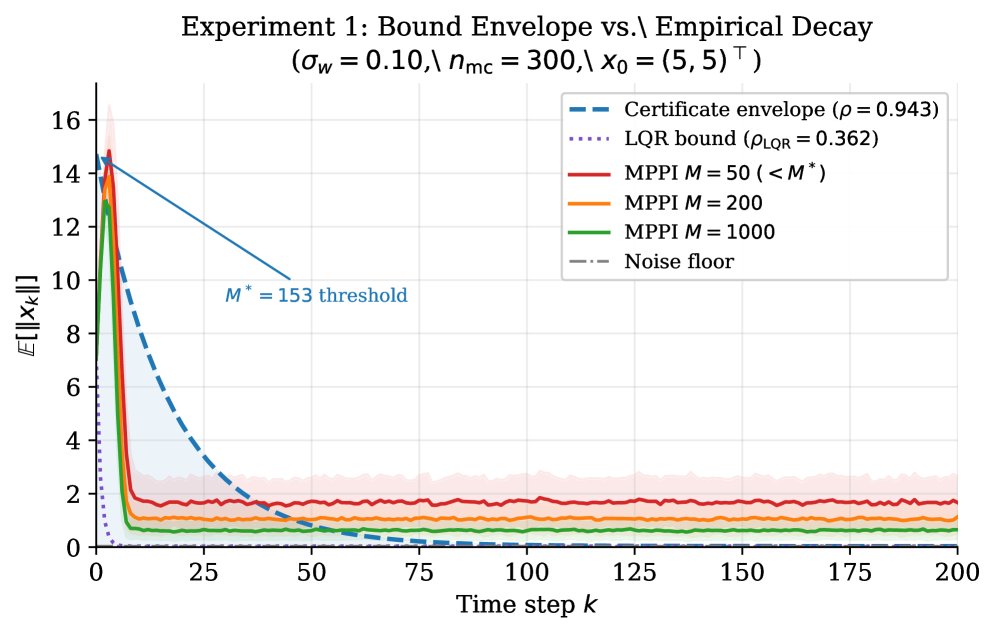
evaluation 覆盖非常窄:一个 double-integrator LTI benchmark,二次型 cost,无约束,无真实机器人,无非线性、障碍、接触、复杂动力学或多任务测试。它验证的是理论 bound 的 qualitative behavior:样本数足够大时经验衰减进入证书区域,阈值保守但方向正确,噪声主要影响 residual floor 而非 sample threshold。
实验不能证明一般 MPPI 稳定,也不能证明 nonlinear robotics 场景下成立。更重要的是,图中的 envelope 甚至没有完整包含 finite-sample MPPI approximation floor,因此不是严格 numerical verification of theorem,而是 sanity check。文中未充分说明常数 C_{X,U} / C1 的系统性计算或校准流程,增益来源不清;M*=153 与 empirical 30 的差距说明证书是 sufficiency diagnostic,不是 tight predictor。
Limitation
最大限制是 setting 过于结构化。DARE terminal cost、unconstrained LTI、quadratic cost 共同保证 exact finite-horizon MPC 第一动作为 LQR;一旦有 constraints、nonlinear dynamics、nonquadratic cost、state-dependent noise 或 saturation active constraints,这个 reference reduction 就不再直接成立。
第二个限制是温度与样本数的 trade-off 没有真正解决。理论要求 λ→0 可消除 bias,但小 λ 会导致 importance weights 更尖锐,实际需要更大 M;论文分别处理 κ_λ 和 ε_M,却没有给出 tight joint scaling。这里可能隐藏了实际 MPPI 中最关键的 degeneracy 问题。
第三,bounded warm-start 和 bounded implemented control 是证明 clean 的关键假设。实际 MPPI 的 Gaussian perturbation 是 unbounded 的,论文通过 clipping/saturation 解释 Assumption 6,但这会改变采样分布和 update law;这一偏差文中未充分说明。
第四,稳定性结论是 finite-horizon localization 下的 practical bound。由于高斯噪声无限时域必然逃出任意 bounded set,本文无法给出传统意义上的 almost-sure global boundedness。这个限制是诚实的,但也说明 claim 的 deployment 含义有限。
第五,horizon independence 只属于 exact LQR first action,不属于 sample complexity。H_N、F_N、mN 维采样、normalization lower bound、warm-start diameter 都可能随 horizon 恶化;scalability 上限文中没有充分量化。
Takeaway
- 1. 最值得迁移的 insight 是:对 sampling-based controller,先找一个有 Lyapunov margin 的 deterministic baseline,再把 sampling update 证明为 bounded perturbation,往往比直接证明 sampling objective 稳定更可行。
- 2. MPPI 的有限样本误差必须和 finite-temperature bias 分开看。
- 增加 M 只解决 Monte Carlo error;如果 λ 固定且 nominal sequence 偏离 optimum,infinite-sample MPPI 仍可能有不可消失 bias。
- 3. 对 MPPI 稳定性来说,ESS 不是可靠稳定性指标。
一句话总结
这篇论文把有限样本 MPPI 的闭环稳定性问题,在一个高度结构化的 LTI/二次型 setting 中,转化为“MPPI 是 LQR 的有限样本与有限温度扰动”的 classical Lyapunov certification 问题;贡献是理论归约和可计算证书,而不是新的 MPPI 算法。