精读笔记
Problem Setting
[Governed Caste Reassignment in Heterogeneous Swarms: An Asymmetric-Trust Protocol with Audited Operator Countersignature](arXiv preprint / 2026)
这篇论文解决的不是传统意义上的 heterogeneous swarm role allocation,而是 role/caste reassignment 的治理承认问题:当一个机器人从一个 caste 迁移到另一个 caste 时,系统应如何判断这次迁移是否扩大了权限、是否需要外部授权、以及事后能否向 regulator 证明授权链条。
真正困难点在于 reassignment 是运行时高频事件,不能全部交给 operator 同步审批;但一旦 caste 绑定了 action envelope,某些迁移就等价于 privilege relaxation,不能让内部 allocator、auction 或 consensus bundle 自己决定自己是否被允许升权。过去方法卡在把 reassignment 当作 optimization / coordination primitive,而不是 governance primitive。关键矛盾是:swarm 需要局部自治来保持响应速度,监管环境又要求任何权限放宽必须外部可归责。
Motivation
作者的动机不是提出一个更优的 task allocator,而是指出现有 role allocation / MRTA / adjustable autonomy / normative MAS 都缺一个共同部件:一个能把“角色变化”转译为“权限边界变化”的 admission layer。
已有路线各自只覆盖一部分:MRTA 解决谁做任务,但不解决谁授权升权;adjustable autonomy 讨论何时交给人,但不产生可离线验证的授权证据;normative MAS 有规范与制裁语言,但通常没有把每次权限迁移绑定到 cryptographic provenance。作者看到的缺口是:regulated embodied deployment 需要的不是更多内部共识,而是 operator-anchored, audit-verifiable, privilege-monotone 的状态迁移纪律。
Core Idea
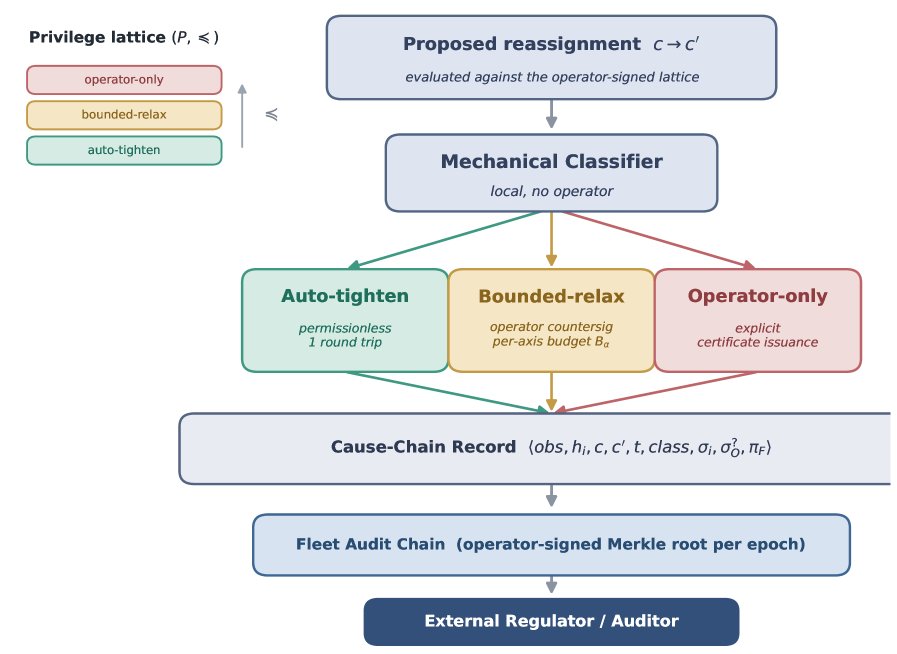
核心思想是把 caste reassignment 从“角色选择问题”改写成“权限状态机迁移问题”。每个 caste 对应一组可请求 action,operator 在部署时声明 privilege lattice 和 relaxation axes;任意 transition 都先被机械分类为 auto-tighten、bounded-relax 或 operator-only。这样系统不再问“这个角色分配是否效率最高”,而是先问“这次迁移是否扩大了权限,扩大多少,是否在 operator 预承诺边界内”。
理论上它成立的直觉很简单:降权方向具有单调安全性,可以让 swarm 自治;升权方向破坏安全 envelope,必须绑定外部 authority。相比 prior,本质区别不是用了签名、Merkle log 或 quorum,这些都很常规;区别在于它把 privilege direction 作为协议分支的第一原则。这个 inductive bias 让方法可以叠在任何 allocator 上,因为 allocator 的选择被降级为 proposal,真正被系统承认的是通过 lattice/audit/operator gate 的 transition。
Method
1. Privilege lattice:解决“角色变化是否是权限变化”的判定问题。caste 不只是 label,而是 action set 的载体;partial order 和 monotone actions 使 tighten/relax 可以本地计算。它带来的变化是把模糊的 role semantics 变成可验证的权限结构。
2. 三路径 admission:auto-tighten 走 fleet quorum,bounded-relax 走 operator countersignature,operator-only 走显式证书/绑定。这个机制解决实时性与可问责性的分流问题:安全方向不打扰人,危险方向必须有人类 authority 留痕。
3. Baseline-anchored envelope:bounded relaxation 的 charge 从 operator-reset baseline 计算,而不是从当前 caste 计算。它解决两个核心攻击面:先降权再升权的 caste laundering,以及多次小幅 relaxation 的累计越界。关键变化是 envelope 是 target-above-baseline bound,不是 usage counter。
4. Cause-chain audit:每次 transition 记录 triggering observation、robot identity hash、source/target caste、签名路径和 Merkle/audit inclusion。它解决事后 forensic reconstruction,而不是在线控制本身。尤其 upstream observation signature 与 robot signature 分离,是为了防止机器人自己伪造“原因”。
5. Replicated audit / fork exclusion:多个成员对 audit log 位置签名并使用 quorum certificate 排除分叉。它解决审计历史一致性,而不是解决 liveness 或完整 consensus;这部分更像把已有 quorum-log primitive 适配到 caste governance。
Key Insight / Why It Works
最核心的贡献是 privilege-direction asymmetry,而不是 cryptography。论文真正有效的原因是它抓住了角色重分配中的非对称风险:权限收缩和权限放宽在安全含义上完全不同。只要 caste-action lattice 定义正确,tighten 的安全性来自集合包含关系的传递性;relax 的安全性来自 operator signature 和 baseline-bound envelope;审计有效性来自签名链和 append-only log。
最有价值的机制是 baseline-anchored per-axis envelope。它避免把 relaxation budget 设计成从当前状态扣减的局部量,因为那会允许 adversary 通过 transient tighten 制造“看似合理”的回升空间。把所有 relaxation 都从 operator-reset baseline 计量,本质上把路径依赖攻击压扁成 target-state check。这是论文中最像新 insight 的地方。
cause-chain 和 offline auditor 是必要的治理工程,但不是理论上最深的部分;Ed25519、Merkle log、quorum certificate、fork exclusion 都是成熟构件的组合。distributed audit layer 也主要是 safety infrastructure composition,不应被解读为新 consensus 协议。实验中的 attack refusal 基本是 by construction,增益不是从数据、scaling 或 learned representation 来的,而是来自更强的 protocol invariant。这里没有 hidden reasoning,也没有 learning-based generalization;所谓 generality 来自抽象接口:任何 allocator 只要输出 caste transition,就能被这个 gate 包住。
需要直接指出的是:方法把大量难题转移到了 deployment specification。lattice 是否正确、relaxation axes 是否完备、B_alpha 是否合理、authorized sensor 是否可信,这些都不是协议自动解决的。协议证明的是“符合已声明规则的授权路径不可绕过”,不是证明规则本身合理,也不是证明物理世界中的 cause 为真。
Relation To Prior Work
它最接近四条谱系:MRTA/role reallocation、adjustable autonomy、normative MAS/electronic institutions、robot authorization/audit infrastructure。与 MRTA 的区别是它不优化任务分配,而是治理分配结果;与 adjustable autonomy 的区别是 human handoff 被固定为 privilege relaxation trigger,并产生 cryptographic record;与 normative MAS 的区别是 norm enforcement 被具体化为 operator-signed lattice transition,而不是抽象规范监控;与 blockchain/swarm trust 的区别是 trust anchor 不是 swarm 内部共识,而是 operator authority。
看似新的部分里,签名、Merkle audit、quorum intersection、access-control lattice 都不是新东西。实质创新在组合方式:把 role change 放进 access-control lattice,再用 asymmetric authorization path 处理不同 privilege direction,并用 baseline-bound envelope 防止路径依赖升权。这属于 runtime governance / authorization wrapper 的技术谱系,而不是 coordination algorithm 的谱系。
Dataset / Evaluation
评估覆盖三类模拟场景和不同 fleet size,并使用真实 crypto implementation;这足以验证协议开销在模型假设下不离谱,也能验证实现确实执行了签名、quorum、audit 和 envelope check。多进程 TCP 实验比纯模拟更有说服力,至少说明 fork-exclusion 不是只存在于伪代码里。
但 evaluation 支撑的是 admission-surface claim,不支撑完整 deployment claim。没有物理机器人,没有真实无线网络 broadcast storm,没有多主机 wide-area 条件,没有 crash-recovery durability,没有动态 membership,也没有 operator 工作流实验。攻击实验主要验证四个作者定义的 threat patterns;由于拒绝是由 invariant 直接推出的,zero admission 更像 conformance test,而不是发现性的安全评估。random fuzz 有帮助,但覆盖不了 stale signed observation、replay、compromised authorized sensor 这类现实攻击。
Limitation
最大限制是它依赖正确的外部语义配置。privilege lattice、action set、relaxation axes、magnitude function、operator-reset baseline 和 B_alpha 都必须在部署时定义正确;一旦配置错误,协议会非常可靠地执行错误治理。这里的泛化不是数据驱动泛化,而是形式接口泛化;真实迁移能力取决于不同 deployment 是否能把复杂权限语义压进这个 lattice/envelope 模型。
第二个限制是 trust anchor 很集中。operator key compromise 直接破坏 relaxation 安全;authorized sensor compromise 会让伪造但签名有效的 observation 通过;operator unreachable 时,pre-issued token 只是把实时人工判断替换为预授权 envelope,并没有解决 envelope 外异常。
第三个限制是 distributed layer 的边界很窄。它证明 running nodes 在可靠广播、静态 membership、无丢失 signed-position state 下 fork-free;但 crash/restart、durable storage、view change、reconfiguration、asynchronous liveness 都未解决。生产系统必须接入标准 consensus/reconfiguration substrate,否则安全声明容易在工程现实中变弱。
第四个限制是物理控制面不受协议约束。协议只能限制 fleet 和 operator 承认什么 caste binding,不能阻止被物理攻陷的机器人直接驱动执行器。换言之,它治理的是 cooperative recognition surface,不是 actuator-level safety。
Takeaway
- 1. 最值得迁移的 insight 是 privilege-direction asymmetry:在很多 autonomous system governance 问题中,能力收缩和能力扩张不应走同一授权路径。
- 2. Baseline-anchored budget 是一个干净的设计模式:对抗路径依赖攻击时,不要按当前状态计费,而要按 operator/reset baseline 对目标状态做全局约束。
- 3. 这篇真正推动的是把 role reassignment 从 allocator 内部事件提升为可审计治理事件;未来工作应围绕 lattice/envelope specification、sensor freshness/replay defence、operator-key hierarchy 和 durable replicated audit 展开。
- 4. 方法的价值不在性能数字,而在分层边界:allocator proposes, governance admits, audit reconstructs。
一句话总结
这篇论文是把异构 swarm 的角色重分配从内部优化问题改造成 operator-anchored privilege-governance protocol 的工作,实质贡献在于 privilege-monotone asymmetric admission 和 baseline-bound relaxation,而不是新的分配算法或共识算法。