精读笔记
Problem Setting
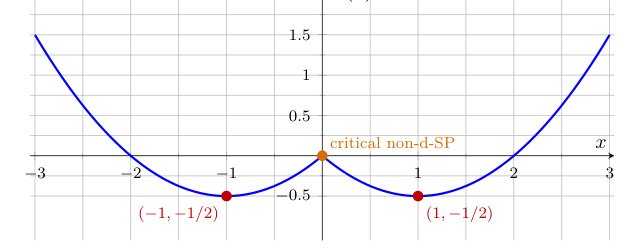
这篇论文实际解决的是 max-structured nonsmooth DC 中“DCA criticality 太弱”的问题。标准 DCA 对 h=max_i ψ_i 只需要选 v∈∂h(x)=conv{∇ψ_i: i active},因此极限条件自然是 ∇g∈∂h。这个条件在 smooth 或 singleton-active 区域没问题,但在多 active tie 点会失真:convex hull 可以包含 ∇g,即使每个 active vertex 都与 ∇g 不一致,此时仍存在 directional descent。
真正困难点不是求一个 DCA step,而是如何在 active set 很大或具有组合结构时检查 vertex-level stationarity。对 single finite max,精确扫 max_i||∇g-∇ψ_i|| 还可以接受;但对 sum-of-max,active vertex 是各 block active piece 的和,数量是笛卡尔积。以前方法要么接受 averaged/selected subgradient,从而可能只到 critical point;要么更完整地枚举 active pieces 或解多个子问题,扩展性差。关键矛盾就是:理论正确性要求看所有 active vertices,可计算性要求不要显式展开它们。
Motivation
作者的出发点很明确:DCA 的 subgradient selection 不是一个无关紧要的实现细节,而是决定极限 stationarity 类型的核心机制。finite-max DC 中,convex-combination 子梯度天然适合 criticality,但 directional stationarity 要求更强的 vertex agreement。也就是说,averaging 本身就是会隐藏 descent direction 的操作。
已有 enhanced DC / B-stationarity 路线已经意识到 active pieces 的重要性,但通常付出的代价是更重的 active-piece enumeration 或多个 convex subproblems。随机 component sampling 又没有直接保证会抓到最坏 active vertex。本文缺口定位在这里:需要一个比 full active-vertex scan 更可扩展、但又不退化为 convex-hull criticality 的 active-set screening 层。RA-DCA 的动机不是让 DCA 子问题更复杂,而是让“选哪个 subgradient”带上 directional-stationarity safeguard。
Core Idea
核心想法是 vertex-first randomized active-set selection。算法先不急着找一个让 ∇g 接近 convex hull 的组合,而是先问:是否存在某个 active vertex 与 ∇g 相差很大?这个问题由 sampled vertex residual 近似回答:把 active-gradient residuals 投影到随机方向上,在 sketch 空间中找最大者。如果 residual 大,就强制选这个 violating vertex 进入 DCA step;如果 residual 小,说明至少在 embedding 成功时所有 active vertex 都已经接近 ∇g,此时再用 LP 做 convex-combination centering 是安全的。
这改变的是 stationarity 信息的优先级:prior DCA 往往先构造一个合法 subgradient;RA-DCA 先排除 vertex-level violation。它引入的 inductive bias 是“最坏 active piece 优先”,而不是“平均 active pieces”。随机投影则把 active geometry 压缩成矩阵乘法,使方法在 large active set 或 block aggregate 场景中有机会比 exact enumeration 更 scalable。严格说,方法不是更 general 的 DCA 框架,而是对 finite max / sum-of-max 结构的更有针对性的 stationarity-preserving selection rule。
Method
方法中真正必要的机制如下。
1. 数值 active set:用 ε_k-active set 而非 exact active set,是为了处理有限精度和 near-tie。它的代价是 descent inequality 多一个 ε_k error;理论上要求 ε_k summable,并额外假设 active-set consistency。这个假设很关键,不是小技术项。
2. Sampled vertex residual:计算 max_i||D_k(∇ψ_i(x^k)-∇g(x^k))||。它解决的是 convex hull cancellation 问题,是整个方法的 stationarity safeguard。没有这一步,LP 或 averaged subgradient 只能证明 weaker criticality。
3. Vertex-first branch:当 sampled residual 大于 τ_k 时,选 sketched residual 最大的 active vertex。这个分支把 detected violation 转化为 DCA 子问题中的线性化方向。理论证明依赖于:若某 accumulation point 非 d-stationary,则某 active vertex residual 保持正下界;embedding 保留该下界;因此 safeguard 会无限触发;再由 DCA optimality condition 推出 step length 不可能趋零,与 descent 矛盾。
4. LP fallback:当 sampled residual 已经小,解一个 sketched Chebyshev LP 找 convex combination。它不是为了证明 d-stationarity,而是为了在低 residual / near-active regime 中稳定子梯度选择,避免数值 active set 中的非 exact active pieces 造成无意义跳动。
5. Proximal DCA subproblem:仍然是标准 convex update,σ 或 g 的强凸性保证唯一解和下降。论文的创新不在这个 subproblem,而在 subgradient selection layer。
Key Insight / Why It Works
最核心 insight 是 Lemma 2.1:对 unconstrained single finite-max DC,directional stationarity 等价于所有 active gradients 都等于 ∇g,即 R_d(x)=0。这比通常的 ∇g∈conv(active gradients) 强很多,也直接解释了为什么 averaged DCA 会失败。这个等价关系把一个方向导数条件转成了 vertex residual condition,使得算法可以围绕 residual screening 来设计。
RA-DCA 真正有效的部分是 vertex safeguard,而不是随机化本身,也不是 LP。随机化只是让 safeguard 可能便宜;LP 只是局部 centering。若 exact full-vertex scan 便宜,full-vertex DCA 是更直接的方案。RA-DCA 的贡献在于说明:只要随机 embedding 在 active span 上保范,sketched residual 足以维持与 exact residual 同阶的 stationarity 判断。换句话说,它本质上是把 active-set stationarity 证书 sketch 化。
这不是 scaling alone,也不是简单 engineering。理论部分给出一个清晰机制:非 d-stationary accumulation point 会导致某 vertex residual 不消失;embedding 让 sampled residual 不消失;safeguard 迫使选 vertex;DCA optimality 又迫使 step length 有正下界;而 descent 要求 step length →0,矛盾。这个链条相当干净。
但实验中的部分性能提升确实可能只是 active-set ambiguity 特定构造下的结果。max-affine signed pairs、x=0 tie、binary penalty x_i=1/2 都是为展示该机制而设计的退化场景。在这些场景中,RA-DCA 的优势是预期内的。到 QUBO 后,active-set ambiguity 不再主导,增益立刻变弱,说明方法不是一个通用 nonconvex optimizer 增强器,而是一个 stationarity-certificate repair mechanism。
Relation To Prior Work
这篇工作属于 DCA / enhanced DCA / B- or directional-stationarity computation 的谱系,最接近 Pang et al. 的 nonsmooth DC stationarity 框架、Pang-Tao 的 decomposition 方法,以及近期 Le Thi–Huynh–Pham Dinh 的 unified DCA-type directional-stationarity framework。它与这些工作的差异不在“也考虑 active pieces”,而在计算组织方式:本文不是泛化 stationarity 框架,而是专门针对 finite max / sum-of-max,把 active vertex residual 作为 first-class safeguard,并用 random projection 压缩该 residual scan。
看似新的部分中,DCA descent、proximal regularization、subspace embedding、convex-combination LP 都不是全新思想;它们是已有工具的重组。实质创新是把“directional stationarity = all active vertices match ∇g”这一结构事实变成算法优先级:先 vertex residual,再 convex-combination centering。这个 ordering 很重要,也比单纯说“随机采样 active components”更有内容。
与随机 component sampling 的本质区别是,RA-DCA 不是均匀抽一个 active piece,而是在 sketch space 中估计最违反 stationarity 的 vertex。与 full-vertex enhanced DCA 的区别是,它尝试用 active-span embedding 降低筛选层成本,并为 block aggregate 情况提供一个理论 benchmark。
Dataset / Evaluation
实验设计基本围绕 claim 展开,而不是追求通用优化 benchmark。最有说服力的是 single finite-max 合成实验和 sparse support-function 实验:这些场景直接验证 averaged criticality 会失败、vertex safeguard 能避免非 d-stationary 点、sketch 能接近 full-vertex scan。max-quadratic 进一步说明 active gradients 随 x 变化时机制仍成立。
block top-k 支持了“组合 active set 下 sketch greedy 有用”的说法,但需要注意:这里对比的是 full-space greedy reference,不是 exact aggregate enumeration;因此它验证的是 sketched greedy 能跟踪 greedy,而不是证明接近 exact safeguard。trimmed regression 是很好的负例/边界测试:同样的 stationarity residual heuristic 不一定改善统计目标。QUBO 更像 stress diagnostic:结果显示 multistart、DC split、rounding 和 box-QP solver 的影响大于 active-set sketch。
整体 evaluation 支持核心理论 claim,但不支持更强的泛化 claim。文中也相对诚实地区分了 theorem tests、block computational extensions 和 boundary diagnostics。没有真实部署或工业规模 solver 集成;GPU 也主要是实现潜力而非主实验证据。
Limitation
第一,理论假设不轻。active-set consistency 是关键弱点:exact active set 沿一侧收敛到 tie 点时可能漏掉 limit-active piece,因此需要 ε-active schedule 捕捉它。这个条件在有限精度中可接受,但在严格渐近算法中不是自动成立。
第二,block extension 的理论上限明显。Corollary 要求 exact aggregate vertex residual 或 fixed-factor approximate safeguard;但实际 block experiments 多用 greedy,没有证明 approximation factor。所以 block 部分更像方法论指引,而不是完整收敛理论。
第三,scalability 的优势有条件。对于 explicit single max,如果 active gradients 已经 materialized,full scan O(nr) 可能比 dense sketch 更便宜。RA-DCA 的价值主要在 projected products 可复用、active gradients 隐式生成、或 aggregate vertices 无法枚举时。否则随机 sketch 可能只是额外开销。
第四,LP fallback 的实际贡献有限。主实验中 safeguard 往往一直触发,LP 很少是性能路径。LP 的价值更多体现在 near-active 数值稳定性诊断;它不是核心增益来源。
第五,对困难 nonconvex/combinatorial 任务,方法没有解决 global search。QUBO 结果说明,所谓 improvement 很可能主要来自 multistart 和 DC split;active-set selection 只是局部 tie-handling。若迭代点很少处在多 active tie,RA-DCA 没有太多可发挥空间。
Takeaway
- 1. finite-max DC 中,subgradient selection 是 stationarity 类型的决定因素;不能把它当实现细节。
- 2. 对 max-structured nonsmooth DC,正确的 safeguard 应该是 vertex-level residual,而不是 convex-hull residual。
- convex combination 可用于 centering,但不应作为 directional-stationarity 证书。
- 3. 随机投影在这里的合理用法不是随机优化目标,而是压缩 active-gradient geometry;这类思想可以迁移到其他需要检查大量 extreme points 的 stationarity / feasibility 证书中。
一句话总结
RA-DCA 是一篇把 finite-max DC 中“criticality 与 directional stationarity 的缺口”转化为 sketched active-vertex residual safeguard 的工作,实质贡献是 stationarity-preserving 的 active-subgradient selection,而不是新的 DCA 子问题或通用非凸优化加速器。