精读笔记
Problem Setting
[Lifted Schrödinger Bridges for Gaussian Mixture Endpoints: Projection Gaps and Path-Space Obstructions](arXiv preprint / 2026)
这篇论文实际解决的是:在 Brownian prior 下,如何为 Gaussian-mixture endpoints 构造可计算、可解释、可反馈实现的 stochastic density control,并且严格说明这种构造和原始 unlabeled Schrödinger bridge 之间的关系。
关键矛盾在于:GMM endpoint 自带 component label 的诱惑,但原始 SB 的路径空间没有这个 label。直接 SB 是在 state path space Ω 上优化;而把 GMM 拆成 Gaussian components 后做 pairwise bridges,等于引入了一个外部 assignment variable。这个变量让问题变得可解,但也改变了问题本身。
以前路线卡在两个地方:一是 direct non-Gaussian SB 通常没有有限维闭式解;二是 GMM-based flow / mixture bridge 虽然工程上有效,却经常没有清楚区分“labeled lifted problem 的最优解”和“unlabeled original problem 的最优解”。这篇论文的主要价值就是把这个差异 formalize,而不是单纯提出一个新的 GMM transport heuristic。
Motivation
已有 Gaussian SB 理论已经足够成熟:Gaussian-to-Gaussian 在 Brownian / linear-Gaussian prior 下闭式可解,drift、marginal、energy 都能写出来。但 multimodal endpoint 不是 Gaussian,direct SB 不会自然封闭在有限 GMM family 内。
作者的核心观察是:GMM 表示里的 mode identity 不是物理状态的一部分,而是人为分解带来的 latent structure。如果直接利用它,必须承认自己求解的是 augmented path-space problem。于是缺的不是一个新的 Gaussian formula,而是一个 path-space accounting:引入 label 后获得的可计算性,究竟以什么信息代价换来?
这也是论文标题里 projection gap 和 obstruction 的来源。label lifting 不是免费午餐;它提供了 tractability,但投影回原空间时会丢掉条件 label 信息,这部分正是 lifted objective 与 unlabeled objective 的差。
Core Idea
论文的核心思想是把 GMM endpoint SB 改写成一个 labeled path-space entropy minimization:每条路径携带一个 source-target component label z=(i,j)。给定 label 后,连续控制问题变成 Gaussian-to-Gaussian SB;label 本身的分布 π 则通过有限维 entropic coupling 决定。
这个建模改变很关键:它把一个无限维非高斯桥问题重排为“闭式 pairwise bridge library + 离散 assignment”。inductive bias 是明确的 mode-to-mode routing:质量只能通过 component pair channels 组织,而不是在 state space 上任意形成 coupling。
但论文没有把这包装成 direct SB 的闭式解。相反,它强调 projection 后一般不保持最优性。这个负结果反而是最有价值的部分:它说明 GMM decomposition 方法的本质是一种 structured feasible approximation / lifted exact solution,而非原问题的普适精确解。
Method
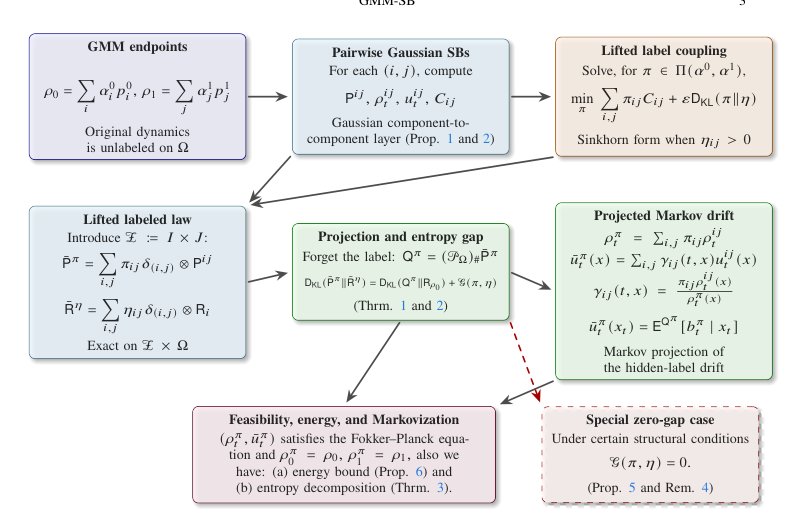
方法的必要机制可以压缩成四个层次。
第一,pairwise Gaussian SB。对每个 (i,j),求从 p_i^0 到 p_j^1 的 Gaussian bridge,得到 ρ_t^{ij}, u_t^{ij}, C_ij。它解决连续层不可解问题;所有非高斯性都被推迟到 component mixing。
第二,component coupling π。π 满足 row/column sums 等于 mixture weights,表示多少质量从 source component i 到 target component j。优化目标是 ∑π_ij C_ij + ε KL(π||η)。这里 η 不是无害常数,而是 lifted reference assignment prior;它会实质影响 π。
第三,lifted law 与 projection。lifted law 是 ∑π_ij δ_(i,j)⊗P^{ij}。忘掉 label 后得到 Q^π=∑π_ij P^{ij},它满足原始端点约束。但 KL chain rule 给出 D_KL(Pbar^π||Rbar^η)=D_KL(Q^π||R^{ρ0})+G(π,η)。G 是条件 label posterior 的 KL gap。
第四,Markov feedback。Q^π 是 mixture of path laws,通常带 hidden-label memory,不一定是 Markov。论文构造当前状态 posterior γ_ij(t,x)=π_ijρ_t^{ij}(x)/ρ_t^π(x),并定义 ubar_t^π(x)=∑γ_ij u_t^{ij}(x)。这个 drift 生成一个 Markov law Qhat^π,端点正确,并有 kinetic energy upper bound。
Key Insight / Why It Works
最核心的 insight 是:GMM bridge 的 tractability 来自 latent structure,而不是来自原始 SB 本身变简单。label lifting 把不可闭式的 non-Gaussian Schrödinger system 换成一组 Gaussian Schrödinger systems;Sinkhorn 只是在离散 assignment 层做 entropy-regularized transport。真正起作用的是 latent component label 提供的分解坐标系。
理论上方法成立有三个原因。第一,KL 在 label-sliced mixture 上有 chain rule,所以 lifted objective 可以精确分解成 discrete KL + pairwise path KL。第二,Gaussian endpoints 下 pairwise SB closed-form,因而连续层没有近似误差。第三,Fokker–Planck equation 对 density/current 是线性的,posterior-averaged drift 满足 ρ u = ∑πρ^{ij}u^{ij},因此混合后的 density-flow 可行。
最可能的核心贡献不是 Sinkhorn form,也不是 posterior averaging formula;这些在 entropic OT / GMMflow 语境中都不新。核心贡献是 projection-gap identity 和 Markovization decomposition:它们把三个对象分开了——lifted labeled optimizer、projected path law、Markov feedback law。
这里的增益主要来自 better inductive bias + scaling,而不是更强的 optimization。它用 component-level representation 避免 state-grid curse of dimensionality;但如果 component decomposition 本身不好,方法不会自动恢复 direct SB。所谓 scalable 本质是把复杂度从 state discretization 转移到 GMM component count。
Relation To Prior Work
这篇属于 Schrödinger bridge / stochastic control / covariance steering 与 Gaussian-mixture transport 的交叉谱系。最近的 GMMflow、Gaussian mixture OT、covariance steering 已经有类似的 pairwise Gaussian bridge + mixture posterior averaging 结构;因此公式层面的新意有限。
和 prior 的本质差异在于 path-space bookkeeping。已有方法往往关注构造一个可行的 GMM flow 或 feedback,并用 component assignment 提供解释;这篇明确指出该 construction 是 lifted problem 的 exact solution,而不是 direct unlabeled SB 的 exact solution。它新增的是 KL projection identity、conditional label-information gap、以及 projected non-Markov law 到 Markov law 的 decomposition。
从技术创新看,finite-dimensional entropic coupling 是标准 entropic OT;Gaussian bridge closed form 是已有 SB 结果;posterior averaging 也不是全新。实质创新是把这些已有块放到一个严格的 augmented path-space 框架里,并证明 lifting/projection/Markovization 三层之间的熵关系。
Dataset / Evaluation
实验覆盖 1D mixture、2D multi-component mixture、single Gaussian to eight modes、以及 crescent-to-star shape matching。它们验证的是:方法可以生成端点匹配的 analytic density flow 和可模拟 Markov feedback;π 的 assignment 可解释;相对低维 grid direct SB,计算快很多。
但 evaluation 对核心理论 claim 的支撑是有限的。projection gap 本身没有系统数值估计,Markovization loss 也没有作为主要实验对象展开。direct SB comparison 只在低维网格可行场景中出现;高维优势主要是 complexity argument,而不是实证上的 large-scale benchmark。
shape matching 依赖 GMM fitting,更多是可视化 demonstration,不是严肃泛化测试。没有真实系统、没有高维真实数据、没有复杂 nonlinear prior。实验足够说明 construction works,但不足以说明它普遍接近 direct unlabeled SB。
Limitation
最大限制是问题被转移了:原始 unlabeled SB 的难度被替换成选择 GMM decomposition、prior coupling η、以及 pairwise component library。若 density 的 GMM 表示不唯一,输出 law 也会依赖表示;这点文中没有充分处理。
第二,lifted objective 优化的 π 未必最小化 projected path entropy,更未必最小化 Markov feedback energy。因为 projected entropy = lifted objective - gap,而 gap 依赖 π;按 lifted objective 选 π 可能不是按 projected objective 选 π。论文指出了 gap,但没有解决这个 mismatch。
第三,zero-gap 条件相当结构化,本质上要求 active pairwise likelihood ratio 共享 common path potential,并满足 compatibility。这个条件很干净,但一般 GMM 几何下很少自然成立。
第四,Markov posterior averaging 会丢掉 path-history 中关于 label 的信息。Q^π 通常非 Markov,Qhat^π 是它的 Markov projection;这个 projection 带来的 loss 在复杂多模态情况下可能不小。文中给了 decomposition,但缺少何时小的可检验条件。
第五,scaling 并非无上限。复杂度随 N1N2 增长,且 pairwise bridge 在 nonlinear / constrained dynamics 下可能需要数值求解;届时闭式优势消失,增益来源不清,可能主要来自 component-level coarse graining。
Takeaway
- 1)这篇真正推动的是概念澄清:GMM bridge construction 应被看作 lifted latent-label SB,而不是 direct unlabeled SB 的闭式解。
- 2)projection gap 是可迁移 insight。
- 任何在 path problem 中引入 latent assignment / correspondence / mode label 的方法,都应该检查投影后的 KL 或 objective 是否保持;否则最优性声明很可能是错位的。
- 3)posterior-averaged drift 的正确理解是 Markovization,而不是原 projected mixture law 本身。
一句话总结
这篇论文把 GMM Schrödinger bridge 从一个工程化的 pairwise-Gaussian superposition 方法提升为严格的 lifted path-space construction,并明确指出其代价是 projection gap 与 hidden-label Markovization loss。