精读笔记
Problem Setting
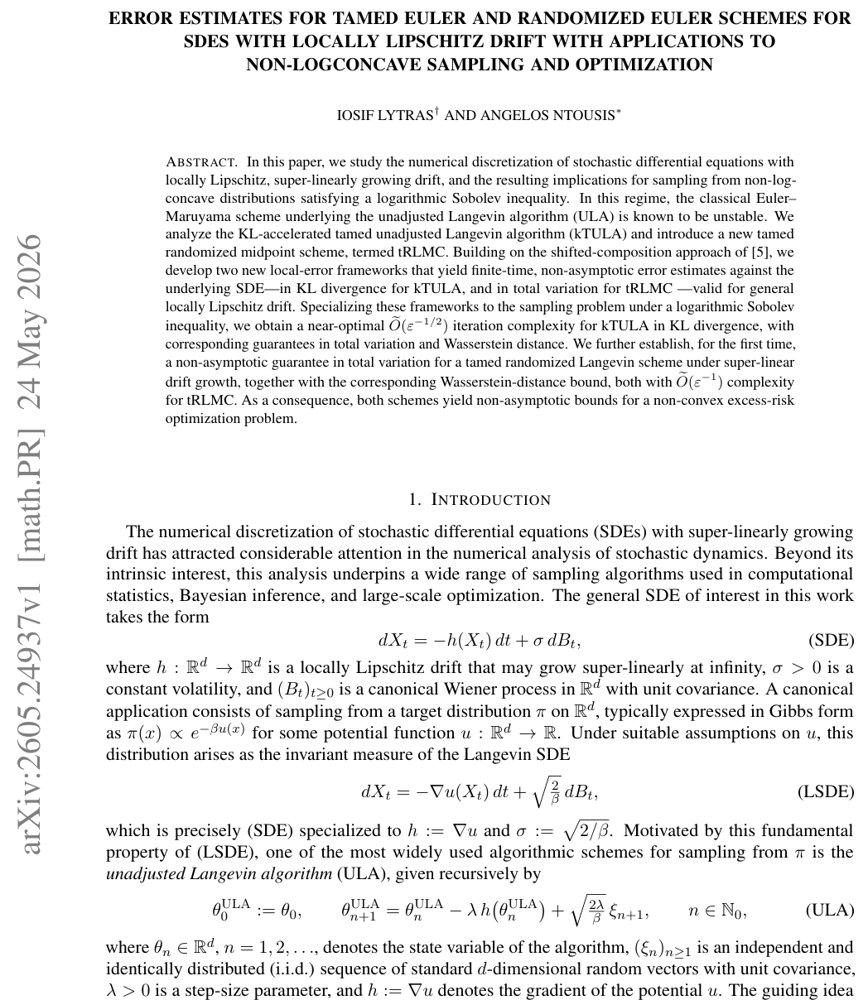
这篇论文解决的不是普通 Langevin sampling 收敛问题,而是 super-linear locally Lipschitz drift 下显式 SDE discretization 的强度量误差估计问题。具体对象是 dX_t=-h(X_t)dt+σdB_t,其中 h 允许超线性增长;sampling 只是 h=∇u、σ=√(2/β) 且目标 π_β∝e^{-βu} 时的应用层。
真正困难点有三个。第一,经典 Euler-Maruyama / ULA 在 super-linear drift 下可有限时间均方发散,离散过程 moment 会爆,因而常规稳定性前提不存在。第二,KL / TV 不像 W2 那样可以直接用同步 coupling 累积误差;kernel 不同会使 one-step 信息距离比较非常脆弱。第三,局部 Lipschitz 的 Lipschitz modulus 随状态增长,local error 中不可避免出现 endpoint-dependent amplification,不能再用一个全局常数打包。
以前方法卡在组合 regime:全局 Lipschitz + LSI 下 shifted-composition 可做 KL;tamed Euler 下可做稳定性和部分 Wasserstein/KL;randomized midpoint 在全局光滑下可分析。但“taming + locally Lipschitz + super-linear + KL/TV finite-time local-error framework”这一组合缺口还没有被系统填上。关键矛盾是:taming 是稳定所必需的,但 taming perturbation 又是强度量误差分析中的额外 bias;randomization 可能降 bias,但随机中点破坏了可用的 KL cross-regularity。
Motivation
已有路线不够的原因不是单点假设太强,而是它们没有同时处理“稳定性”和“强度量误差传播”。在 super-linear drift 下,先验上最自然的 ULA 已经数值不稳定;如果只做 dissipativity/Wasserstein,得不到 KL/TV 级别的 sampling guarantee;如果沿用全局 Lipschitz 的 shifted-composition,则 coupling increment 是常数这一关键结构消失。
作者的核心观察是:super-linear drift 带来的困难可以被拆成两部分。稳定性问题交给 tamed drift 和 dissipativity;强度量误差传播问题交给 shifted composition;两者之间的接口是 uniform high-order moment bound。也就是说,local Lipschitz 的 state dependence 并非不可控,只要辅助过程和离散链的高阶矩能 uniformly close。
关键缺口是 tamed randomized scheme 的强度量非渐近分析。randomized midpoint 在光滑 Langevin 文献中有 bias-reduction 直觉,但一旦 drift 超线性,随机中点是否仍稳定、是否能给 TV/W2 guarantee 都不清楚。论文把这个缺口作为第二条线:能证明 KL 的地方给 kTULA,KL 做不了的 randomized scheme 则转向 TV。
Core Idea
论文真正的核心不是提出某个新的算法公式,而是把 tamed discretization 放进一个改造后的 shifted-composition local-error 框架。辅助过程从真实 SDE 链出发,逐步沿 Wasserstein 方向 shift 到离散链,最后一步接上离散 kernel,使终端分布等于算法分布。这样 KL/TV 的全局差异被拆成 SDE kernel regularity、离散 local error 和 shifted distance recursion 的组合。
相对 prior 的本质区别在于:prior shifted composition 基本依赖全局 Lipschitz,local coupling increment 可视为常数;本文允许 Γ(x,y,λ)=O(λ(1+||x||^p+||y||^p)) 这样的 state-dependent coupling increment。这个改变看似小,但它是把框架推进到 super-linear drift 的关键。它引入的 inductive bias 是:不再要求全局 smoothness,而是用 dissipativity 驱动的 moment stability 来平均控制局部粗糙性。
理论上有效的直觉很清楚:taming 把离散过程拉回稳定区域,避免 moment explosion;SDE semigroup 提供 smoothing / regularity,使 KL 或 TV 比较不会完全失控;shift sequence 在每一步控制“向离散链靠近多少”,平衡 contraction 和 local error。最终复杂度由 local strong error λ^{3/2}、weak error λ^2、regularity 常数 λ^{-1} 和 mixing horizon Nλ 的平衡决定。
Method
kTULA 部分的关键机制是 tamed drift h_λ=ax+(h(x)-ax)/(1+λ||x||^{2(ℓ+1)})^{1/2}。它解决的是 drift 超线性导致的离散 moment explosion。保留 ax 是为了继承 dissipativity;归一化 h(x)-ax 是为了把增长压到可控尺度;λ→0 时恢复原 drift 保证一致性。其核心变化是:算法不再忠实使用原始 drift,而是使用一个随步长收缩的稳定代理。
KL framework 解决的是多步信息误差无法直接累积的问题。它需要三个 one-step 输入:strong local error 控制路径级偏差,weak local error 控制平均 bias,cross-regularity 控制离散 kernel 到 SDE kernel 的 KL。shifted auxiliary process 把这些局部量组织成一个 deterministic recursion。没有这个过程,KL 误差会把 propagation 和 discretization 混在一起,难以得到 sharp finite-time bound。
tRLMC 的机制是把 randomized midpoint 和同一个 taming map结合:先用 tamed drift 走到随机中点,再在中点评估 tamed drift 完成一步。它试图继承 randomized midpoint 的 bias cancellation,同时避免原始 drift 在中点爆炸。这里真正必要的是 taming,randomization 的必要性在理论上不如 kTULA 清楚。
TV framework 是对 tRLMC 的技术妥协。由于随机积分时间使 KL cross-regularity 目前不可得,作者改用 one-step TV bound,再通过 Pinsker 和 shifted recursion 累积。核心变化是降低目标度量以换取可证明性。这是合理的,但也说明 randomized scheme 的理论优势尚未完全兑现。
sampling / optimization 层只是把 SDE-level error 接到 LSI contraction。LSI 提供连续 Langevin semigroup 到 π_β 的指数收敛;离散误差给 bias floor;二者平衡得到 iteration complexity。optimization corollary 进一步用 Gibbs concentration 把 sampling error 转成 excess risk,本质是标准 simulated annealing/Langevin optimization 分解。
Key Insight / Why It Works
最重要的 insight 是:在 super-linear locally Lipschitz regime 中,强度量误差分析的瓶颈不是 local Taylor expansion 本身,而是 local Lipschitz 常数随状态增长后,能否保证所有被 shifted construction 访问到的状态都有足够高阶 uniform moments。本文的有效性基本来自这个 closure:taming → dissipativity/moment stability → state-dependent Γ 可积 → shifted recursion 可用 → KL/TV telescoping 成立。
kTULA 的核心贡献更实质。它把 taming error 做到 λ 级 drift deviation,使 strong local error 为 λ^{3/2}、weak local error 为 λ^2;再乘上 KL regularity 的 λ^{-1},多步后给出 ((Nλ)∨logN)λ^2 量级的 KL discretization error。这个结构解释了为什么 KL accuracy ε 可以用 λ≈√ε、N≈1/√ε 达成。复杂度增益主要来自 local-error order 与 shifted-composition 的平衡,而不是某种新的 sampling dynamic。
tRLMC 的贡献更像“把 randomized scheme 带入可分析 super-linear regime”。TV guarantee 是新的,但其 complexity 仍是 Õ(ε^{-1}),没有明显超过 kTULA;randomization 是否提供核心收益并不充分。文中对 randomized midpoint bias reduction 的动机是合理的,但在最终主结果中,tRLMC 的理论优势主要是少用 A5 Jacobian Lipschitz、能给 TV/W2,而不是更快 mixing。
哪些部分可能只是辅助?数值实验基本是辅助 sanity check,不是机制证明。optimization bound 也主要是 sampling bound + Gibbs concentration 的标准转译,不是新的优化理论。taming map 的具体形式重要但不一定唯一;真正可迁移的是“保留 dissipative linear part + tame residual + 用 moment closure 支撑 local-error framework”这个设计原则。
这不是 scaling、retrieval、data coverage 之类的工作;增益来自 better analytic inductive bias:用 taming 改变数值动力系统的稳定性结构,用 shifted composition 改变误差信息流。若说有 engineering/scaling 成分,主要在实验和常数隐藏上,而非主定理机制。
Relation To Prior Work
这篇论文处在三条技术谱系的交叉处:tamed Euler for non-globally Lipschitz SDE、Langevin sampling under functional inequalities、以及 shifted-composition KL analysis。最接近的是 Chewi-Altschuler-Lu 的 shifted composition 和 Lytras-Sabanis-Zhang 的 kTULA/KL tamed Langevin 分析。
和 shifted composition prior 的本质差异是 state-dependent coupling increment。prior 中 local Lipschitz 常数基本全局受控,误差递推的 a1 是常数级或只依赖单点;本文必须处理 Γ(x,y,λ) 同时依赖离散链和辅助 shifted process。这个差异不是形式上的,因为它迫使作者证明辅助过程 uniform moment,否则递推不能闭合。
和传统 tamed ULA/TULA 的差异是度量和复杂度。很多 tamed sampling 工作主要给 W2 或较弱 KL rate;本文在 KL 下给 kTULA Õ(ε^{-1/2}),并声称优于 [22] 的 ε^{-2/3} 型结果及更差维度指数。这是实质性推进,但依赖 A5 等额外正则。
和 randomized midpoint 文献的差异是适用 regime。已有 randomized Langevin 多在全局光滑或 log-concave/strongly log-concave 下工作;本文把 randomized midpoint 与 taming 结合,并首次在 super-linear drift 下给 TV finite-time guarantee。新意在分析框架和稳定化,而不是 randomized midpoint 本身。
看似新的地方中,optimization application 主要是已有 Langevin optimization 分解的重组;实验对比 SGD/Adam/AMSGrad 也不应被视为核心贡献。实质创新集中在两个 local-error framework,尤其 KL framework 对 super-linear drift 的适配。
Dataset / Evaluation
实验覆盖两个场景:高维 separable double-well sampling 和一个固定特征神经网络的非凸优化 toy problem。它们验证的是非常具体的 claim:untamed ULA/常规优化器在 aggressive step size 下不稳或性能恶化,而 tamed methods 的 iterates 更受控。
sampling 实验选择 double-well + 初始点远离平衡,确实能暴露 super-linear drift 下 ULA 的爆炸问题;这对稳定性 claim 是有支持的。但目标分布是坐标独立、结构简单,不能验证复杂非 log-concave geometry 下的 mixing,也没有直接评估 KL/TV/W2 bound 的 tightness。
优化实验是小规模 synthetic fixed-feature regression。它只能说明 taming 在大 learning rate 下有正则化/稳定化效果,不能说明其作为通用优化器优于 Adam/SGD。β=10^6 使噪声接近很小,实验更像 deterministic tamed gradient method 的稳定性展示,而非 Langevin sampling-driven optimization 的验证。
总体评价:实验足以支持“taming 防爆、控制参数范数”这一工程直觉,不足以验证论文最强的理论 claim,例如 KL Õ(ε^{-1/2}) 是否 sharp、维度依赖是否可用、randomization 是否带来独立收益。没有真实世界大规模 sampling benchmark,也没有系统 ablation taming vs randomization。
Limitation
第一,理论强依赖结构假设。A1-A5 包含多项式增长、局部 Lipschitz、one-sided Lipschitz、dissipativity、高阶 Jacobian Lipschitz;sampling 还需要 LSI。对真正复杂的 multimodal non-log-concave 分布,LSI 常数可能指数差,理论复杂度会失去意义。论文称 non-log-concave 是对的,但不是 arbitrary non-log-concave。
第二,维度依赖和常数隐藏较重。文中多处写 constants polynomial in dimension,但 local error 中出现 d^{M/2}、d^{2ℓ+2} 等高阶幂,M 又由增长指数决定。实际 high-dimensional 可用性未被证明,可能只是形式 polynomial。
第三,tRLMC 的增益来源不清。随机化理论上可降低 bias,但最终 TV/W2 复杂度没有超过 kTULA,且 KL 分析缺失。它的主要优势似乎是少用 Hessian/Jacobian Lipschitz 假设,而不是更快或更准。randomization 在 super-linear drift 下的真正价值仍未充分说明。
第四,部分关键证明呈现偏粗。尤其 cross-regularity、TV local error 的推导有不少“standard calculations / C(x)”式处理;若要复现 sharp constants 或验证所有 moment orders,仍需仔细补全。文中未充分说明这些 C(x) 在最终 uniform bound 中的精确依赖。
第五,optimization corollary 只是 sampling-to-optimization 的标准转化。它依赖 β 大时 Gibbs concentration,但大 β 会改变 LSI 常数、步长限制和数值刚性;这几个量之间的 tradeoff 没有被充分展开。因此 optimization guarantee 的实际含义有限。
Takeaway
- 1. 最值得记住的是方法论:super-linear drift 下做 KL/TV,不要直接追全局 Lipschitz;先用 taming 建立 uniform moments,再让 shifted-composition 吃掉 state-dependent local Lipschitz。
- 2. kTULA 的 Õ(ε^{-1/2}) KL rate 是本文最实质的结果。
- 它说明只要 local weak/strong error order 和 KL regularity 能正确配平,tamed schemes 不必在信息距离上付出传统上那么大的代价。
- 3. randomized midpoint + taming 是有潜力的方向,但当前证据更多证明“可分析、可稳定”,还没有证明“明显更优”。
一句话总结
这篇论文把 tamed Langevin 离散化推进到 locally Lipschitz super-linear drift 的 KL/TV shifted-composition 分析框架中,真正贡献是用 moment-stable taming 关闭 state-dependent local-error recursion,而不是单纯提出一个新采样算法。