精读笔记
Problem Setting
《Quantitative semidefinite certificates for ground-state energies of Pauli Hamiltonians》(arXiv preprint / 2026)。这篇论文实际解决的是:对 Pauli k-local Hamiltonian 的 ground-state energy,用非交换 SoS / NPA 型 SDP 层级做 certification 时,有限 level d 的误差能否被显式控制。不是证明 hierarchy 完备;完备性早就有,且 level n 可由 Pauli basis span 全矩阵代数得到有限收敛。真正问题是低层级是否有可量化意义。
关键矛盾是:local Hamiltonian 本身 QMA-hard,所以不能期待低层 SDP 总是精确;但如果 hierarchy 只是“最终收敛”而没有 rate,则对实际计算没有 certificate value。已有非交换 SoS 结果卡在 qualitative convergence,缺少类似 commutative SoS on sphere / cube 中的 kernel-based rate。本文要填的是这个 quantitative gap:在 Pauli setting 下,给出依赖 d/n 的显式误差上界。
Motivation
已有路线不够的地方很明确:NPA / ncSoS 能给 monotone lower bounds,但不知道 fixed d 的 gap;upper-bound hierarchy 也类似。对于 Hamiltonian complexity 和 many-body certification 来说,实际可求的是低层 SDP,而不是 level n 的指数级对象。
作者的核心观察是 Pauli algebra 虽然非交换,但在 trace inner product 下 Pauli words 形成极规整的 orthonormal basis;按 weight 分层后,其 two-copy reproducing kernels 和 Hamming association scheme 同构。换言之,非交换困难中有一块可交换的谱结构:kernel 的 eigenvalues 由 Krawtchouk polynomials 控制。这正好对接 commutative polynomial optimization 中 Christoffel-Darboux kernel 方法的缺口。
Core Idea
论文真正核心不是“写了一个 SDP bound”,而是把 finite-level SoS error 转化为一个 kernel approximation 问题:找一个 degree-2d 的 positive kernel K,它在低 degree Pauli polynomials 上几乎是 identity。若 K 同时满足 positivity-preserving-to-SoS,那么真实 PSD 对象经过 K 可落入 SoS cone;K^{-1} 与 identity 的偏差就是 lower certificate 的损失。
本质区别在于建模方式变了:不直接分析 SDP feasible moment matrix,而是构造一个 Pauli algebra 上的 almost-reproducing operator。这个 operator 的 inductive bias 是 weight-homogeneous Pauli decomposition;它只关心 low-weight components,因为 Hamiltonian 是 k-local。这样误差不依赖总 Hilbert space dimension 2^n,而通过 Krawtchouk 最小根 ξ_{d+1}^{n,4}/n 表达,体现的是 Hamming-scheme spectral geometry。
Method
1. Homogeneous Pauli kernels:定义 C_r^n 作为 weight-r Pauli words 的 reproducing kernel。它解决的是如何把 Hamiltonian 的 local degree structure 显式投影出来。必要性在于误差只需控制 degree ≤ k 的分量,而不是整个 4^n 维矩阵空间。
2. Krawtchouk diagonalization:在 two-copy space 中引入单站点算子 A_j=(3/4)I+(1/4)∑_W σ_W^j⊗σ_W^j。A_j 的 0/1 谱和 multiplicity 1/3 使 C_r^n 的谱变成 q=4 Krawtchouk polynomial。它把非交换 kernel positivity 变成一维离散正交多项式问题,这是整篇的技术枢纽。
3. Positive almost-reproducing kernel:取 K=∑_{r≤2d} c_r C_r^n,并通过 univariate SoS polynomial f=∑ c_r(-1)^r K_r^{n,4} 保证 K positive。c_0=1 保证常数被 reproducing;c_{2r}≈1 保证 even low-weight components 被近似 reproducing。
4. Lower hierarchy proof:如果 p-λ_min PSD,则 K^{-1}(p-λ_min+ε) 仍 PSD,只要 K^{-1}p 与 p 的 spectral-norm 差小于 ε;再由 K 的 positivity-to-SoS 性质推出 p-λ_min+ε 属于 Σ_d。这里 inverse 是 lower bound 需要额外 degree condition 的原因。
5. Upper hierarchy proof:用 ground-state eigenvector v 和 K 构造 s=(v⊗I)^*K(σ,x)(v⊗I)。s 自动是 SoS 且 trace-normalized,目标值偏差由 Kp-p 控制。因为不用 K^{-1},所以 upper bound 对所有 d 成立。
Key Insight / Why It Works
最核心贡献是发现 Pauli homogeneous reproducing kernels 的谱正好落在 q=4 Krawtchouk family 上。这个发现使得 ncSoS convergence-rate 问题可以降维成离散 orthogonal polynomial 的 extremal problem。它不是 scaling,也不是 numerical engineering;是结构性 spectral reduction。
方法有效的原因有三点。第一,Pauli words under trace inner product 让 degree projection 完全干净:C_r^n 精确抽取 weight-r component。第二,two-copy representation 把 kernel positivity 变成矩阵 PSD,而 A_j 的 tensor-product diagonalization 给出 Hamming weight 参数 i;这消除了非交换 algebra 的大部分复杂性。第三,Krawtchouk root ξ_{d+1} 是 measure-based SoS kernel 对 linear function i 的最优 moment,因而自然控制“离 identity 的平均偏差”。
真正的误差瓶颈不是 SDP hierarchy 本身,而是 c_{2r} 与 1 的距离。Lemma 8 用 univariate SoS 选择 f,使 ∑_{r≤k/2}(1-c_{2r}) ≤ O_k(ξ/n)。这一步本质上是在用 degree-d polynomial kernel 在 Hamming scheme 上近似 delta at 0。换句话说,kernel 越集中在 i=0,越接近 reproducing identity。
辅助但不那么核心的是 γ_k bound:用 noise operator 和 Vandermonde/Chebyshev interpolation 控制 homogeneous component norms。它保证常数不依赖 n,但 C(k) 指数级,实际 tightness 存疑。这个部分更像为定理闭合所需的 norm bookkeeping,而不是主要 conceptual advance。
偶权重假设是证明机制的直接产物:只有 even coefficients c_{2r} 被控制得接近 1,而 odd components 没有同样性质。Appendix 的 ancilla trick 解决 spectral statement,但没有说明是否保持稀疏 SDP 的实际优势。这里应理解为理论规约,不是工程上免费。
Relation To Prior Work
最接近的是 commutative SoS convergence-rate 的 Christoffel-Darboux kernel 路线,尤其 binary cube 上 Laurent–Slot 的 Krawtchouk-root 分析。本文本质上是把这条路线移植到 Pauli algebra,但移植并不平凡:需要证明 Pauli homogeneous kernels 的 spectra 仍由一个 association scheme 控制。
与传统 NPA / ncSoS 工作的区别在于,后者强调 hierarchy completeness 和 SDP formulation;本文强调 finite-level quantitative approximation。它不是提出新的 SDP hierarchy,而是给已有 hierarchy 一套可计算误差证书。
与 Hamiltonian approximation / variational upper bounds 的关系也很清楚:那些方法给 feasible states,通常是 algorithmic approximation;本文主要给 certification bounds,尤其 lower certificates。Theorem 2 的 upper hierarchy 也不是变分 ansatz,而是 measure/kernel-smoothed ground-state projector。
看似新的地方中,kernel method 和 Krawtchouk extremal root 不是原创思想,来自 commutative optimization / coding theory;实质创新是识别 Pauli two-copy kernel 的 q=4 Krawtchouk structure,并把它嵌入 noncommutative SoS certificate 证明链条。
Dataset / Evaluation
这篇没有 dataset 或实验 evaluation;它是纯理论结果。验证核心 claim 的方式是 theorem proof,而不是 benchmark。覆盖范围是 dense n-qubit Pauli Hamiltonians with fixed locality k,主要先处理 even-weight Pauli expansions,再用一个 ancilla 扩展到一般 k-local Hamiltonian。
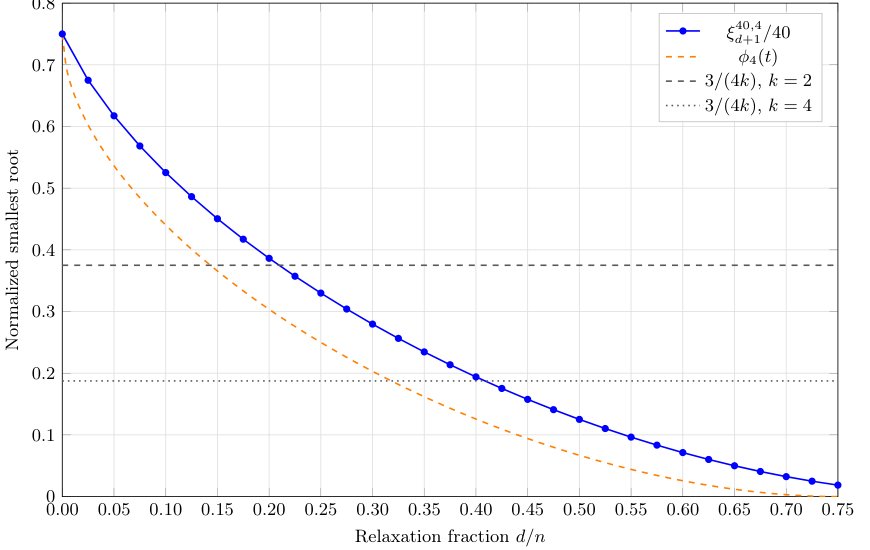
从 claim 支撑角度看,数学证明足以支持“存在 finite-level quantitative rate”。但它没有回答实际 SDP 解算中最关心的问题:在可承受的 d 下 bound 是否非平凡;常数 C(k) 是否过大;稀疏 Hamiltonian 或物理 lattice Hamiltonian 上是否更好;与实际 NPA lower bounds 的 observed gap 是否匹配。Figure 只是说明 Krawtchouk root 的尺度,不是 empirical validation。
Limitation
第一,结构依赖很强。证明利用 Pauli qubit algebra、normalized trace、two-copy diagonalization、Hamming scheme multiplicities 3^i binomial(n,i)。这不是一般非交换 polynomial optimization 的 rate;甚至直接 qudit 推广也在文中显示会出现 c_{2r} coefficient collapse。
第二,常数 C(k)<(2/3)k(k+2)(1+√2)^{2k+1} 很粗且指数增长。对固定小 k 有理论意义,但很难说是 sharp。若 k 稍大,保证可能主要是 asymptotic existence 而非 usable certificate。文中未充分说明实际数值 tightness。
第三,lower-bound theorem 需要 ξ_{d+1}^{n,4}/n 足够小,等价于 d/n 达到一定比例;对 low d regime 是否有非平凡 lower certificate 取决于 k 和 root behavior。这个条件是 K^{-1} 机制带来的硬约束。
第四,even-weight 到 general Hamiltonian 的 ancilla reduction 保谱,但可能改变 locality parity、稀疏结构和 symmetry。对于实际 sparse SDP 或 problem-specific hierarchy,这个规约未必免费。
第五,方法给的是 worst-case dense hierarchy rate。它没有利用 interaction graph、geometric locality、frustration structure、gap、commutativity、stoquasticity 等物理信息。因此 bound 的上限很明确:它是 algebraic worst-case certificate,不是 many-body physics aware approximation theory。
Takeaway
- 1. 这篇真正推动的是 ncSoS finite-level analysis:从 qualitative convergence 进入 quantitative rate,至少在 Pauli finite-dimensional setting 下成立。
- 2. 最可迁移的 insight 是:不要直接分析 SDP;先找 algebra 的 reproducing kernel 和其 association-scheme spectrum,再把 SoS positivity 降到一维 orthogonal polynomial extremal problem。
- 3. Pauli algebra 的 q=4 Krawtchouk structure 是关键 latent structure。
- 未来若要做 fermions、qudits、swap algebra 或 sparse hierarchies,核心问题都是找对应的 kernel diagonalization 和 root/control theory。
一句话总结
这篇论文把 Pauli Hamiltonian 的非交换 SDP/SoS 层级从“最终会收敛”的定性理论推进到“Krawtchouk-root 控制的有限层误差证书”,本质贡献是用 Pauli reproducing kernel 的 Hamming-scheme谱结构实现 ncSoS 的 quantitative convergence analysis。