精读笔记
Problem Setting
《Generalized Model Predictive Path Integral Control as Expectation–Maximization》(arXiv preprint / 2026)关注的不是提出一个全新控制器,而是给 MPPI 一个更准确的算法解释:标准 MPPI 的 cost-weighted sampling update 到底在优化什么、为什么重复更新有意义、以及它能否自然推广到非高斯分布。
关键矛盾是:MPPI 在工程上非常有效,尤其适合不可微模拟器、接触、障碍代价等场景;但它的理论表达通常停留在 control-as-inference 的 posterior reweighting,缺少一个可复用的 optimization-theoretic fixed-point view。已有工作能解释指数权重从哪里来,却不充分解释“下一轮 proposal 为什么应该这样更新”。
以前方法的卡点在于:标准 Gaussian MPPI 的均值加权平均看起来像 heuristic moment update;CEM / VI-MPC / CMA-ES 又各自有 projection 或 distribution adaptation 解释,但 MPPI 本身和 classical EM 的对应关系没有被明确建立。本文实际想补的是这个“算法身份缺口”。
Motivation
已有路线不够的地方很明确:control-as-inference 给出 posterior q(u) ∝ p(u) exp(-J/τ),但从 posterior 到下一轮 proposal p(u;θ+) 的投影步骤没有被统一为一个经典迭代算法。结果是 MPPI 的推广经常变成 ad hoc:想用 mixture、想调 covariance、想换分布族,都缺少统一准则。
作者的核心观察是:optimality event 是观测,control trajectory 是 latent variable,那么最大化 P(O=1;θ) 就是一个标准 latent-variable MLE 问题。MPPI 的采样加权不是单独的 trick,而是 EM 中 E-step 的 posterior reweighting;而 weighted average 是 Gaussian family 下 M-step 的 weighted MLE 闭式解。
这个动机是合理的,因为它把 MPPI 的两个经验组件——Boltzmann weighting 和 moment update——放进同一个 objective 里。缺的是一个能同时导出更新、解释单调改进、并指导换分布族的框架。
Core Idea
论文的核心思想是把 MPPI 从“对控制序列做采样搜索”改写为“对控制分布做 likelihood ascent”。设 proposal 为 p(u;θ),最优性 likelihood 为 exp(-(J(u)-J*)/τ),则 marginal likelihood 为 ℓ(θ)=log ∫p(u;θ)exp(-J(u)/τ)du + const。这个 objective 偏好把概率质量放在低成本轨迹上。
EM 分解后,E-step 得到 q(u;θ)=p(u|O=1;θ)∝p(u;θ)exp(-J(u)/τ),M-step 解 max_{θ+} E_q log p(u;θ+)。这一步本质上是把 Boltzmann-reweighted posterior 投影回参数族。固定协方差 Gaussian 下,M-step 的最优均值就是加权样本均值,因此标准 MPPI 被识别为 EM 的一个特例。
本质区别在于建模对象变了:不是直接优化单条 nominal control sequence,而是优化一个可采样的 trajectory distribution。这个改变引入了一个明确的 inductive bias:控制搜索被限制在某个分布族内,算法每步做的是 posterior-to-family projection。它的 generality 来自 M-step 可以换成任意 weighted MLE,而不是只能做 Gaussian mean update。
Method
1. Optimality likelihood:它解决的是“如何把 cost 变成 likelihood”的问题。用 exp(-J/τ) 定义 O=1 的概率后,低成本轨迹自然获得更高 posterior mass。这里 J* 只用于保证概率不超过 1,实际优化中是 θ 无关常数。核心变化是把最优控制 objective 改成 marginal likelihood ascent。
2. E-step as Boltzmann reweighting:它解决的是“哪些采样轨迹应该影响下一轮 proposal”的问题。posterior q(u;θ) 不是显式建模,而是通过样本权重 w_i ∝ exp(-J(u_i)/τ) 隐式表达。这一步正好复现 MPPI 的指数权重。
3. M-step as weighted MLE:它解决的是“如何从 weighted samples 生成下一轮 proposal”的问题。对于 Gaussian fixed covariance,weighted MLE 只更新均值,得到标准 MPPI;对于 exponential family,M-step 是 sufficient statistics 的 moment matching;对于 MoG,则需要内层 EM 拟合 weighted samples。
4. Convergence analysis:它解决的是“这个迭代是否只是 heuristic”的问题。作者借用 EM 理论得到 likelihood monotonicity、极限点 stationary、局部线性速率。速率由 EM map 的 Jacobian 给出;Gaussian 下形式为 Cov_q[u]Σ^{-1},直接说明 posterior covariance 与 exploration covariance 的相对关系决定局部收敛速度。
这些机制的必要性都来自同一个点:一旦承认 MPPI 是 posterior projection,那么分布族、moment matching、local rate 都变成同一个 EM 框架的不同投影后果。
Key Insight / Why It Works
最重要的 insight 是:MPPI 的“加权平均”不是孤立的控制启发式,而是固定协方差 Gaussian family 下的 I-projection / weighted MLE。换句话说,标准 MPPI 的有效性来自两个耦合机制:低成本轨迹通过 Boltzmann posterior 被放大;proposal family 通过 moment matching 向这个 posterior 移动。
这解释了几个现象。第一,temperature τ 控制 posterior sharpness,过小会导致权重塌缩,过大则更新弱;这在 EM 视角下就是 posterior 过窄或信息不足。第二,exploration covariance Σ 不只是采样噪声,而是局部收敛矩阵中的 preconditioner:Cov_q[u]Σ^{-1} 越小,局部收敛越快;但 Σ 太小又会失去探索能力。第三,Gaussian MPPI 在多模态场景下失败不是偶然,而是 projection family 错了:把双峰 posterior 投影成单高斯时,均值可能落在低概率甚至碰撞区域。
最可能的核心贡献是 EM 解释与由此得到的 generalized projection view,而不是 MoG 实验本身。MoG-MPPI 的收益主要来自更好的 inductive bias / latent structure,即保留多个策略模式;这不是 EM 独有能力,CEM、VI-MPC、CMA-ES 系列早就有类似 distribution adaptation 思想。本文的实质价值是把这些看似不同的 proposal update 放到 MPPI 的 EM 语义中。
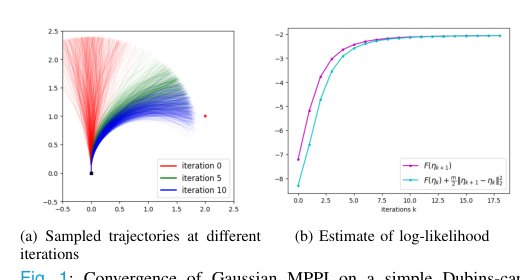
哪些部分可能只是辅助:Dubins car 实验基本是展示性验证,不足以证明 generalized EM-MPPI 在复杂系统中的实际优势;finite-sample sufficient increase 也只是 population result 加 Monte Carlo error remark,离真实 MPPI 稳定性还有距离。所谓 generalized framework 的工程性能增益,很可能取决于分布族 expressivity、采样预算和并行 rollout scaling,而不是 EM 解释本身。
Relation To Prior Work
最近的谱系包括 control-as-inference、VI-MPC、CEM/CMA-ES、MPPI 收敛分析,以及用 EM 解控制 / RL 的工作。本文和 control-as-inference 最接近,但它补的是 posterior 之后的 M-step:不是只说 optimal-control posterior 是 Boltzmann reweighting,而是说 repeated MPPI update 是对 P(O=1;θ) 做 EM likelihood ascent。
和 VI-MPC / Tsallis divergence 等工作的关系更微妙。已有工作已经把控制看成对某个 variational family 的 weighted projection,也有 mixture Gaussian 的内层 EM。本文的新意不是“用 mixture”或“weighted MLE”,而是明确指出标准 expectation-based MPPI 更新本身就是 EM iteration。这个识别让 MPPI 的 convergence 可以直接调用 EM 理论。
和 CEM 的差别在于 weighting scheme 与 objective 语义:CEM 通常用 elite samples 或 rare-event likelihood,MPPI 用 exponential cost weighting;但从 distribution fitting 角度二者都属于 sample-reweight-project。本文把 MPPI 放进这个家族,强调它的 exact EM identity。
和已有 MPPI convergence work 的差别是分析对象不同:那些工作更多依赖控制 objective、系统结构、二次近似或采样协方差设计;本文分析的是 likelihood over proposal parameters。它给的是 latent-variable MLE 的 stationary guarantee,不等价于原始 optimal control 的全局最优保证。
Dataset / Evaluation
评估非常窄:主要是 Dubins car 导航与障碍绕行。这个设置适合展示两个 claim:Gaussian MPPI 在双模态路径选择中会平均掉模式;MoG proposal 能保留左右两条可行策略,并在环境代价变化时重新分配 mode weight。
但 evaluation 没有真正覆盖论文理论 claim 的全部外延。理论声称 generalized EM-MPPI 适合更一般分布族、非光滑或模拟器定义系统;实验没有高维机器人、接触动力学、真实系统、随机扰动闭环稳定性,也没有和 CEM/CMA-ES/VI-MPC 做系统对比。
对 sufficient increase 的验证也比较弱:画 Monte Carlo likelihood estimate 与下界趋势只能说明公式在简单 Gaussian setting 下数值一致,不能说明实际有限样本 MPC 闭环会稳定改进。MoG 的展示更像机制示例,而不是强 benchmark。结论应解读为 proof-of-concept,而不是实证上证明 generalized EM-MPPI superior。
Limitation
第一,理论成立的主体是 exact expectation EM,而实际 MPPI 的核心难点正是有限样本 self-normalized importance estimate。文中只说误差 O(N^{-1/2}),但没有给高概率单调性、权重退化条件或有效样本数分析。实际系统中,finite-sample noise 可能完全破坏单调改进。
第二,likelihood ascent 不等于原始控制问题的全局求解。ℓ(θ)=log E_{pθ}[exp(-J/τ)] 是一个 smoothed risk-sensitive objective over distributions;stationary point 只是 proposal 参数空间中的局部固定点。分布族选错时,EM 会稳定收敛到错误投影,例如单高斯在双峰 posterior 下的不可行均值。
第三,local convergence rate 依赖强局部假设:Hessian 负定、M-step 唯一、非退化曲率、固定点邻域可微。这些条件在 mixture、约束控制、截断分布、碰撞代价、非光滑模拟中都可能失败。MoG 还会有 label switching、component collapse、局部极值等标准问题。
第四,scalability 上限没有解决。更丰富分布族带来更好表达能力,但也提高样本复杂度和 M-step 难度。在高维长 horizon 控制序列中,MoG 的模式维护可能很快被稀疏采样和权重塌缩抵消。增益来源不清:是 EM framework,还是多模态分布族,还是更多 test-time compute / samples。
第五,闭环 MPC 维度缺失。论文分析的是单个 horizon 内重复更新;实际控制中会 shift horizon、warm start、只执行第一步、再观测新状态。receding-horizon closed-loop stability 和 recursive feasibility 文中未充分说明。
Takeaway
- 1. 最值得记住的是 MPPI = EM under optimality-event latent-variable model。
- 这个等价关系把 Boltzmann weighting 和 weighted MLE projection 接起来,给 MPPI 一个清晰的 optimization identity。
- 2. 分布族才是 generalized MPPI 的主要设计自由度。
- Gaussian MPPI 的局限不是权重公式错,而是 posterior projection family 太弱;多模态、结构化、约束感知 proposal 会是更自然的演化方向。
一句话总结
这篇论文把 MPPI 从经验性的 Boltzmann 加权采样控制重新定位为 optimality-inference 模型上的 EM likelihood-ascent,并由此把标准 Gaussian 更新、指数族 moment matching 和多模态 proposal 统一成 posterior projection 的一条方法演化线。