精读笔记
Problem Setting
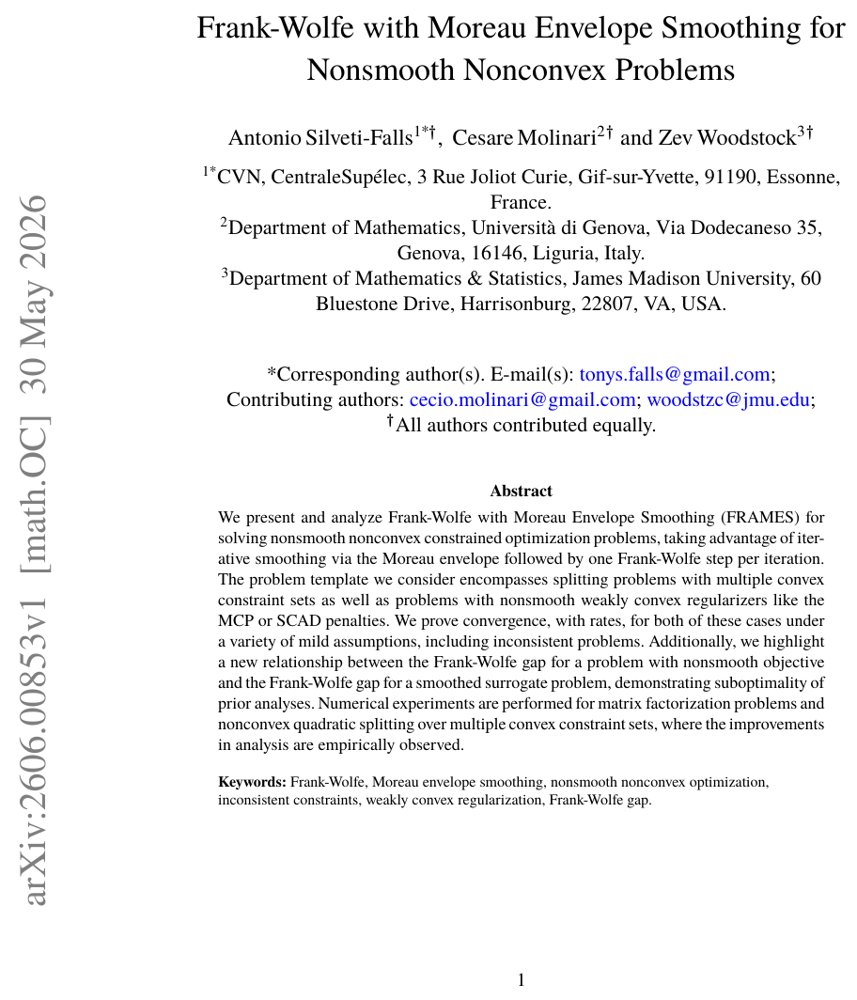
论文题目:Frank-Wolfe with Moreau Envelope Smoothing for Nonsmooth Nonconvex Problems(arXiv preprint / 2026)。
它实际解决的问题是:在非凸光滑损失 f、紧凸 LMO 可访问集合 C、线性映射 T、以及 prox 可访问但非光滑的 g 下,求解 min_{x∈C} f(x)+g(Tx),并给出对原始非光滑问题有效的一阶 stationarity 证书。
困难点有三层。第一,FW 本身需要梯度,不能直接吃 nonsmooth g;用 subgradient 代替 gradient 在 FW 中通常不稳定,已有反例。第二,Moreau smoothing 虽然给了梯度,但它给的是 smoothed problem 的 stationarity,不是原问题的 stationarity。第三,β→0 会让代理越来越接近原问题,但 smoothness constant 同时按 1/β 爆炸,导致优化误差和近似误差形成硬 tradeoff。
以前方法的主要卡点不是算法形式,而是证书语义。许多 convex composite FW 或 splitting FW 证明的是 smoothed gap、primal-dual gap 或 functional gap;在非凸 nonsmooth 设定下,这些量并不直接说明原始问题的一阶必要条件成立。尤其 indicator case 中,Frames 的迭代点只保证在 C 内,不保证 Tx∈D,因此原问题 feasible set 上的 FW gap 甚至不能直接当作普通非负 gap 使用。
Motivation
作者真正想补的缺口是:Moreau-smoothed Frank-Wolfe 在 nonsmooth nonconvex composite problem 中到底能证明什么。已有路线默认“平滑后 gap 小”是好事,但对原问题而言这只是代理证书。特别是 gβ 的梯度 ξβ=(Tx-proxβg(Tx))/β 属于 ∂g(proxβg(Tx)),而不是 ∂g(Tx),这就是 stationarity mismatch 的根源。
因此论文的动机不是再发明一个 FW variant,而是重新校准 smoothing-based FW 的理论目标:先承认 smoothed gap 只是中间量,再分析它在什么条件下能转化成 feasibility、signed gap 或 subgradient gap。这个观察直接解释了为什么 prior 中一些看似合理的 smoothing schedule,例如 βk≈1/log k,对 smoothed gap 友好但对原始 nonsmooth certificate 很差。
Core Idea
核心思想很干净:每轮用 Moreau envelope 平滑 g,得到 Φk(x)=f(x)+gβk(Tx),然后只做一步标准 Frank-Wolfe。βk 逐步下降,使代理问题从易优化的光滑版本逐渐回到原始非光滑问题。这个算法层面几乎是已有 smoothing FW 的自然延续,真正的贡献在于分析层面把“目标随 k 改变”这一点纳入能量估计,并把 smoothed gap 与原问题 gap 的差异显式量化。
本质区别是,论文没有把 Moreau envelope 当作简单的光滑化 trick,而是把它视为一个带偏差的 stationarity oracle。这个 oracle 的偏差由 β 控制,而优化难度由 1/β 控制。最终选 γk≈k^{-1/2}, βk≈k^{-1/4},不是因为算法经验,而是因为要平衡三项:FW step error、changing-objective drift、smoothing bias。这个平衡给出原始 nonsmooth certificate 的 O(N^{-1/4}),也解释了为什么只优化 smoothed gap 会选错 β schedule。
Method
关键机制可以压缩成三点。
1. 只平滑 g,不平滑 g∘T。这样每步只需 prox_g 和 LMO_C,而不需要 prox_{g∘T} 或 projection onto C∩T^{-1}(D)。这保持了 Frank-Wolfe 的 projection-free 优势,也使方法能覆盖一般线性 composition。
2. 对变化目标建立 energy estimate。由于 Φk 每轮都变,标准 smooth nonconvex FW 的 telescoping 不能直接用。论文用 Moreau envelope 随 β 变化的上界控制 Φk+1-Φk,并把 smoothness Lk≈L∇f+||T||^2/βk 放进下降项,得到平均 smoothed gap rate O(N^{-min{p-q,1-p-q}})。这里的技术核心是把目标漂移项和 FW curvature 项放在同一个求和框架里。
3. 分类型做 gap-transfer。indicator case 中,smoothed gap 同时下界 signed gap 加 feasibility penalty dist_D(Tx)^2/β;再配合 error bound,把 signed gap 的负部也控制住。weakly convex Lipschitz case 中,Moreau gradient 是 prox 点的 subgradient,因此需要 proximal-lift z∈C, Tz=proxβg(Tx),把证书转移到 z 上。这个 lift 是有限时间结论的关键,也是最强假设。
Key Insight / Why It Works
最重要的 insight 是:smoothed gap 收敛不是最终目标,甚至可能误导 schedule 设计。若只看 smoothed gap,β 下降越慢越好,因为 smoothness 不会太快变差,理论上可接近 smooth FW 的 N^{-1/2}。但原问题 certificate 还要付 β 的 approximation error,所以慢 smoothing 会直接拖垮真实 stationarity。论文把这个 tradeoff 写成 min{q,p-q,1-p-q},最优平衡就是 q=1/4,p=1/2。
这篇真正有效的部分不是 algorithm engineering,而是 certificate alignment。它把 Moreau smoothing 的“代理梯度”与 nonsmooth stationarity 的“真实 subgradient/feasible-set gap”之间的错位量化了。indicator gap bound Lemma 4.4/6.4 是全篇最有迁移价值的部分:它说明 penalty-like smoothing 不只是降低 objective,还隐式给出了 feasibility violation 与 true feasible-set stationarity 的耦合关系。
weakly convex case 的有限时间 transfer 相对不够干净。prox-lift 把 prox 点拉回 C,本质上是为了修补 ξβ∈∂g(proxβg(Tx)) 而非 ∂g(Tx) 的问题;这不是算法自然产生的对象,而是分析需要的几何条件。因此这部分结论更像“在合适结构下可转移”,不是一般 nonsmooth nonconvex FW 的完整解决。
没有 evidence 表明收益来自 scaling、data coverage 或复杂工程;这是纯优化理论论文。实验中的增益主要来自 schedule selection 与 certificate choice,而不是算法算力或实现技巧。
Relation To Prior Work
它属于 Moreau-envelope smoothing + conditional gradient 这条谱系,最近的是 convex composite FW、augmented-Lagrangian conditional gradient、以及 Woodstock/Pokutta 的 nonconvex splitting FW。算法模板与这些工作高度相似:prox 处理 g,LMO 处理 C,β 逐步下降。
真正不同点有两个。第一,允许非凸 f 和 Lipschitz weakly convex g,而不是主要停留在 convex composite 或特殊 linear-subspace indicator。第二,更重要的是它明确区分 smoothed FW gap 与原问题 nonsmooth stationarity certificate,并证明 transfer bound。这是 prior 中最容易被忽略但最关键的缺口。
看似新的“FRAMES algorithm”本身并不新奇,基本是 homotopy smoothing FW 的自然单循环版本;实质创新在分析:变化 smoothing 下的非凸 gap rate、indicator/inconsistent constraints 的 stationarity 解释、以及对 prior logarithmic smoothing schedule 的重新评价。它更像是把已有 Moreau smoothing FW 的证书体系补完整,而不是提出全新算法范式。
Dataset / Evaluation
实验是理论驱动的,不是应用驱动的。nonconvex splitting 例子最有说服力,因为 signed nonsmooth gap 可闭式计算,能直接展示 smoothed gap 与 true nonsmooth gap 的区别,也能验证 power β schedule 相比 log schedule 的优势。NMF 和 trend-filtered matrix factorization 展示了模板覆盖 indicator 与 weakly convex regularizer,但更多是可行性展示。
inconsistent constraint toy problem 有价值,因为它验证了论文一个容易被忽视的结论:当 C 与 T^{-1}(D) 不相交时,算法不会魔法地产生 feasible point,而是收敛到 closest-point set C† 并在其上做 secondary selection。这部分理论语义清楚,实验也对上了。
但整体 evaluation 没有证明该方法在真实大规模问题上优于替代 nonsmooth/proximal/projection-free 方法。没有系统比较 projection cost、LMO cost、prox cost 的 wall-clock tradeoff,也没有展示在高维困难实例中的鲁棒性。实验主要支持“分析中的 schedule/certificate 现象”,不支持更强的实际性能 claim。
Limitation
最核心限制是 transfer 结论依赖额外几何假设。indicator case 的 finite-time bound 要 error bound dist_{C∩T^{-1}(D)}(x)≤κ dist_D(Tx),这在很多 ill-conditioned 或非regular intersections 中可能失败。weakly convex case 的 proximal-lift 更强:要求 proxβg(Tx) 能在 C 中找到 preimage z,并且位移可控。这基本把一部分困难从 nonsmooth stationarity 转移到了 T,C,g 的几何兼容性上。
rate 上限也明显。O(N^{-1/4}) 是平滑误差与光滑优化误差平衡后的自然结果,但相比 smooth nonconvex FW 的 O(N^{-1/2}) 慢一档。论文没有给出 lower bound,因此不清楚这是该 oracle model 的本质限制,还是分析松弛。短步长、adaptive β、line search 或 variance-reduced-like averaging 是否能改善,文中未充分说明。
算法只保证 subsequential stationarity,而非 full sequence convergence;这在 FW 中合理,但实际部署时 certificate selection 依赖 best/last-half-best iterate,不是自然在线输出。对于 weakly convex case,最终 gap 还是定义在 lifted zk 而非原始 xk 上,虽然 zk 与 xk 距离 O(β),但这个证书语义略不直接。
实验侧 limitation 也很清楚:规模有限,更多是机制验证;增益来源主要是 schedule/certificate analysis,不是算法本身显著更强。与 no-smoothing nonsmooth FW、prox-linear、projected/proximal baselines 的实际比较不足。
Takeaway
- 1. 对 smoothing-based nonsmooth FW,不能只报 smoothed gap;必须说明它如何转成原问题 stationarity。
- 否则 schedule 可能被错误优化。
- 2. Moreau envelope 在 composite FW 中的关键代价是 β 与 1/β 的对偶:β 控制 modeling bias,1/β 控制 curvature blow-up。
- 这个 tradeoff 很可能也适用于其他 variable-smoothing 非凸算法。
一句话总结
这篇论文把 Moreau-smoothed Frank-Wolfe 从“能优化光滑代理”推进到“能解释原始非光滑非凸 stationarity”的证书层面,实质贡献是 gap-transfer 与 smoothing schedule 的重新校准,而非算法形式本身。