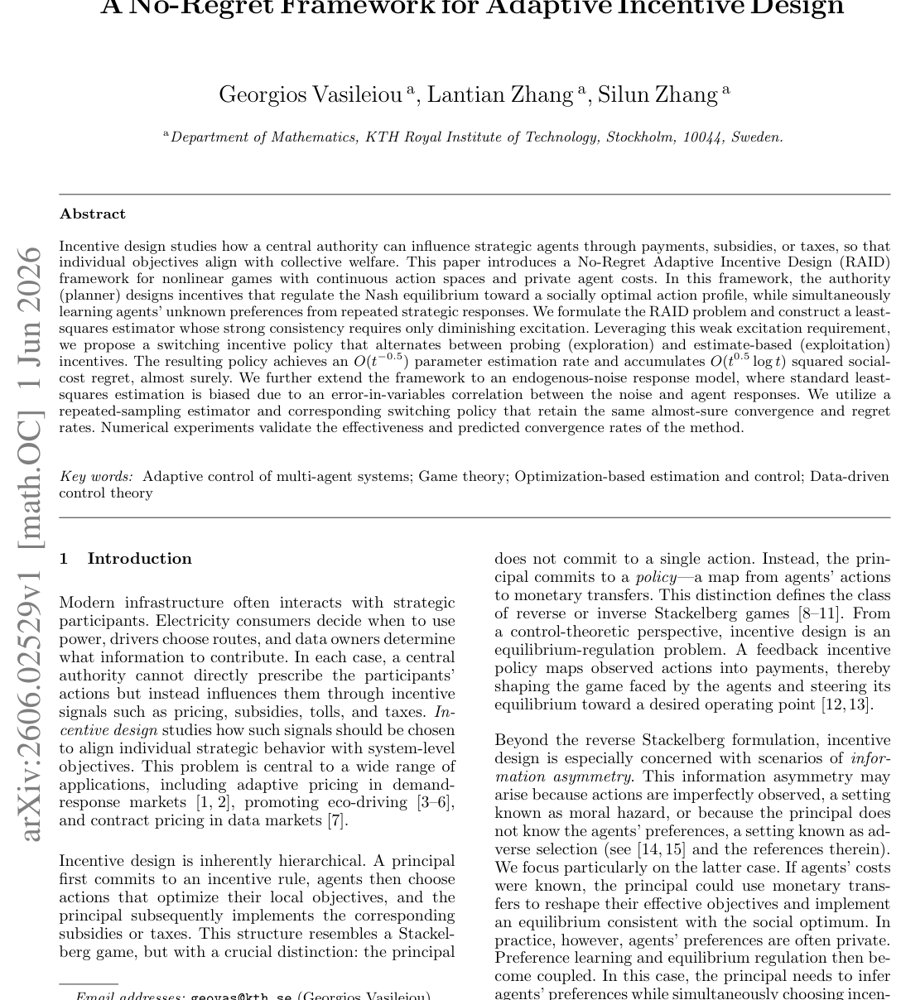
精读笔记
Problem Setting
这篇论文实际处理的是一个 inverse/reverse Stackelberg 型的 adaptive control 问题:planner 不能直接控制 agents 的动作,只能发布 action-dependent monetary transfer;agents 根据含激励的私有成本形成 Nash equilibrium;planner 既不知道成本梯度参数,又希望 equilibrium 接近社会最优。关键矛盾是识别和控制共享同一个输入 p:若 p 总是设成当前估计的最优激励,系统会停在目标附近,regressors 缺乏信息;若持续随机 probing,参数能学到但 social regret 线性累积。以前方法通常在有限动作/类型、已知 payoff 结构、强 PE 或外部性可观测条件下做 no-regret;这里卡点在于连续非线性 game 中,数据不是外生样本,而是由当前 incentive 诱导的 NE 内生生成。
Motivation
已有路线不够的地方在于,它们要么把 incentive design 当成已知 game 的 equilibrium shaping,要么把 learning 当成固定数据上的 utility estimation;真正困难的 adaptive setting 中,planner 同时是实验设计者和控制器。作者的核心观察是:如果 affine incentive 足以实现最优 equilibrium,那么 learning 的对象不是完整 utility,而只是 strategically relevant 的 marginal-cost pseudo-gradient;如果 strong monotonicity 保证 incentive-response map 可逆,那么 equilibrium response 本身就是一条回归方程。缺口在于如何用尽可能少的探索保证该回归可识别,并把探索成本纳入 regret 分析。
Core Idea
论文真正的核心不是 RLS 或 Gaussian probing,而是把 incentive design 的函数空间问题压缩成 pseudo-gradient 参数识别问题。affine incentive 的 slope p 直接抵消 agent 在目标点的 marginal cost:p*=-Θ*Φ(x†)。因此,只要估计 Θ*,就能用 certainty-equivalent policy 实施目标 equilibrium。这个建模改变很重要:planner 不再学习完整 payoff,也不需要求解一般 reverse Stackelberg policy,而是学习一个与 equilibrium first-order condition 对齐的 latent linear structure。理论上有效的原因是强单调 game 给出了 response uniqueness 和 H(p)=G0^{-1}(-p) 的可逆结构,使得每个 interior equilibrium response 都等价于一条 noisily observed linear equation Θ*Φ(x)+p≈0。和 prior 的本质区别在于,这不是有限 Stackelberg online learning 的 regret minimization,也不是 passive inverse game;它更像 stochastic adaptive control:输入设计产生可识别 regressors,plug-in 控制减少 tracking error,switching schedule 在两者之间分配样本。
Method
第一,affine incentive optimality:它解决 policy class 太大的问题。作者证明在 separable convex incentives 中,满足目标 equilibrium 和目标 payment 的任何方案都逐点不低于特定 affine law,因此限制到 affine 不是任意工程选择,而是带有最小支付意义的结构化约束。第二,response-map diffeomorphism:它解决 equilibrium observation 能否用于回归的问题。Assumption 2 的强单调性保证唯一 NE,并让 p↦x*(p) 在 informative region 上可逆且 Lipschitz,这为估计误差到 action/regret 误差的传递提供常数界。第三,indicator LS/RLS:它解决未知 informative region 的问题。模型方程只在 response 位于 interior 时成立;用 δ=1{x_hat∈int X} 过滤数据,本质上是只使用满足 first-order stationarity 的样本。第四,switching exploration:它解决 PE 与 no-regret 冲突。算法不持续探索,而是在信息矩阵低于阈值时插入 Gaussian probing;阈值 A(t)=t^γlog t 使探索次数次线性但足以让 λ_min 增长超过 log t。第五,repeated-sampling EIV estimator:它解决 endogenous noise 造成 regressor-noise correlation 的偏差。通过同一 p 下多个独立 response 的交叉矩阵 U_t、X_t,把相关噪声从 moment 中剥离,类似 instrumental variables。
Key Insight / Why It Works
最关键的 insight 是“少量探索足够”:LS 强一致只需要 log t=o(λ_min),而不是传统 persistent excitation 的线性全时段探索。因此可以把 λ_min 维持在 t^γlog t 量级,让探索样本数也只有 t^γlog t,从而 sublinear regret。这个结果的技术核心是 Lai-Wei 型随机回归条件与 response-map diffeomorphism 的结合;Gaussian probing 只是一个方便保证 filtered regressors 满秩的工具。第二个关键 insight 是 regret 归因:exploitation 阶段的 action error 通过 H 的 Lipschitz 性正比于 incentive parameter error,而 incentive parameter error 又正比于 Θ_hat-Θ*;所以 exploitation regret 近似累加估计误差平方,得到 O(t^{1-γ})。探索阶段每次代价有界,次数 Θ(t^γlog t),所以总 regret 由二者 trade-off 决定。γ=1/2 是 balance 后的自然选择。第三,endogenous-noise 部分真正贡献在于指出普通 LS 会因 v 与 Φ(x_hat) 相关而有 EIV bias,并给出 repeated-sampling moment construction;这比简单把噪声并入 martingale 更严谨。辅助性较强的部分是 monomial basis 和具体 RLS 更新;它们不是核心创新,更多是为了得到可验证的 finite-dimensional regression。本文的增益不来自 scaling/data,也不是 benchmark trick,而来自更弱 excitation 条件和 game-response 可逆结构的理论拼接。潜在问题是常数和维度依赖文中没有充分展开,高维时所谓 no-regret 可能被常数吞掉。
Relation To Prior Work
最接近的技术谱系有三条:reverse Stackelberg/control-theoretic incentive design、adaptive incentive/Stackelberg learning、inverse game/utility learning。和经典 reverse Stackelberg 的差异是,这里不假设 utilities 已知,也不求解一般 policy,而是通过 affine law 把问题变成参数识别。和 finite Stackelberg no-regret learning 的差异是,这里 action/type 连续、game nonlinear,regressors 由 NE 内生生成;分析工具更接近 adaptive control 和 stochastic regression。和 utility learning/inverse games 的差异是,planner 主动设计 incentives 改变数据分布,不是 passive revealed preference。看似新的部分如 exploration-exploitation switching、certainty-equivalence control、IV/repeated sampling,本身都不是新思想;实质创新在于把这些思想嵌入 adaptive incentive design,并证明在强单调 nonlinear games 中 filtered equilibrium responses 能满足弱 excitation 下的 almost-sure no-regret。
Dataset / Evaluation
实验是理论验证型而非应用验证型。主要覆盖三人 polynomial game,其中模型完全满足 monomial parametrization 和 strong monotonicity,用来检查估计误差、regret、探索次数与理论 rate 是否一致;另有 endogenous-noise 合成实验验证 repeated-sampling estimator;最后的 coupled oscillator misspecification case 展示当真实 pseudo-gradient 不在 feature span 中时,incentive error 收敛到非零 bias floor。评价支持“在假设满足时 rate 可观察”这一 claim,但不支持更强的实际部署 claim。没有真实世界数据、没有大规模 agent network、没有非均衡 learning agents、没有复杂约束或高维 feature 下的性能分析。实验也没有系统比较已有 adaptive ID 方法在相同假设下的 regret/estimation trade-off,因此 empirical advantage 不清楚;论文主要依赖理论结果成立。
Limitation
最大限制是结构假设重。强单调/diagonal strict convexity 基本排除了多均衡、局部均衡选择、非稳定 response 等现实博弈现象;x† 必须在 interior,否则 first-order stationarity 和 informative filtering 会失效或需要 KKT/VI 版本。affine incentive 的最优性只在 separable convex own-action incentive class 内成立,不代表一般 incentive policy 下全局最优。参数化假设也很强:成本梯度必须落在已知 monomial span 内,D 随 agent 数和多项式阶数爆炸;这会直接影响信息矩阵维度、探索次数常数和数值稳定性。endogenous-noise 扩展把问题转移为重复采样和独立噪声假设:同一 incentive 连续执行三次且 agents 独立响应,在战略环境中未必可信。文中未充分说明常数依赖,尤其 informative region 的体积、H 的 condition number、R/m、feature norm 对 regret 常数的影响;这些可能决定方法是否可扩展。misspecification 下没有 no-regret 到真实 oracle 的保证,所谓鲁棒性只是在实验中看到 approximation floor。另一个细节是 exploitation 阶段不更新估计,这简化分析但可能浪费自然产生的信息;是否最优不清楚。
Takeaway
- 第一,adaptive incentive design 可以被有效地看成 equilibrium-generated regression + certainty-equivalent control;关键是找到使 response map 可逆的结构,而不是设计更复杂 payment functions。
- 第二,弱 excitation 是该问题 no-regret 的核心杠杆:只要识别理论允许 λ_min 次线性增长,就可以把探索从持续 PE 降到间歇 probing。
- 第三,endogenous response noise 不能随便当 exogenous measurement noise;在 strategic response 中 EIV bias 是一阶问题,重复采样/IV 思路值得迁移到其他 inverse game 和 adaptive mechanism design。
- 第四,未来真正值得做的是把 monomial finite-dimensional exact model 换成可控的 function approximation/VI formulation,同时保留 identifiability 和 regret 证明;否则该框架更像强假设下的理论基准,而不是直接 scalable 的机制。
一句话总结
这篇论文把连续非线性 adaptive incentive design 从“未知偏好的逆 Stackelberg 设计”重构为“弱激励条件下的 equilibrium-generated stochastic regression + certainty-equivalent no-regret control”,实质贡献是用 response-map 可逆性和 diminishing excitation 打通类型识别与次线性 regret。