精读笔记
Problem Setting
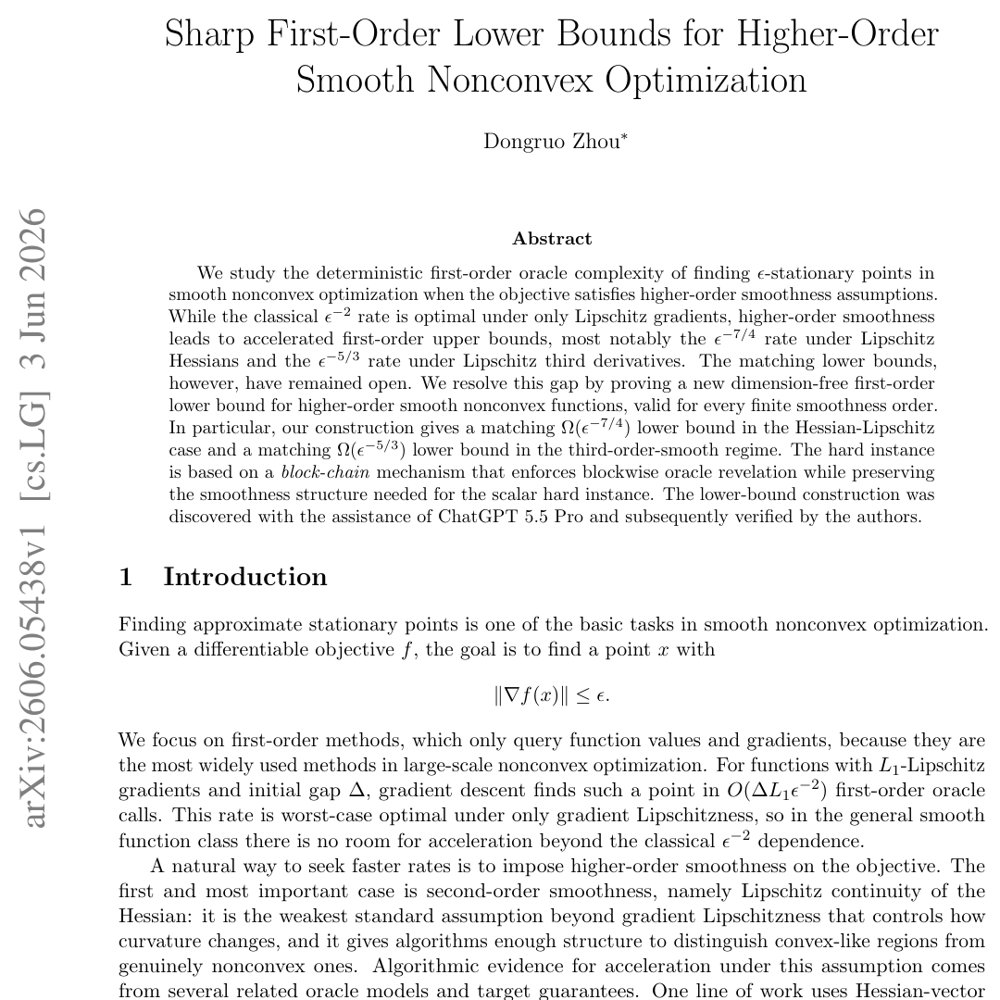
论文标题:Sharp First-Order Lower Bounds for Higher-Order Smooth Nonconvex Optimization(arXiv preprint / 2026-06-05)。
这篇论文实际处理的是一个很窄但关键的 oracle-complexity 缺口:在目标函数不仅 L_1-smooth,而且有 Lipschitz Hessian / Lipschitz third derivative / 更高阶 smoothness 时,确定性一阶方法找到 ||∇f||≤ε 的最坏情况复杂度到底是多少。
困难点在于:高阶 smoothness 一方面给算法可利用的曲率结构,已有上界确实能超过 ε^{-2};另一方面,下界构造必须同时满足这些高阶导数约束,不能像普通 nonconvex chain 那样任意制造尖锐转折。此前 scalar zero-chain 的信息隐藏机制足够清楚,但 smoothness calibration 太受限:链上传播、非凸 forcing、导数尺度都绑在同一个 scalar coordinate 上,导致调参时必须在梯度 residual 和高阶 smoothness 之间妥协,最终指数卡在 ε^{-12/7} / ε^{-8/5}。
关键矛盾是:要让一阶 oracle 看不到 tail,必须维持严格的逐坐标 revelation;但要匹配上界,又必须额外压低高阶导数 Lipschitz 常数而不削弱 tail-hidden residual。论文的贡献就是给这个矛盾加了一个新的自由度。
Motivation
已有路线的问题不是没有 hard scalar potential,而是 scalar potential 的尺度控制能力不够。Carmon et al. 的链式构造已经知道如何在 tail 未触达时保持梯度残差;真正缺的是一种可以独立调节高阶 smoothness 的 mechanism,同时不让梯度方向泄露未来坐标。
作者的核心观察可以概括为:非凸势能作用的“观测变量”不必等于算法逐步发现的坐标。若把 scalar state 写成线性 readout a^T z,那么高阶导数会通过 ||a|| 的幂被重新缩放;但直接这么做会破坏 zero-chain,因为梯度沿 a 方向一次性暴露 suffix。于是需要把 revelation channel 和 observation channel 分开:entry coordinate 负责链上传播,suffix readout 负责非凸势能与 smoothness scaling。
因此 motivation 不是设计一个更复杂的 hard function,而是给 lower-bound construction 增加一个 missing degree of freedom:在保持 scalar residual certificate 的同时,用 block 内部 Green kernel response 来重标定高阶导数。
Core Idea
核心思想是把原来的 scalar chain lift 成 block chain。每个 phase 不再是一个标量 u_s,而是一个 block z_s∈R^M。上一 phase 的 scalar readout u_{s-1}=a^T z_{s-1} 只通过当前 block 的 entry coordinate e_1^T z_s 注入;当前 phase 的非凸势能则只看 suffix readout u_s=a^T z_s。block 内部用 massive path Laplacian H=γI+L P_M 连接 entry 到 suffix。
这改变了 hard instance 的建模方式:prior 的 scalar chain 只有一条同时承担信息传播和势能观测的通道;这里把通道拆开,形成“entry-driven revelation + suffix-based observation”。path quadratic 保证 zero-respecting method 必须逐层穿过 block,不能直接看到 suffix;而 linear pullback 让高阶导数尺度由 ||a||、β=a^T H^{-1}a 等 Green-kernel quantities 控制。这个分离正是缩小指数缺口的关键。
本质区别在于,它不是换了一个 scalar potential,而是重新组织了 lower-bound instance 的信息流:算法发现坐标的顺序和函数非凸性的作用位置被刻意错开。
Method
1. Block-layer hiding:用 path Laplacian 作为 block 内部传播器。它解决的是 zero-respecting method 可能跳到 readout 坐标的问题。由于 H 是 tridiagonal,梯度 support 每轮最多向前推进一个坐标层;suffix a 支撑在后半段,所以最后一个 block 的 readout 在 Nj_* 步前保持为 0。
2. Linear readout pullback:非凸势能不直接作用在 coordinate 上,而作用在 u_s=a^T z_s。它解决的是高阶 smoothness calibration 缺自由度的问题。q 阶导数 Lipschitz 主要按 ℓ_q r^{3-q} ||a||^{q+1}/β 缩放,使 higher-order budgets 可以通过 a 的幅度和 Green response 单独调节。
3. Green-kernel normalization:定义 ρ=e^T H^{-1}e, α=a^T H^{-1}e, β=a^T H^{-1}a,并取 λ=1/α, τ=1/β, κ=λ^2ρ。它解决的是 block lift 后 scalar residual 是否仍然可用的问题。这个 normalization 使某些梯度投影组合精确还原 scalar chain residual 2u_s-u_{s-1}-u_{s+1}+Υ'(u_s)。
4. Calibration:选择 M≈sqrt(L_1/γ)、N≈Δγ/ε^2、||a||≈γ/ε、β≈γ/ε^2,并令 γ≈Γ_p。它解决的是把 gap、L_1 smoothness、高阶 smoothness、gradient certificate 同时卡紧的问题。最终 lower-bound depth 是 NM≈Δ L_1^{1/2} Γ_p^{1/2} ε^{-2}。
Key Insight / Why It Works
最核心的有效性来自“revelation 与 observation 的解耦”。以前 scalar zero-chain 中,想降低高阶导数 Lipschitz 常数,就会同时削弱非凸 residual 或缩短可隐藏链长;这里通过 block readout,把 smoothness scaling 转移到 a 和 β 上,而 scalar residual 通过投影恒等式保留下来。这个机制实质上是 lower-bound construction 里的 representation alignment:高维变量 z 的 oracle support 按 path 局部结构增长,而真正决定 stationarity 的 latent scalar state u=a^Tz 被藏在 suffix 中。
最可能是核心贡献的部分是 Lemma A.1 / Lemma 4.8 背后的投影 identity:它说明虽然梯度在高维 block 中,但存在两个 test directions w_out 和 w_in,使得相邻 block 梯度投影组合恢复 scalar residual。这一步把 scalar Carmon chain 的硬性证明“嵌入”到了 block geometry 里。没有这个 identity,block construction 只是一个信息隐藏 gadget,无法保证 tail-hidden 时真的有大梯度。
block path 本身更像必要的 engineering,但不是普通工程细节:它是为了兼容 zero-respecting revelation 的最小局部传播结构。a 的具体 suffix 常数向量、M 的一半位置、各种绝对常数主要是 scaling / calibration;真正 insight 是通道分离和 Green-kernel normalization。
这不是 retrieval、data coverage 或 benchmark trick;它是一个 oracle lower-bound 的 latent-structure construction。若要类比 ML 机制,它更像把一个 hard latent scalar process 编码进高维局部可见 representation 中,并控制 decoder norm 来满足 smoothness constraints。
Relation To Prior Work
最接近的是 Carmon et al. 的 first-order lower bounds for finding stationary points,尤其是 scalar zero-chain 和 Υ_r potential。本文并没有抛弃这一路线,反而是对它做了结构性增强:scalar residual certificate 仍然来自 Carmon chain,zero-respecting-to-deterministic reduction 也沿用既有框架。
真正新增的信息是 block-chain lift。prior 的 zero-chain 是 coordinate-level revelation;本文引入 block-level revelation,并通过 entry-to-suffix coupling 保持 oracle 隐藏。prior 的 smoothness calibration 依赖 scalar μ、λ、σ、r 这类全局尺度;本文增加了 linear observation operator 的 norm / Green response 作为 selective calibration knob。这是实质创新。
和高阶 oracle lower bounds 不同,本文不讨论算法能访问 Hessian 或 higher derivatives 的情形;它属于“objective has more smoothness, oracle remains first-order”的谱系。和 upper-bound 里的 convex-until-proven-guilty 相比,本文证明那些加速率不是算法分析 artifact,而是该 oracle model 下的真实极限。
看似新的部分中,scalar potential Υ_r、zero-respecting reduction、orthogonal invariance trick 都是已有思想重组;真正新的只有如何把 scalar transition obstruction 嵌入一个可调 smoothness 的 block observation 结构。
Dataset / Evaluation
这是一篇纯理论 lower-bound 论文,没有 dataset、实验或 benchmark。evaluation 的对象是定理是否覆盖目标函数类和 oracle model,而不是数值表现。
就理论验证而言,核心 claim 得到了直接支撑:hard instance 被证明属于 F_{1:p}(Δ,L_1,...,L_p),且任意 zero-respecting method 在 tail hidden 前梯度不小;再转移到任意 deterministic first-order method。p=2 和 p=3 的 ε 指数与已知上界匹配,因此确实关闭了原问题中最关键的 dimension-free deterministic gap。
但它验证的范围也很明确:只验证 worst-case deterministic full-gradient oracle complexity,不验证实际优化算法在真实 loss landscape 上是否会遇到类似结构,也不覆盖 stochastic / finite-sum / low-dimensional quasi-Newton / mixed-oracle 场景。
Limitation
1. 模型依赖强:结论依赖确定性一阶 oracle 和 worst-case 高维构造。现实中随机性、噪声、finite-sum structure、implicit regularization 或低维 Hessian approximation 都可能改变可达复杂度。
2. 构造是 adversarial geometry,不是自然 nonconvex landscape。block-chain 的困难来自人为设计的 support revelation barrier;它说明 oracle model 的极限,但不能直接解释深度学习训练中的 hard instances。
3. 维度无关下界并不排除 dimension-dependent 改善。Jiang et al. 类 quasi-Newton 方法已经显示低维下 ε exponent 可更好但带 d 依赖;本文的结论不否定这条路线。
4. p≥4 的结果更多说明一阶维度无关 exponent saturation,但 smoothness constants 的最优依赖未必完全闭合。Theorem 中 p≥4 的显式 bound 用了一个较粗的 min_q 下界,Γ_p 的精确 active-constraint 结构仍可能有细节空间。
5. 文中未充分说明 AI-assisted construction 的发现过程对证明可靠性没有影响当然可以由形式证明保证,但对读者判断构造是否有更广泛可迁移性帮助有限。
6. 这篇的增益主要来自 scaling freedom 的重新组织,而不是一个全新的 lower-bound principle;如果未来模型允许更丰富 oracle,block-chain 可能只是把困难转移到“必须穿过局部坐标层”这一假设上。
Takeaway
- 1. 高阶 smoothness 对一阶非凸 stationarity 的加速极限基本闭合:Hessian-Lipschitz 给 ε^{-7/4},third-order smooth 给 ε^{-5/3},更高阶 smoothness 在维度无关一阶模型中不再改善 ε exponent。
- 2. lower-bound construction 的关键可迁移 insight 是:把 latent hard scalar process 与 oracle revelation coordinates 分离,再用线性 readout / Green kernel 控制 smoothness。
- 这种“observation vs revelation decoupling”可能是构造 sharp 下界的一般模板。
- 3. 已有 upper bounds 的 ε exponent 不是分析松弛,而是 oracle model 的真实 barrier;未来若想突破,只能改变模型假设,例如允许 Hessian-vector、dimension dependence、随机/finite-sum 结构、或额外 problem geometry。
一句话总结
这篇论文把 Carmon scalar zero-chain 升级为可调 smoothness 的 block-chain,关闭了高阶光滑非凸优化中确定性一阶维度无关下界的指数缺口,证明 ε^{-7/4} 与 ε^{-5/3} 加速率在该 oracle model 下已经最优。